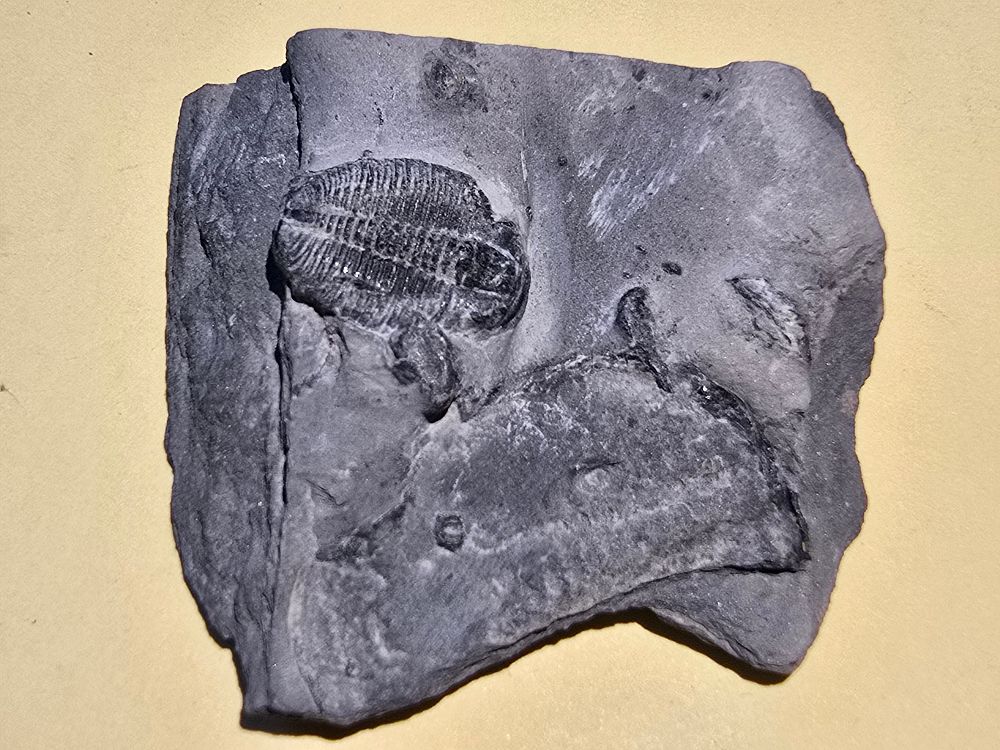
Bidspirit auction | Original trilobite fossil - a
Original trilobite fossil - a millions-year-old item - The item was carved from shale quarried in Utah in the House Range, United States. The surface size is 4X4.5 cm. The beetle is 15 mm long. ”The trilobites are one of the best-known extinct groups alongside the dinosaurs. Fossil finds of trilobites from the Lower Cambrian period testify to the great diversity of trilobites that existed and their wide geographical distribution. Because of their wide diversity and their well-preserved exoskeleton as fossils, trilobites left behind many fossils of about 17,000 different species known to science that existed throughout the Paleozoic. Trilobite fossils are of great importance for research in the fields of biostratigraphy, paleontology, and plate tectonics. Among other things, trilobite finds have helped estimate the rate of species formation (speciation) during the Cambrian explosion of the Cambrian period, since trilobites are the most diverse group of animals known from fossils from the early Cambrian period, and they are easy to identify thanks to their complex morphology that is well preserved. In fossils. The different trilobites lived in different ways: some lived on the seabed and played an ecological role as predators, scavengers or fed on food that they filtered from the water; others swam and fed on plankton, while others probably developed symbiotic relationships with sulfur bacteria, from which they extracted food. The largest of them was the Isotalus, which reached a length of 700 mm. The body of the trilobites was divided into three body parts, head, thorax, and tail, and three longitudinal lobes. Each thorax segment was attached to a pair of legs with which it walked, swam, and dug. They had a pair of fixed eyes on their heads and cheeks with a spine at the ends that turned backwards. They lived on sandy or muddy seabeds in shallow water, and their body length was between 2–60 cm. Many of them could curl up for defense, like mosses.