Bidspirit auction | EXCEPTIONAL SET OF 2 EDO-PERIOD
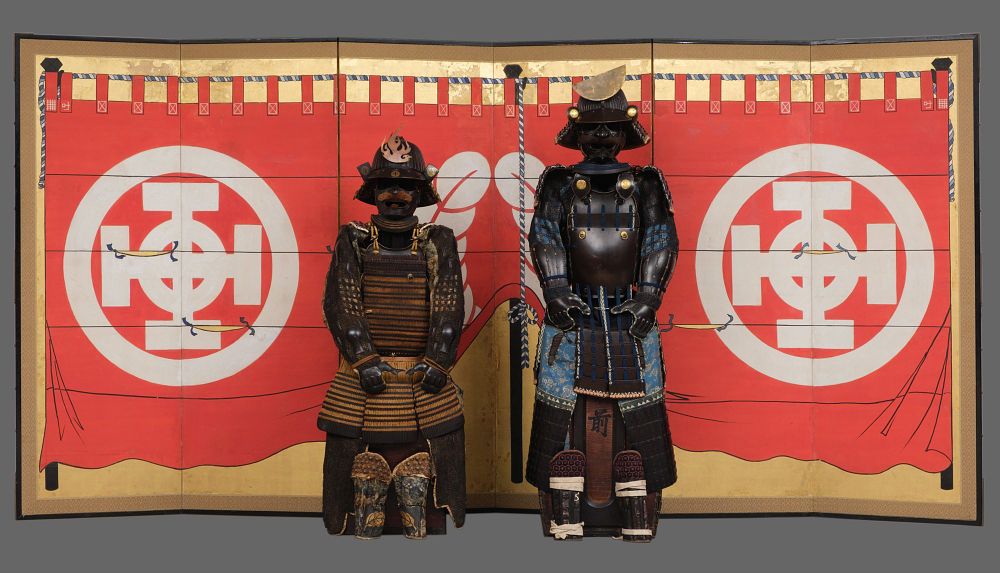
EXCEPTIONAL SET OF 2 EDO-PERIOD SUITS-OF-ARMOUR (YOROI), COMPLETE WITH 2 MATCHING FOLDING SCREENS (BYÔBU) - Important unique set of two suits-of-armour (yoroi), complete with two high six-panel screens, that belong together as is indicated by the used family crests (mon). Two crests are used, both belonging to the Nakagawa family of Oka Castle, Ôita prefecture on Kyûshû. They are: – the Nakagawa-kurusu, a circle depicting a Celtic-like cross through a ring. The cross was originally a Christian symbol but after the ban on Christianity in Japan the use of a hidden cross in family crests could continue. – the Nakagawa-kashiwa, two leaves of the Japanese Emperor Oak turned to each other (dakikashiwa mon). The remarkable aspect of this ensemble is the presence of matching crests on both the yoroi and the accompanying folding screens. The kurusu and kashiwa crests adorning the yoroi are elegantly replicated on the screens, providing compelling evidence that these pieces form a harmonious and unified set. This exceptional cohesion between the armour and screens further enhances their artistic and historical value. After the warlord Toyotomi Hideyoshi (1537-1598) had interfered in the battle between the Lord of Bungo Province Ôtomo Yoshi-mune (1558-1605) and the Shimazu of Hyûga Province, he split the Bungo Province in a number of small fiefs and transferred in 1594 Nakagawa Hideshige (1570-1612) from Miki Castle in the Harima Fief to Oka Castle in Kyûshû. The Nakagawa family stayed in possession of Oka Castle till the abolishment of the military use of castles in 1873. In 1884 the Nakagawa family received the title of Count (a title in use till the abolishment of aristocracy in 1947). After the Nakagawa’s left, the castle and the building soon dilapidated and is now known as Oka Castle Ruins. The castle is located in Taketa Village part of Taketa Town in Ôita Province on Kyûshû. Please take a look at the last three photos to see the ruins of this castle and a sign at the location with additional information. > Set of two tall byôbu (folding screens), painted with large red jinmaku (camp enclosure curtain) on a gold leaf ground. The curtains show both crests of the Nakagawa family: one screen depicts two Nakagawa-kurusu crests next to a Nakagawa-kashi crest in the middle, and the other shows the symbols the other way round. Dimensions: Total width together: 755.2 cm. Total width single screen: 377.6 cm (2 x 64.4 cm, 4 x 62.2 cm); Height 184.5 cm. Period: Japan – Late Edo period (First half 19th century), and maybe even older. > Yoroi with Nakagawa-kashiwa crest: A Japanese black lacquered suit-of-armour (yoroi) completely laced with orange cords (kuro’urushinuri hi’ito odoshi nimai’dô’maru). A thirty-two plate suji’bachi kabuto (helmet with raised ridges) with in front a maedate (fore crest) -with traces of gilding- in the shape of flames, resembling a mythical flaming bird flying down. The fukikaeshi (face guards) and the mabizashi (visor) have the Nakagawa-kashiwa crest in gold maki-e lacquer. Five curved ‘itazane’-plate neck guards (shikoro) laced with orange cords. Together with an ‘angry man’-facial mask (resseibô) with a separate nose piece, brown moustache and a four-piece ‘kiritsuke kozane’-plate gorget (yodarekake). The arms (kote) are protected by various black lacquered pieces connected by Japanese mail (kaushi-gusari), of which two shaped like bottle gourds, hence this type of sleeve armour is called hisago’kote (bottle gourd bracer). The elbow’s protective plate is in the shape of a chrysanthemum flower, and the hand guards (tekko) with a flower-emblem in relief. Placed over a blue-green-golden brocade silk with a dragon and flower design. Two-part maru’dô (cuirass) made of a ‘odoshi’-type laced ‘kiritsuke kozane’-plate construction. The front fitted with a cord-ring with a chrysanthemum-shaped backplate. The back equipped with an iron hook (gattari) and leather support for a flag-pole (machi’uke). From the cuirass hangs a 7-parts of 5-piece ‘kiritsuke kozane’-plate kusazuri (tassets). The haidate, ‘shino’-type, constructed with black lacquered metal pieces connected by Japanese mail. The ones oth the bottom shaped like a chrysanthemum flower as well. Placed over ensuite brocade silk mounted with golden silk borders with a plum blossom design. It has flaps to tie around the leg. Brocade silk suneate -that originally had vertical metal strips- protect the lower legs with a very special feature. The leather parts around the inner ankles are decorated with oak leaves that together form the Nakagawa-kashiwa crest. With a square red lacquered store-box for a suit-of armour (yoroi’bako) with iron ‘pole carrying’-handles. Period: Japan – Early/Mid Edo Period (17th/18th century). Height ca. 150 cm. > Yoroi with Nakagawa-kurusu crest: A complete Japanese black lacquered suit-of-armour (yoroi) laced with dark blue cords, multi-coloured and orange hems,