Bidspirit auction | 1810 Pennsylvania Land Indenture: Deed
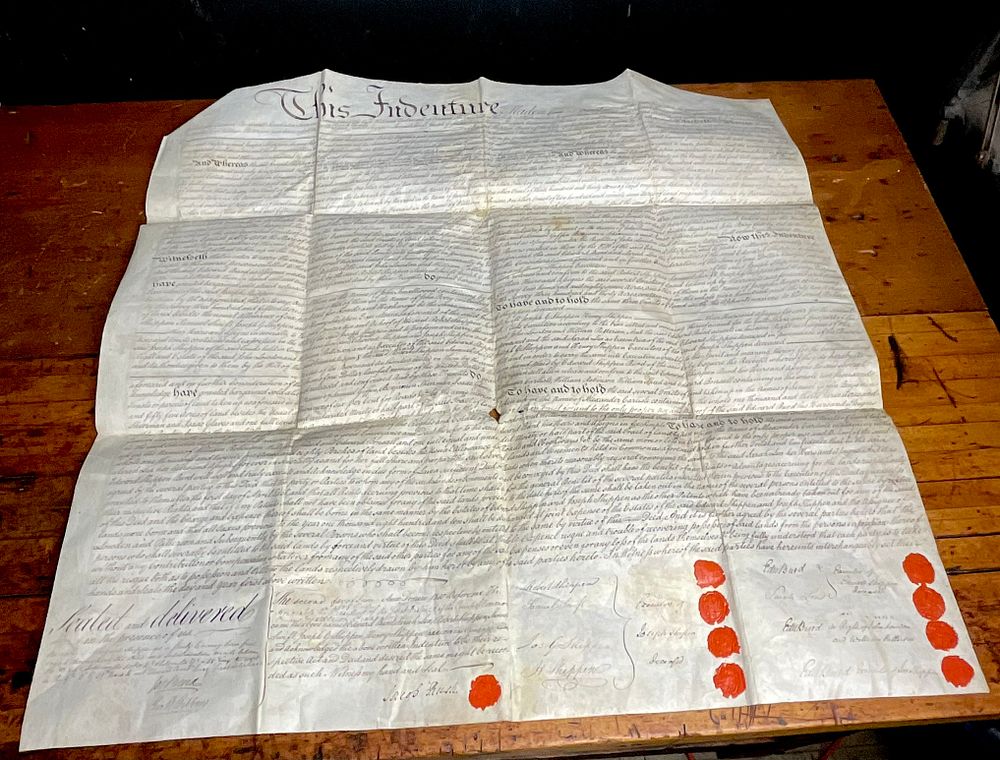
1810 Pennsylvania Land Indenture: Deed of Partition for Little Conemaugh Tracts - This large-scale, multi-page legal archive is a handwritten Deed of Partition detailing the division of significant land holdings totaling nearly 3,000 acres. The land is described as being situated on the Little Conemaugh or Otter Creek, located at the time in Cambria County (formerly part of Bedford County), Pennsylvania. The document pertains to the estate of Edward Shippen IV (1729-1806), the American jurist and Chief Justice of the Supreme Court of Pennsylvania. Signatories and parties mentioned include Edward Burd (son-in-law of Edward Shippen and Prothonotary of the Pennsylvania Supreme Court), Sarah Lea, Edward Shippen Burd, and executors Robert Shippen, Samuel Swift, Joseph G. Shippen, and Henry Shippen. The document is authenticated and signed by Jacob Rush (1747-1820), who served as the President of the Court of Common Pleas for the First District of Pennsylvania and was the brother of Founding Father Benjamin Rush. The archive consists of the primary indenture executed on vellum with a scalloped top edge, a traditional security measure designed to prove authenticity by matching corresponding copies. The document features ten original red wax seals with clear impressions. Accompanying the main indenture is a separate summary sheet titled 10 Tracts of Land on little Conemaugh or Otter Creek, which itemizes the individual tracts by acreage and the names of the original warrant holders, including Samuel Giffen, John Smallwood, and Isaac Glaves. The collection also includes additional Deed Poll documents signed by Sarah Lea and Edward Burd. Dimensions: 31 x 22 inches (approximate, fully unfolded). The manuscript is in excellent condition for its age. The ink remains dark and highly legible. It exhibits original fold lines, minor surface soiling, and light foxing consistent with over two centuries of storage. There is a small separation at the intersection of a central fold. The red wax seals are well-preserved with clear impressions and minimal chipping.