Bidspirit auction | 1426-1900 Collection of Dutch Historical
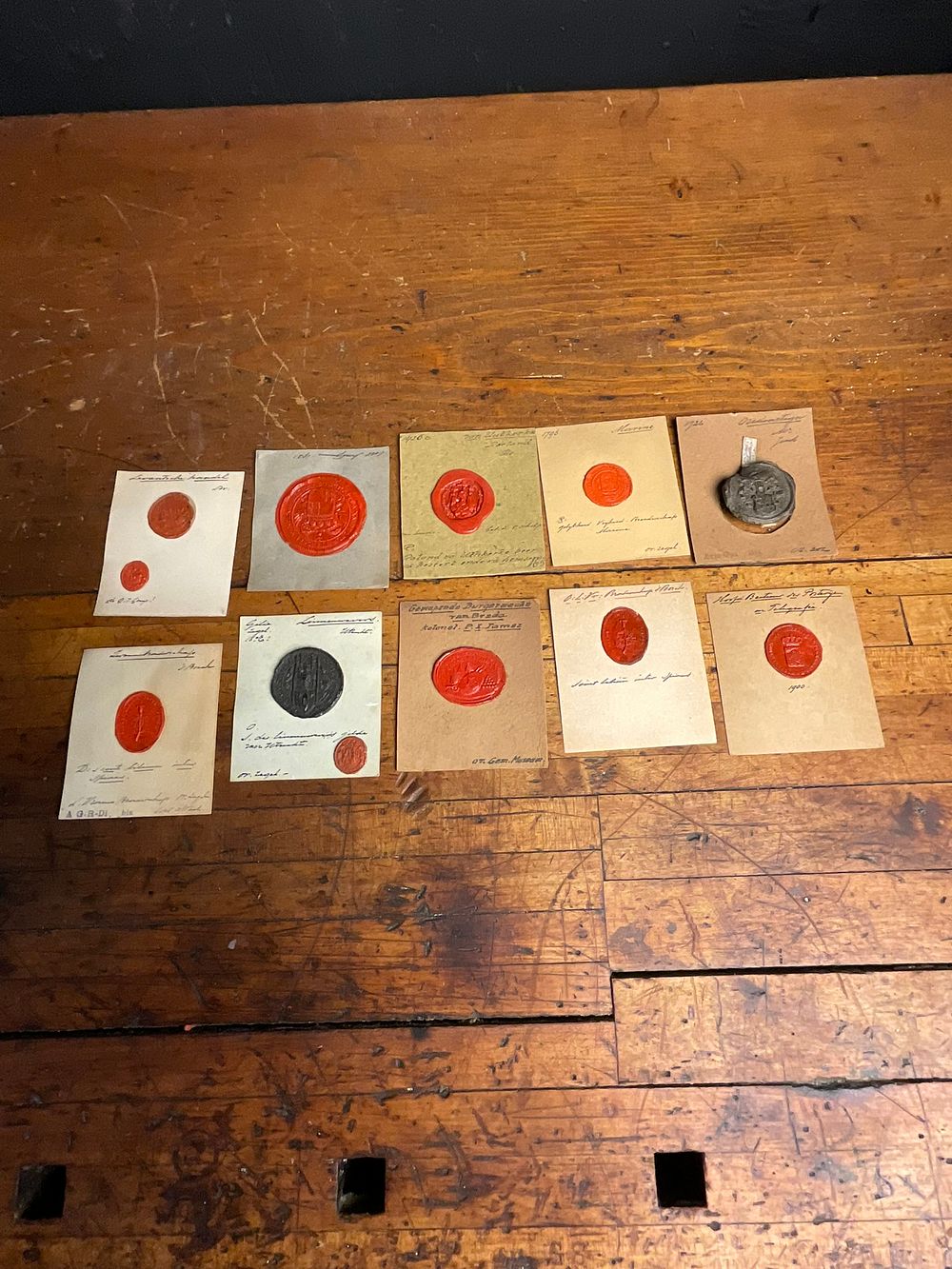
1426-1900 Collection of Dutch Historical Wax and Lead Seal Specimens - This is a professional archival collection of eleven historical seal impressions (sigillography) mounted on ten individual cardstock supports. The collection represents various Dutch historical entities, spanning from the 15th to the early 20th century. Each specimen is meticulously labeled with handwritten Dutch annotations identifying the organization, individual, or period. The collection includes: - A card featuring two red wax seals for the Levant Trade (Levantsche handel) and one annotated de O.I. Comp? (possibly Dutch East India Company/VOC), both featuring maritime vessel imagery. - A large red wax seal for the Water Board of Delfland with border text reading SEGEL VAN DEN HEEMRAETSCHAPPE VAN DELFLANT. - A red wax seal for Roeland van Uutkerke (Roland va Uutkerke), Lord of Hestert and Hemserode, annotated with the date 1426. - An oval red wax seal for the Illustrious Brotherhood of Our Lady (Illustre Lieve Vrouwe Broederschap) from s-Hertogenbosch, bearing the Latin motto SICUT LILIUM INTER SPINAS surrounding a lily plant. - A Revolutionary-era red wax seal for the Marine dated 1796, featuring anchors and the motto gelykheid. Vryheid. Broederschap (Equality. Freedom. Brotherhood). - A dark lead or wax seal for Jacob van Oudensteyn dated 1726, featuring a family coat of arms and an original attached paper tag. - A card for the Linen Weavers Guild of Utrecht (Linnenwevers Gilde) featuring one large dark lead seal and one small red wax seal with symbols of the weaver's trade. - A red wax seal for the Armed Civic Guard of Breda (Gewapende Burgerwacht) for Colonel P. I. Jamez. - A red wax seal for the Board of Post and Telegraphy (Hoofd Bestuur der Posterijen en Telegrafie) dated 1900, featuring the crowned Dutch national arms. Card dimensions: approximately 3.5 inches x 4 inches to 4 inches x 5 inches Seal diameters: approximately 0.75 inches to 2.25 inches. The seal impressions remain crisp and legible. The wax specimens show minor stable cracking and small chips at the edges consistent with age and material. The lead specimens exhibit a natural dark patina. The mounting cards show light age-toning, minor foxing, and occasional edge wear.