Bidspirit auction | UTAGAWA KUNISADA (Toyokuni III) (1786-1865)
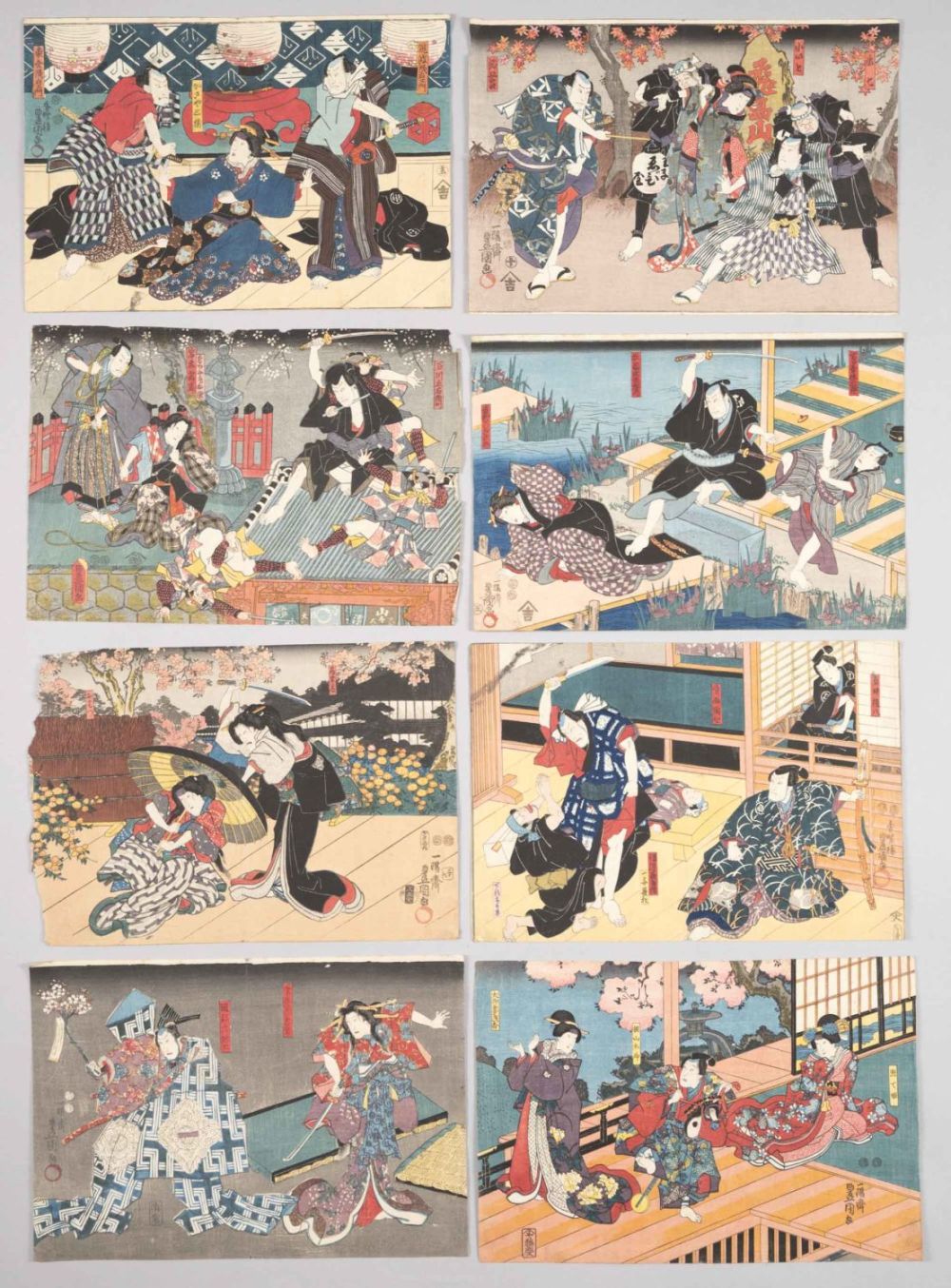
UTAGAWA KUNISADA (Toyokuni III) (1786-1865) Oito xilogravuras coloridas sobre papel, representando cenas de teatro kabuki. Não emolduradas - UTAGAWA KUNISADA (Toyokuni III) (1786-1865) Eight colored woodblock prints on paper, depicting scenes from different kabuki theater plays: 1 - Edo Sodachi Omatsuri Sashichi (江戸育お祭佐七); 2 - Courtesan between two samurais, c.1849-50 (unidentified play); 3 - Samurai attacking a couple, 1849 (unidentified play); 4 - GOEMON-Ishikawa Goemon (GOEMON―石川五右衛門), c.1851; 5 - Kakitsubata Tamuke no Hanakawado (☆手向の☆川戸), c.1850; 6 - Bandö Mitsugorö IV as Iwafuji and Nakamura Shikan II as Ohatsu, in Sakura-doki Onna Gyôretsu (桜時女行列); 7 - Oguri Hangan Kuruma Kaidô (小栗判官車街道) (?); 8 - Ichinotani Mushae no Iezuto (一谷武者畫土産) Approx. total dimensions (each): 25 x 36 cm. The ukiyo-e prints (pictures of the floating world) were a Japanese artistic expression during the Edo period (1603-1868), accessible to the urban class. ”They resulted from a commercial process in which an editor determined which projects to invest in, based on their potential success. The editor would submit the design to the artist (illustrator) and commission the engraver and printer to produce a predetermined number of copies.” The essence of ukiyo-e lies in the connection between a respected canon of literature and poetry, interpreted by kabuki actors. Utagawa Kunisada, also known as Utagawa Toyokuni III, was one of the most well-known and reputable Japanese ukiyo-e artists of the 19th century. Flaws, small faults in the margins, some acid stains and ink. Creases. Not framed. UTAGAWA KUNISADA (Toyokuni III) (1786-1865) Huit estampes colorées sur papier représentant des scènes de différentes pièces de théâtre kabuki : 1 - Edo Sodachi Omatsuri Sashichi (江戸育お祭佐七); 2 - Courtisane entre deux samouraïs, c.1849-50 (pièce non identifiée); 3 - Samouraï attaquant un couple, 1849 (pièce non identifiée); 4 - GOEMON-Ishikawa Goemon (GOEMON―石川五右衛門), c.1851; 5 - Kakitsubata Tamuke no Hanakawado (☆手向の☆川戸), c.1850; 6 - Bandö Mitsugorö IV en tant qu'Iwafuji et Nakamura Shikan II en tant qu'Ohatsu, dans Sakura-doki Onna Gyôretsu (桜時女行列); 7 - Oguri Hangan Kuruma Kaidô (小栗判官車街道) (?); 8 - Ichinotani Mushae no Iezuto (一谷武者畫土産) Dim. approx. totale (chacune) : 25 x 36 cm. Les estampes ukiyo-e (images du monde flottant) étaient une forme d'expression artistique japonaise de l'époque d'Edo (1603-1868), accessible à la classe urbaine. ”Elles résultent d'un processus commercial dans lequel un éditeur déterminait les projets dans lesquels investir, en fonction du potentiel de succès qu'ils pourraient atteindre. L'éditeur soumettait le dessin à l'artiste (illustrateur) et chargeait le graveur et l'imprimeur de produire un nombre prédéfini d'exemplaires”. L'essence des ukiyo-e réside dans la connexion entre un canon respecté de littérature et de poésie, interprété par les acteurs de kabuki. Utagawa Kunisada, également connu sous le nom de Utagawa Toyokuni III, était l'un des artistes japonais d'ukiyo-e les plus connus et les plus réputés du XIXe siècle. Défauts, petites lacunes sur les marges, quelques taches d'acidité et d'encre. Plis. Non encadré. UTAGAWA KUNISADA(Toyokuni III)(1786-1865) 八幅彩色木刻版画,描绘不同歌舞伎剧场场景: 1 - Edo Sodachi Omatsuri Sashichi(江戸育お祭佐七); 2 - 两名武士之间的妓女,约1849-50年(未知剧目); 3 - 武士攻击一对夫妇,1849年(未知剧目); 4 - GOEMON-Ishikawa Goemon(GOEMON―石川五右衛門),约1851年; 5 - Kakitsubata Tamuke no Hanakawado(☆手向の☆川戸),约1850年; 6 - Bandö Mitsugorö IV饰演Iwafuji,Nakamura Shikan II饰演Ohatsu,在Sakura-doki Onna Gyôretsu(桜時女行列)中; 7 - Oguri Hangan Kuruma Kaidô(小栗判官車街道)(?); 8 - Ichinotani Mushae no Iezuto(一谷武者畫土産) 大约尺寸(每个):25 x 36 厘米。 浮世绘版画是日本江户时代(1603-1868)的一种艺术表达形式,适用于城市阶层。 ”这是一个商业过程,由一位编辑决定应该投资哪些项目,根据它们可能取得的潜在成功。编辑将设计提交给艺术家(插图画家),并委托雕刻师和印刷师制作一定数量的副本。” 浮世绘的精髓在于将受人尊敬的文学和诗歌与歌舞伎演员的演绎相结合。UTAGAWA KUNISADA,也被称为UTAGAWA Toyokuni III,是19世纪日本浮世绘艺术家中最著名和最有声望的之一。 有瑕疵,边缘有小缺陷,有些酸性和墨水污渍。有折痕。未装裱。