Bidspirit auction | Karl Ens Porcelain Bust of
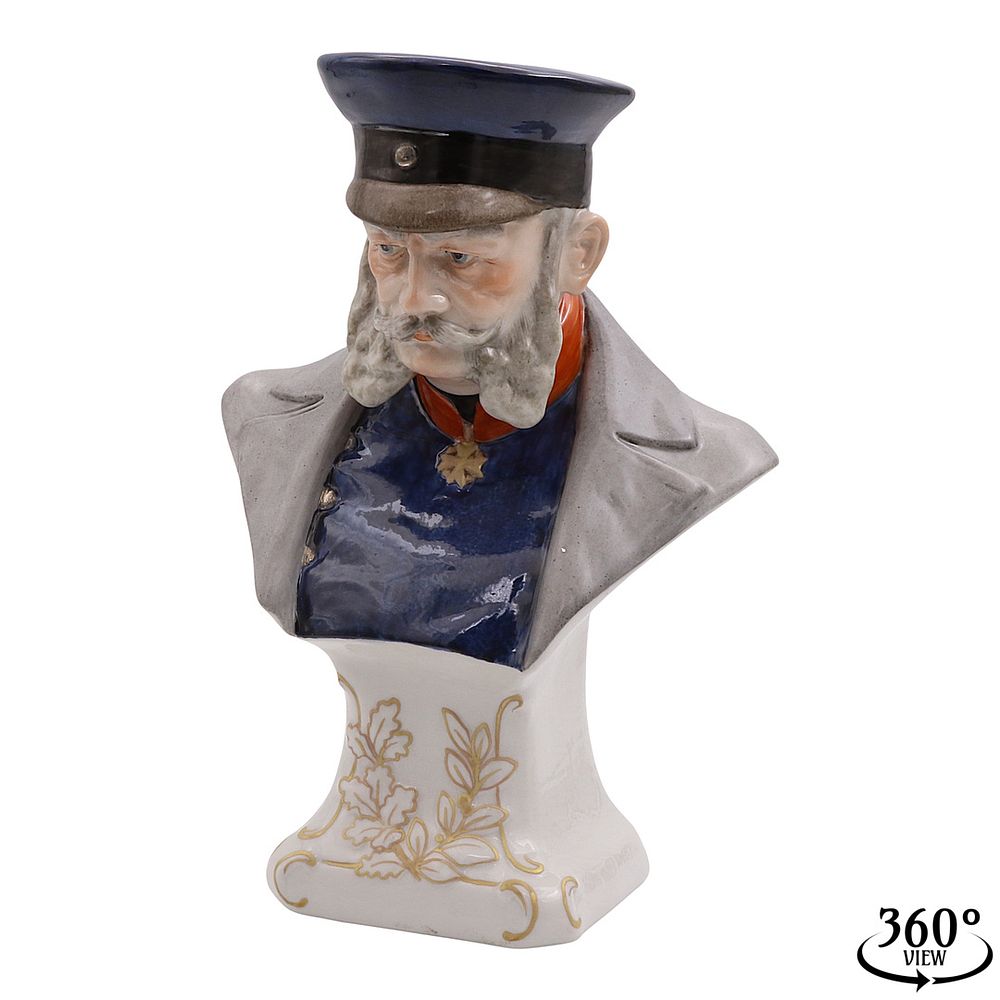
Karl Ens Porcelain Bust of Kaiser Wilhelm I, Volkstedt Thuringia - Porcelain, polychrome painted and gilt, marked on the base with the manufactory mark. A finely executed porcelain bust from the Karl Ens manufactory, depicting Kaiser Wilhelm I. The Prussian King and first German Emperor is portrayed in his blue uniform with the Pour le Mérite order at his neck and a grey coat. The detailed painting of the face, beard, and uniform details attests to the high quality of the manufactory. The base is decorated with golden oak leaf ornaments, good age-appropriate condition, with minor firing flaws, 18.5 x 13.5 x 7.5 cm (HxWxD). 360-degree photo on our website.The Karl Ens porcelain manufactory, founded in 1899 in Volkstedt (Thuringia), was famous for its high-quality figural and bust sculptures. Busts of monarchs, especially of Kaiser Wilhelm I as the founding figure of the German Empire, were extremely popular in the late 19th and early 20th centuries and were part of the representative furnishings of patriotic households. German Description Karl Ens Volkstedt Karl Ens Porzellanbüste Kaiser Wilhelm I. Porzellan, polychrom bemalt und goldstaffiert, am Boden mit der Manufakturmarke gemarkt. Eine fein ausgeführte Porzellanbüste aus der Manufaktur Karl Ens, die Kaiser Wilhelm I. darstellt. Der preußische König und erste Deutsche Kaiser ist in seiner blauen Uniform mit dem Orden Pour le Mérite am Hals und grauem Mantel dargestellt. Die detailreiche Bemalung von Gesicht, Bart und Uniformdetails zeugt von der hohen Qualität der Manufaktur. Der Sockel ist mit goldenen Eichenlaub-Ornamenten verziert, altersgemäß guter Zustand, mit kleineren Brandfehlern, 18,5 x 13,5 x 7,5 cm (HxBxT). 360-Grad-Foto auf unserer Webseite. Die Porzellanmanufaktur Karl Ens, gegründet 1899 in Volkstedt (Thüringen), war berühmt für ihre hochwertigen Figuren- und Büstenplastiken. Büsten von Monarchen, insbesondere von Kaiser Wilhelm I. als Gründerfigur des Deutschen Reiches, waren im späten 19. und frühen 20. Jahrhundert äußerst populär und gehörten zur repräsentativen Ausstattung patriotischer Haushalte.