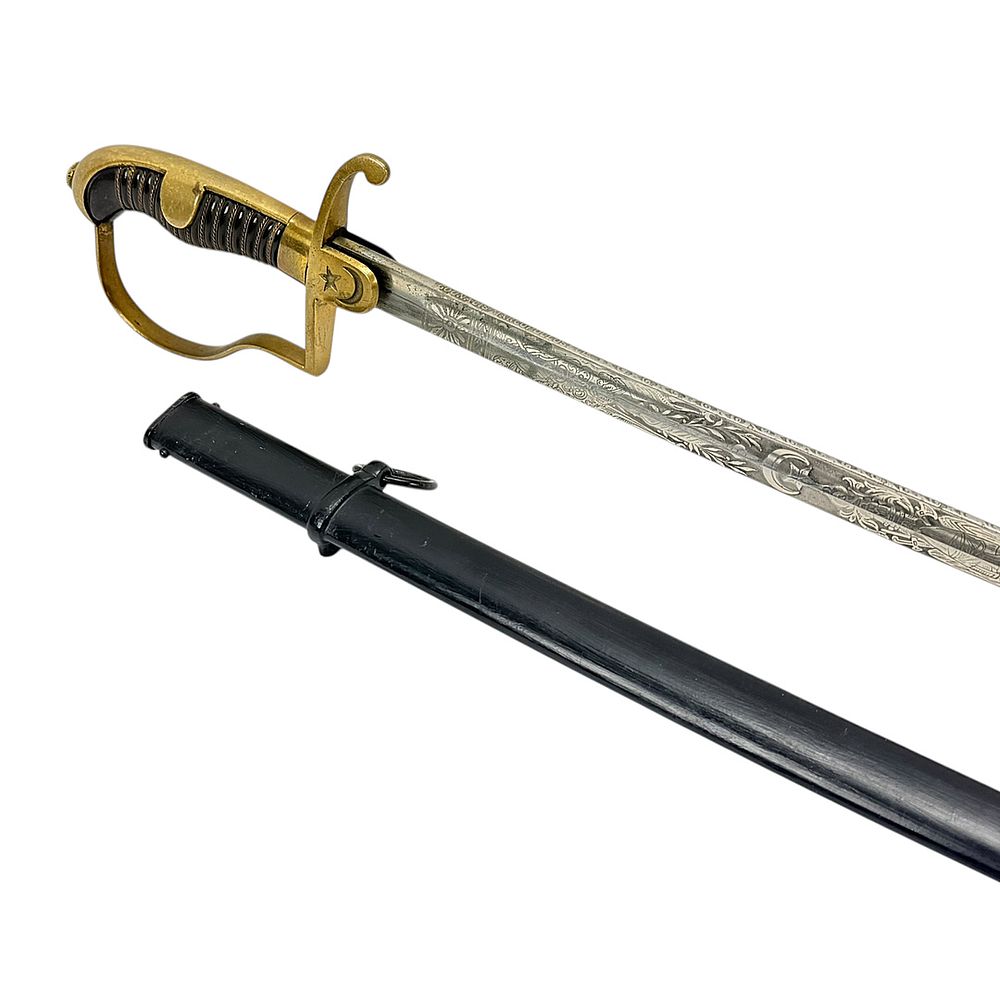
Bidspirit auction | Ottoman Officer's Sabre with Crescent
Ottoman Officer's Sabre with Crescent and Star, Decorative Etchings and Engraved Dealer Name - Steel and brass. Brass hilt with D-shaped guard, crescent and star engraved on the languet. Pertinax grip with triple wire wrapping. Single-fullered blade with elaborate decorative etchings, including crescent and star motifs as well as floral ornaments. Dealer's engraving on the blade spine ”Gounalis Marcopoulos & Cie.” – a trading company based in Geneva and Constantinople. Scabbard re-lacquered. Good, carried condition. Overall length 95 cm, blade length 76 cm. The sabre displays the characteristic symbols of the Ottoman Empire: the crescent and star, officially adopted into the Ottoman flag in 1844 and serving as a mark of state authority. The decorative etchings with floral scrollwork and trophies are typical of Ottoman officer's sabres from the late 19th and early 20th centuries. The dealer's engraving ”Gounalis Marcopoulos & Cie.” refers to a Greek-Swiss trading company active in the late 19th and early 20th centuries, based in Geneva and Constantinople. Ottoman officer's sabres were frequently manufactured by European makers – particularly from Solingen – and distributed through such trading firms in the Ottoman Empire. The blades often featured a reserved space for the engraving of the respective dealer. German Description Osmanischer Offizierssäbel mit Halbmond und Stern, Zierätzungen und graviertem Händlernamen Stahl und Messing. Messinggriffstück mit D-förmigem Bügel, auf dem Parierlappen Halbmond und Stern graviert. Pertinaxgriffstück mit dreifacher Drahtwicklung. Einfach gekehlte Klinge mit aufwendigen Zierätzungen, darunter Halbmond- und Sternmotive sowie florale Ornamente. Auf dem Klingenrücken die Händlergravur „Gounalis Marcopoulos & Cie.” – ein Handelsunternehmen mit Sitz in Genf und Konstantinopel. Scheide nachlackiert. Guter, getragener Zustand. Gesamtlänge 95 cm, Klingenlänge 76 cm. Der Säbel zeigt die charakteristischen Symbole des Osmanischen Reiches: Halbmond und Stern, die 1844 offiziell in die Flagge des Osmanischen Reiches aufgenommen wurden und als Zeichen staatlicher Autorität dienten. Die Zierätzungen mit floralen Ranken und Trophäen sind typisch für osmanische Offizierssäbel des späten 19. und frühen 20. Jahrhunderts. Die Händlergravur „Gounalis Marcopoulos & Cie.” verweist auf ein griechisch-schweizerisches Handelsunternehmen, das im späten 19. und frühen 20. Jahrhundert mit Sitz in Genf und Konstantinopel tätig war. Osmanische Offizierssäbel wurden häufig von europäischen Herstellern – insbesondere aus Solingen – gefertigt und über solche Handelsunternehmen im Osmanischen Reich vertrieben. Die Klingen boten oft eine Freistelle für die Gravur des jeweiligen Händlers.