Bidspirit auction | Cast Medal of Emperor Franz
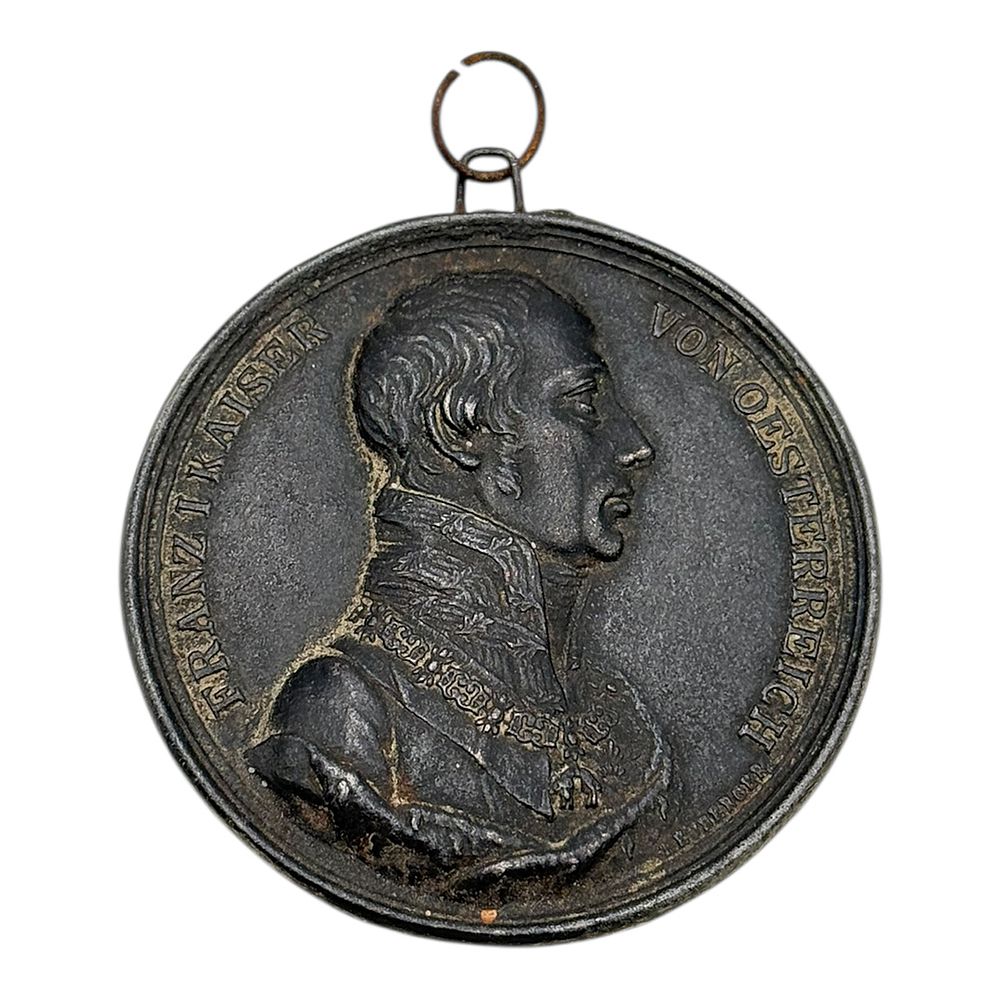
Cast Medal of Emperor Franz I of Austria with Portrait Bust in Uniform and Suspension Loop - Cast iron, blackened. Single-sided cast medal bearing the bust of Emperor Franz I of Austria in profile to the right, wearing uniform with orders. The circumscription reads ”FRANZ I KAISER VON OESTERREICH”. A soldered suspension loop with ring is mounted at the top. The reverse displays the hollow negative impression of the relief with the incised number ”122.”. Age-appropriate condition with traces of oxidation, D. 5.4 cm. Emperor Franz I of Austria (1768–1835) was, as Franz II, the last Emperor of the Holy Roman Empire and, as Franz I, the first Emperor of Austria. His reign was defined by the Napoleonic Wars and the Congress of Vienna in 1815. Cast medals bearing sovereign portraits were widely popular in the nineteenth century as wall and room decoration, serving as expressions of monarchical loyalty. The suspension loop and hollow reverse identify this piece as a later cast intended for decorative purposes. German Description Gussmedaille Kaiser Franz I. von Österreich mit Porträtbüste in Uniform und Aufhängeöse Eisenguss, geschwärzt. Einseitige Gussmedaille mit dem Brustbild Kaiser Franz I. von Österreich im Profil nach rechts, in Uniform mit Ordensschmuck. Die umlaufende Legende lautet „FRANZ I KAISER VON OESTERREICH”. Am oberen Rand eine angelötete Aufhängeöse mit Ring. Die Rückseite zeigt den hohlen Negativabdruck des Reliefs mit der eingeritzten Nummer „122.”. Altersgemäßer Zustand mit Oxidationsspuren, D. 5,4 cm. Kaiser Franz I. von Österreich (1768–1835) war als Franz II. der letzte Kaiser des Heiligen Römischen Reiches Deutscher Nation und als Franz I. der erste Kaiser von Österreich. Seine Regierungszeit war geprägt von den Napoleonischen Kriegen und dem Wiener Kongress von 1815. Gussmedaillen mit Herrscherporträts waren im 19. Jahrhundert als Wand- und Zimmerdekor weit verbreitet und dienten der Repräsentation monarchischer Treue. Die Aufhängeöse und die hohle Rückseite weisen das Stück als Nachguss für dekorative Zwecke aus.