Bidspirit auction | Lot of Seven Bayonets of
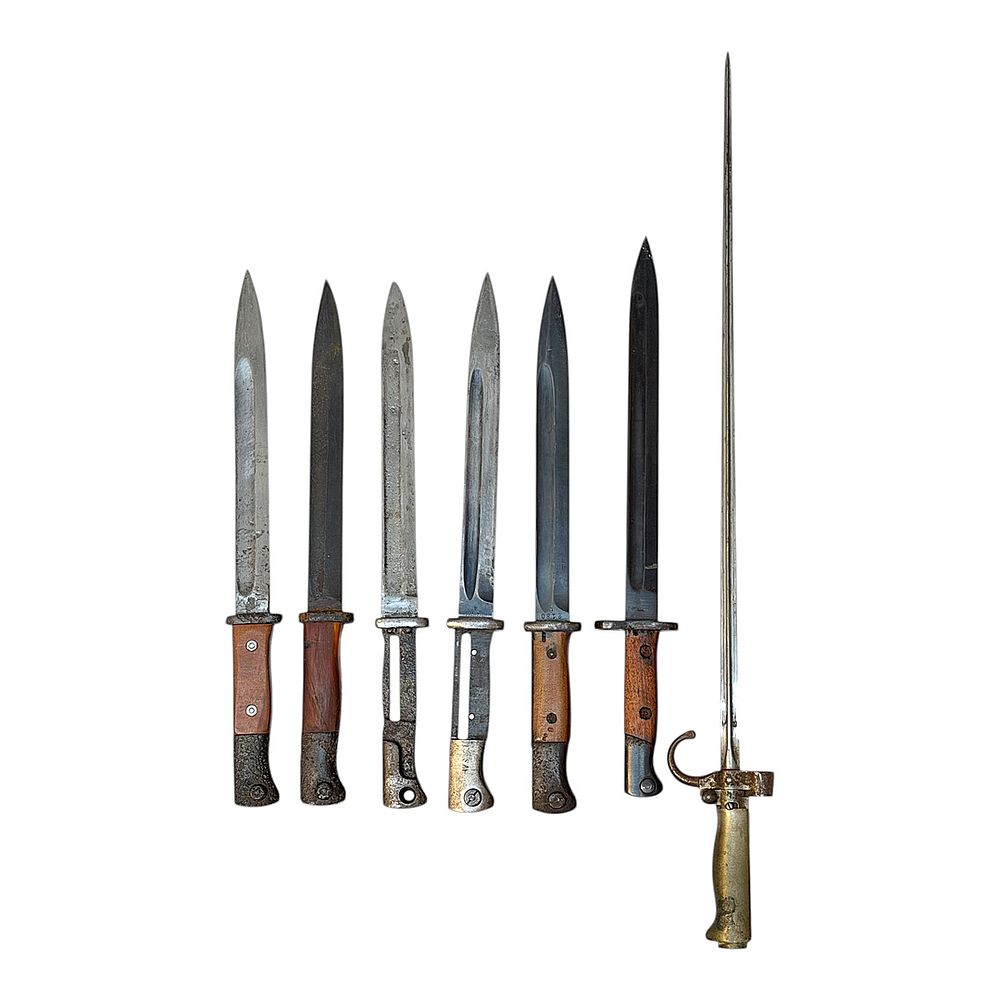
Lot of Seven Bayonets of Various Nations, Partly Heavily Corroded, 19th and 20th Century - Steel, wood and brass. A lot comprising seven bayonets of various origins and periods: 1)–5) Five German bayonets of various models with wooden grips in differing states of preservation. 6) One further bayonet without closer attribution. 7) A French needle bayonet Modèle 1886 (Épée-Baionnette) with brass grip and cruciform blade cross-section for the Lebel rifle. The pieces in varying states of preservation, partly with heavy corrosion and material loss, partly reworked, and partly incomplete. L. 38–63 cm. Please view in person. Bayonets rank among the most widely collected categories in the field of militaria. The present lot brings together German and French models from the 19th and 20th centuries. The French needle bayonet Modèle 1886, with its characteristic cruciform blade cross-section, was developed for the Lebel rifle Modèle 1886 and nicknamed ”Rosalie” by French soldiers during the First World War. The German bayonets date from various periods of the German Empire and the World Wars. German Description Konvolut von sieben Bajonetten verschiedener Nationen, teils stark korrodiert, 19. und 20. Jahrhundert Stahl, Holz und Messing. Konvolut bestehend aus sieben Bajonetten unterschiedlicher Herkunft und Epoche: 1)–5) Fünf deutsche Bajonette verschiedener Modelle mit Holzgriffen in unterschiedlicher Erhaltung. 6) Ein weiteres Bajonett ohne nähere Zuordnung. 7) Französisches Nadelbajonett Modèle 1886 (Épée-Baionnette) mit Messinggriff und kreuzförmigem Klingenquerschnitt für das Lebel-Gewehr. Die Stücke in unterschiedlicher Erhaltung, teils mit starker Korrosion und Substanzverlust, teils überarbeitet, teils fehlen Teile. L. 38–63 cm. Bitte besichtigen. Bajonette gehören zu den meistgesammelten Kategorien im Bereich der Militaria. Das vorliegende Konvolut vereint deutsche und französische Modelle des 19. und 20. Jahrhunderts. Das französische Nadelbajonett Modèle 1886 mit seinem charakteristischen kreuzförmigen Klingenquerschnitt wurde für das Lebel-Gewehr Modèle 1886 entwickelt und von französischen Soldaten im Ersten Weltkrieg „Rosalie” genannt. Die deutschen Bajonette stammen aus verschiedenen Perioden des Kaiserreichs und der Weltkriege.