Bidspirit auction | Photoceramic Portrait Plate of a
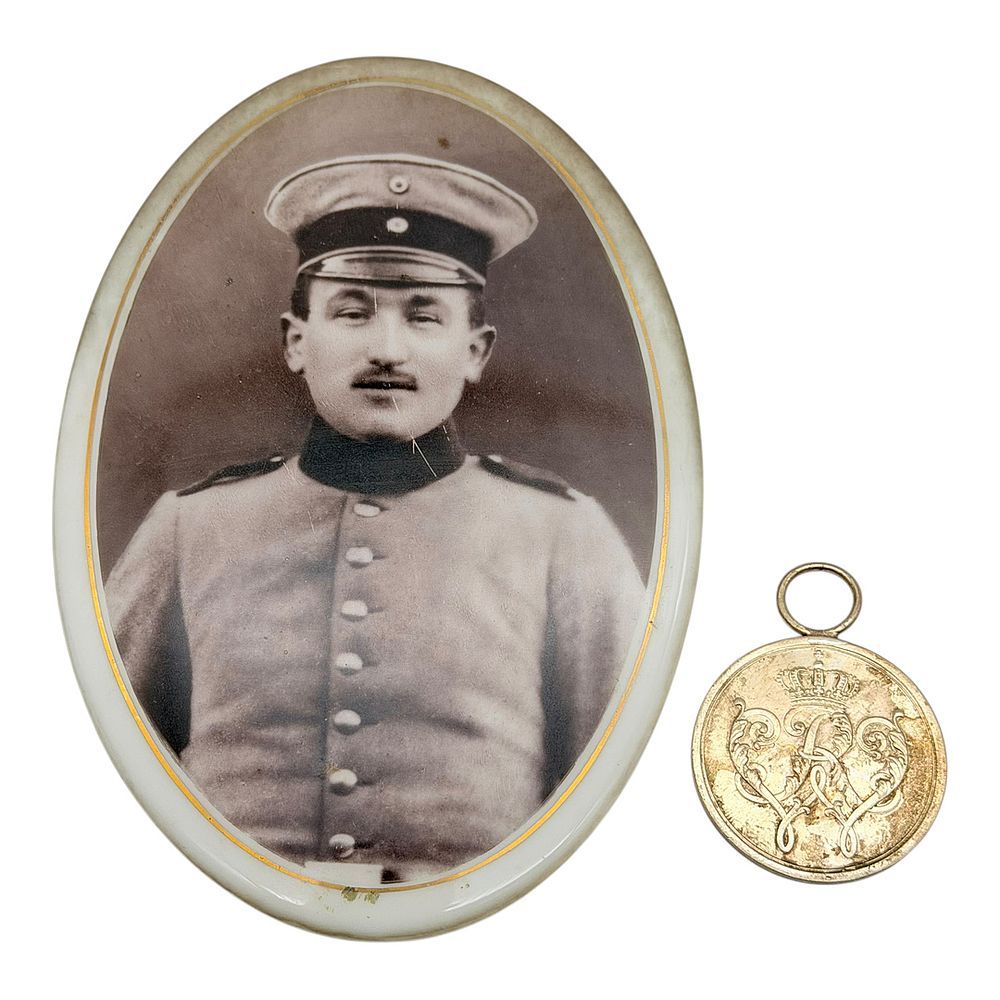
Photoceramic Portrait Plate of a Soldier and Prussian Military Honour Award 2nd Class in Silver - Porcelain, silver. 1) Oval porcelain plate with photoceramic portrait of a German soldier in field uniform with peaked cap and standing collar, bust-length. Reverse inscribed ”232 G”, adhesive residue. 15.5×10.5 cm (HxW). 2) Prussian Military Honour Award 2nd Class in silver, obverse with crowned monogram ”WR” (Wilhelmus Rex) beneath the Prussian royal crown, reverse with laurel wreath and inscription ”KRIEGS VERDIENST”, with suspension loop. D. 40 mm, Wt. 24.7 g. Photoceramic portrait plates were a widespread medium of commemorative culture in the early twentieth century. The technique, in which a photographic likeness is fired onto porcelain, was used both for grave memorials and domestic display. The uniform of the subject, with standing collar and peaked cap, suggests the period before or during the First World War. The accompanying medal is a Prussian Military Honour Award 2nd Class, instituted on 27 February 1864 by King Wilhelm I of Prussia. The crowned monogram ”WR” (Wilhelmus Rex) on the obverse confirms the attribution. The decoration was awarded to non-commissioned officers and enlisted men for bravery and military merit, first during the German-Danish War of 1864, subsequently in the Austro-Prussian War of 1866, the Franco-Prussian War of 1870/71 and the First World War. German Description Fotokeramik-Porträtplatte eines Soldaten und Preußisches Militär-Ehrenzeichen II. Klasse in Silber Porzellan, Silber. 1) Ovale Porzellanplatte mit fotokeramischem Porträt eines deutschen Soldaten in Felduniform mit Schirmmütze und Stehkragen, Brustbild. Rückseitig bezeichnet „232 G”, Kleberückstände. 15,5×10,5 cm (HxB). 2) Preußisches Militär-Ehrenzeichen II. Klasse in Silber, Avers mit gekröntem Monogramm „WR” (Wilhelmus Rex) unter preußischer Königskrone, Revers mit Lorbeerkranz und Inschrift „KRIEGS VERDIENST”, gehänkelt. D. 40 mm, G. 24,7 g. Fotokeramische Porträtplatten waren im frühen 20. Jahrhundert ein verbreitetes Medium der Erinnerungskultur. Die Technik, bei der ein fotografisches Bildnis auf Porzellan eingebrannt wird, kam sowohl für Grabdenkmäler als auch für die häusliche Aufstellung zum Einsatz. Die Uniform des Dargestellten mit Stehkragen und Schirmmütze deutet auf die Zeit vor oder während des Ersten Weltkriegs. Die beiliegende Medaille ist ein Preußisches Militär-Ehrenzeichen II. Klasse, gestiftet am 27. Februar 1864 durch König Wilhelm I. von Preußen. Das gekrönte Monogramm „WR” (Wilhelmus Rex) auf dem Avers bestätigt die Zuordnung. Die Auszeichnung wurde an Unteroffiziere und Mannschaften für Tapferkeit und militärische Verdienste verliehen, erstmals im Deutsch-Dänischen Krieg 1864, in der Folge auch im Deutschen Krieg 1866, im Deutsch-Französischen Krieg 1870/71 und im Ersten Weltkrieg.