Bidspirit auction | Historical Shooting Target, Command of
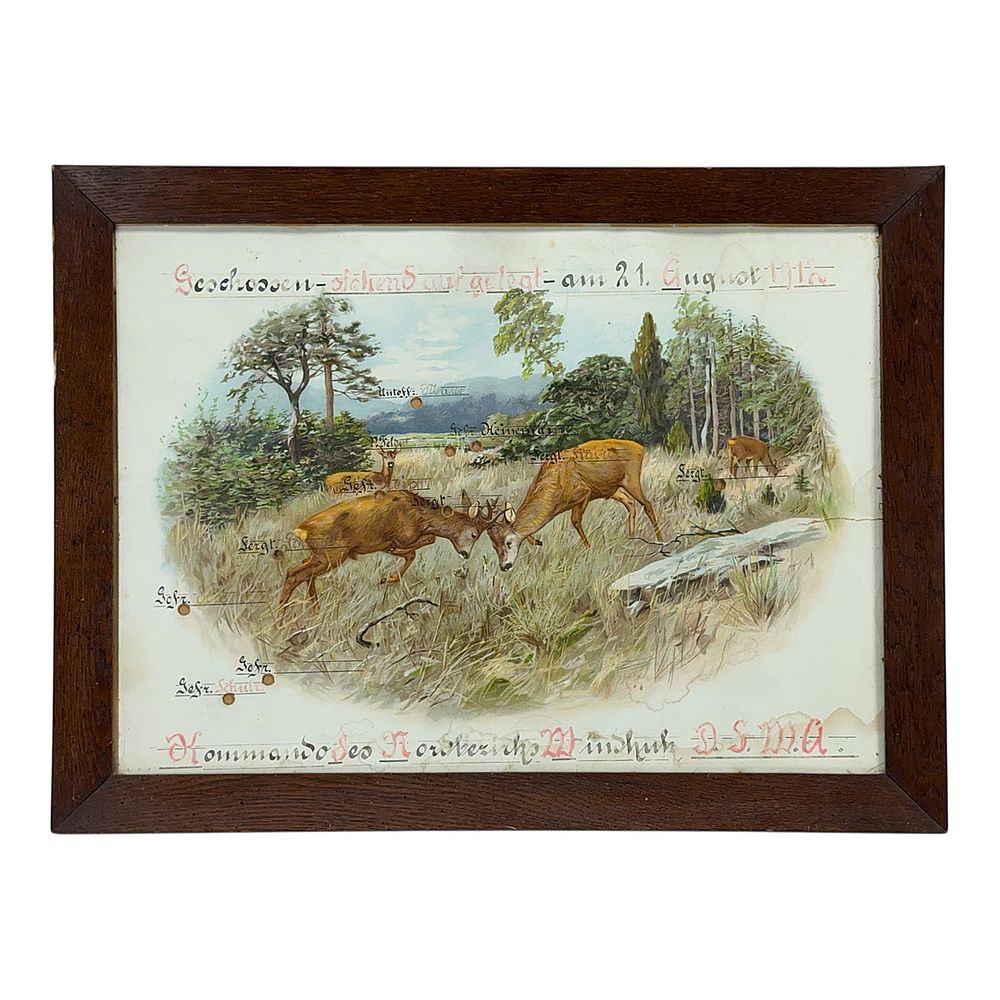
Historical Shooting Target, Command of the Northern District Windhoek (G.S.W.A.), 1912 - Color lithograph on cardboard. A commemorative shooting target of the Imperial Schutztruppe. The central motif depicts a forest landscape with two fighting roebucks in the foreground. At the top is the red calligraphic inscription: ”Geschossen - stehend aufgelegt - am 21. August 1912.” (Shot - standing supported - on August 21, 1912). At the bottom, the designation: ”Kommando des Nordbezirks Windhuk D. S. W. A.” (Command of the Northern District Windhoek, German South West Africa). Several shooting hits are marked on the image field, which are hand-annotated with the military ranks and names of the respective shooters (e.g., Gefr. Schulz, Sergt.). Age-appropriate condition with clear signs of time, water stains, creases, and slight edge wear. 36.5 x 51.5 cm (HxW), framed behind glass, frame bumped and with woodworm damage, overall dimensions 44.5 x 59.5 cm (HxW). Such historical hand-inscribed shooting targets are one-of-a-kind. Pieces with a direct connection to the former German colonies (here German South West Africa, present-day Namibia) and the Schutztruppe stationed there are highly sought after on the militaria and colonial history market. German Description Historische Schützenscheibe, Kommando des Nordbezirks Windhuk (D.S.W.A.), 1912, 1912 farbige Lithografie/Karton, Eine Erinnerungs-Schützenscheibe der kaiserlichen Schutztruppe. Das zentrale Motiv zeigt eine Waldlandschaft mit zwei kämpfenden Rehböcken im Vordergrund. Oben befindet sich die in Rot gehaltene, kalligrafische Aufschrift: „Geschossen - stehend aufgelegt - am 21. August 1912.“. Unten die Bezeichnung: „Kommando des Nordbezirks Windhuk D. S. W. A.“ (Deutsch-Südwestafrika). Auf dem Bildfeld sind mehrere Schusstreffer markiert, denen handschriftlich die militärischen Ränge und Namen der jeweiligen Schützen (z. B. Gefr. Schulz, Sergt.) zugeordnet wurden. Altersgemäßer Zustand mit deutlichen Spuren der Zeit, Wasserflecken, Knickspuren und leichten Randläsuren, 36,5 x 51,5 cm (HxB), hinter Glas, gerahmt, Rahmen bestoßen und mit Wurmfraß, Gesamtmaß 44,5 x 59,5 cm (HxB) Solche historischen handbeschrifteten Schützenscheiben sind Unikate. Insbesondere Stücke mit direktem Bezug zu den ehemaligen deutschen Kolonien (hier Deutsch-Südwestafrika, das heutige Namibia) und der dort stationierten Schutztruppe sind auf dem Markt für Militaria und Kolonialgeschichte äußerst gesucht.