Bidspirit auction | Pair of Steins from a
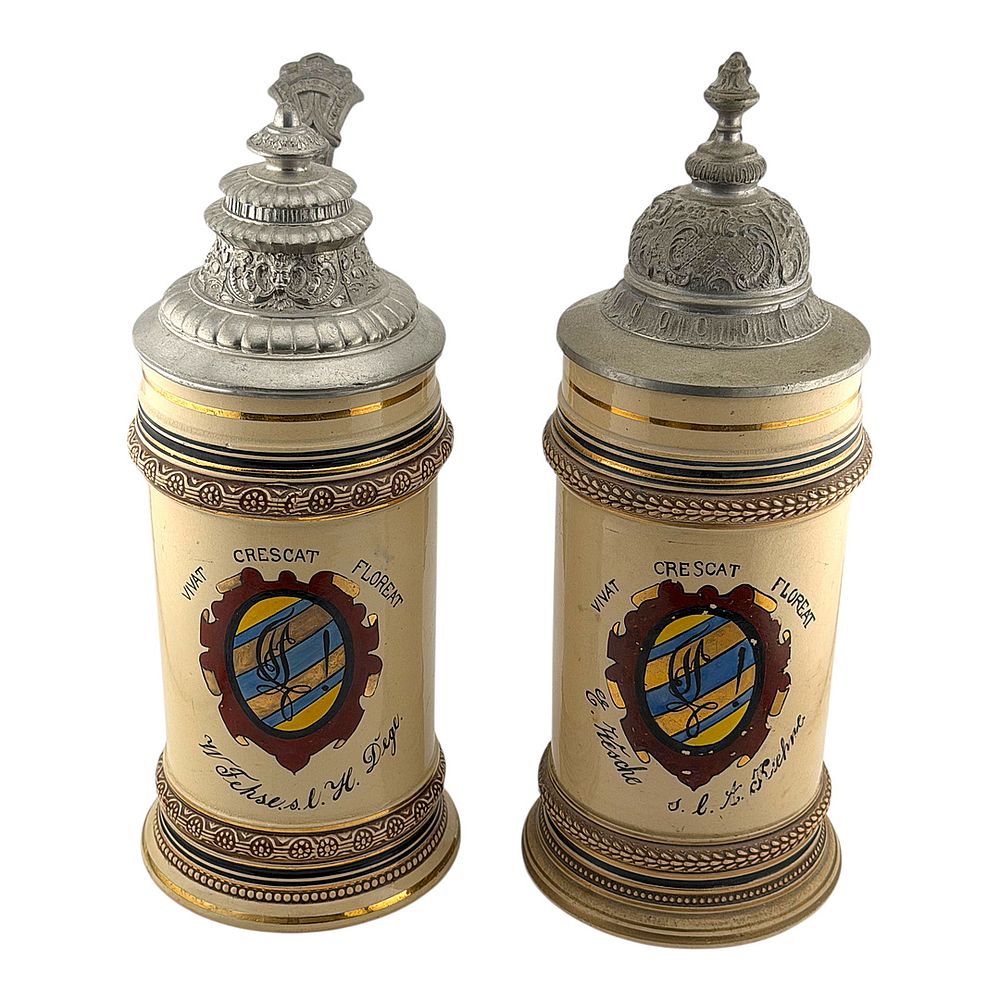
Pair of Steins from a Presumed Braunschweig Student Association, c. 1900 - Two identically shaped, tall slender beer steins in ivory-coloured fine stoneware with relief-moulded decorative bands and substantial pewter lids (Westerwald, model no. 570). The front of each stein displays a hand-painted polychrome coat of arms. The central motif is the colour ribbon (Couleur) in the sequence gold-blue-gold with blue percussion (thin blue border lines flanking broad gold stripes and a broad blue central band). The colour scheme corresponds to the territorial colours of the Duchy of Braunschweig (blue-yellow), although student associations did not necessarily adopt local colours. The coat of arms also incorporates the cipher (Zirkel) of the association, which remains unresolved. The unusually high number of diagonal bars in the coat of arms is a feature not documented in any known student association. The coat of arms is framed by a red cartouche. Above it appears the Latin motto ”Vivat, crescat, floreat” (May it live, grow, flourish). Below the coats of arms are personal dedications in black calligraphy: 1. ”W. Fehse s. l. (seinem lieben / to his dear) H. Dege.” 2. ”E. Wesche s. l. (seinem lieben / to his dear) A. Kiehne.” The steins have elaborately decorated pewter lids with relief ornament (scrollwork/mascarons) and tower-shaped finials. The thumbrests are sculpted ornaments. Each base bears the impressed model number ”570”. Both in good used condition. 24.5 x 10.5 cm (H x D). Based on the colour scheme (blue-gold), the regionally typical surnames (Fehse, Wesche, Kiehne, Dege) and the provenance of the objects from the Braunschweig area, the steins point to a secondary-school or alumni fraternity (Pennälerverbindung) in the Braunschweig/Wolfenbüttel region. Such associations imitated the customs of university fraternities (hence the cipher and the coat of arms) and used the classic Latin toast ”Vivat, crescat, floreat”. The cipher remains unresolved. The steins are typical products of the Westerwald stoneware industry, which around 1900 individually painted steins with coats of arms and dedications for student associations. German Description Paar Krüge einer wohl Braunschweiger Schüler- oder Abiturientenverbindung, um 1900 Zwei identisch geformte, hochschlanke Bierkrüge aus elfenbeinfarbenem Feinsteinzeug mit reliefierten Zierbändern und massiven Zinndeckeln (Westerwald, Modellnr. 570). Die Schauseiten zeigen jeweils ein handgemaltes, polychromes Wappen. Das zentrale Motiv ist das Farbband (Couleur) in der Abfolge Gold-Blau-Gold mit blauer Perkussion (dünne blaue Randlinien, gefolgt von breiten goldenen Streifen und einer breiten blauen Mittelbahn). Die Farbgebung entspricht den Landesfarben des Herzogtums Braunschweig (Blau-Gelb), wobei Studentenverbindungen nicht zwingend Ortsfarben führten. Im Wappen ist zudem der Zirkel der Verbindung integriert, der bislang keiner bekannten Korporation zugeordnet werden konnte. Die ungewöhnlich hohe Anzahl der Schrägbalken im Wappen ist ein Merkmal, das bei keiner bisher dokumentierten Verbindung in dieser Form nachgewiesen wurde. Das Wappen wird gerahmt von einer roten Kartusche. Darüber steht der lateinische Wahlspruch „Vivat, crescat, floreat” (Es lebe, wachse, blühe). Unterhalb der Wappen befinden sich die persönlichen Widmungen in schwarzer Kalligrafie: 1. „W. Fehse s. l. (seinem lieben) H. Dege.” 2. „E. Wesche s. l. (seinem lieben) A. Kiehne.” Die Krüge besitzen aufwendig verzierte Zinndeckel mit Reliefdekor (Ornamentik/Maskarons) und turmartigen Zierknäufen. Als Daumenrasten dienen plastisch ausgearbeitete Ornamente. Am Boden befindet sich jeweils die eingepresste Modellnummer „570”. Beide im guten gebrauchten Zustand. 24,5 x 10,5 cm (H x D). Aufgrund der Farbgebung (Blau-Gold), der regionaltypischen Familiennamen (Fehse, Wesche, Kiehne, Dege) und der Herkunft der Objekte aus dem Raum Braunschweig deuten die Krüge auf eine Schüler- oder Abiturientenverbindung (Pennälerverbindung) im Raum Braunschweig/Wolfenbüttel hin. Solche Verbindungen ahmten die akademischen Sitten der Universitätskorporationen nach (daher der Zirkel und das Wappen) und nutzten den klassischen lateinischen Segenswunsch „Vivat, crescat, floreat”. Der Zirkel ist nicht aufgelöst. Die Krüge sind typische Erzeugnisse der Westerwälder Steinzeugindustrie, die um 1900 für studentische Verbindungen individuell mit Wappen und Widmungen bemalt wurden.