Bidspirit auction | Miniature Graduation Badge (Frachnik) of
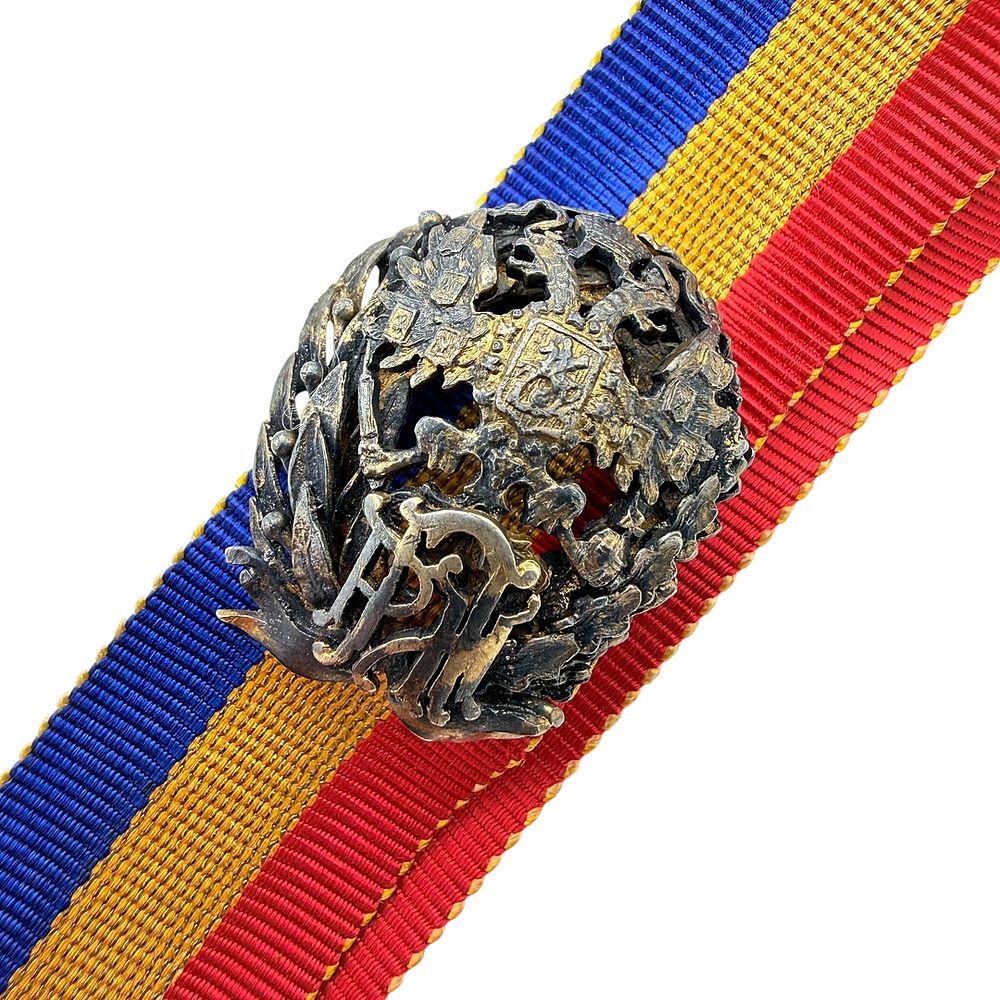
Miniature Graduation Badge (Frachnik) of Riga Polytechnic Institute on Corps Ribbon, c. 1902–1918 - Probably silver (gilt), silk ribbon. Miniature graduation badge (so-called Frachnik) of the Riga Polytechnical Institute (RPI), mounted on the tricolour corps ribbon of Corps Concordia Rigensis in blue-gold-red. Badge in the form of an oval wreath of laurel leaves and oak foliage, centred on the Russian imperial double-headed eagle with crown, sceptre and orb, bearing the Moscow city arms (St George on horseback) on its breast, with the six territorial coats of arms of the Russian Empire on the wings. Joined at the base by a band with the Cyrillic monogram ”RPI”. High-quality manufacture, gilding with considerable wear. 27x20x25 mm (HxWxD), sash length 116 cm. The Riga Polytechnical Institute, founded in 1862 as the oldest technical university in the Baltic region, was granted state status in 1896 and was regarded as the finest polytechnic in the Russian Empire from c. 1906 to 1916. This badge type with the imperial eagle was officially approved around 1902/1903. As a Frachnik (miniature badge for semi-formal occasions), it was worn on the lapel of a frock coat. Corps Concordia Rigensis, founded in 1869 in Riga, is the oldest surviving Baltic German student corporation and has continued in Hamburg since 1956. The combination of a state graduation badge with the corps ribbon of a Baltic German corporation is a rare testament to the dual identity of Baltic German academics in the Russian Empire. German Description Miniatur-Abschlussabzeichen (Frachnik) des Rigaer Polytechnikums am Couleurband, um 1902–1918 wohl Silber (vergoldet), Seidenband. Miniatur-Abschlussabzeichen (sog. Frachnik) des Rigaer Polytechnischen Instituts (RPI), montiert auf dem dreifarbigen Couleurband des Corps Concordia Rigensis in Blau-Gold-Rot. Das Abzeichen in Form eines ovalen Kranzes aus Lorbeerblättern und Eichenlaub, im Zentrum der doppelköpfige russische Reichsadler mit Krone, Zepter und Reichsapfel, auf der Brust das Moskauer Stadtwappen (Hl. Georg zu Pferd), auf den Schwingen die sechs Territorialwappen des Russischen Reiches. Unten verbunden durch ein Band mit dem kyrillischen Monogramm „RPI” (Rischskij Politechnitscheskij Institut). Hochwertig gefertigt, Vergoldung mit deutlichen Abriebspuren. 27x20x25 mm (HxBxT), Scherpenlänge 116 cm. Das Rigaer Polytechnische Institut, 1862 als älteste technische Hochschule im Baltikum gegründet, erhielt 1896 den Status einer staatlichen Einrichtung und galt um 1906–1916 als bestes Polytechnikum im Russischen Reich. Der vorliegende Abzeichentyp mit Reichsadler wurde um 1902/1903 offiziell genehmigt. Als Frachnik (Miniaturabzeichen für halbformelle Anlässe) wurde er am Revers des Fracks getragen. Das Corps Concordia Rigensis, 1869 in Riga gegründet, ist die älteste heute noch aktive deutschbaltische Studentenverbindung und besteht seit 1956 in Hamburg fort. Die Kombination aus staatlichem Graduierungsabzeichen und Couleurband einer deutschbaltischen Korporation ist ein seltenes Zeugnis der doppelten Identität baltendeutscher Akademiker im Russischen Kaiserreich.