Bidspirit auction | Antique Postcard “The Language of
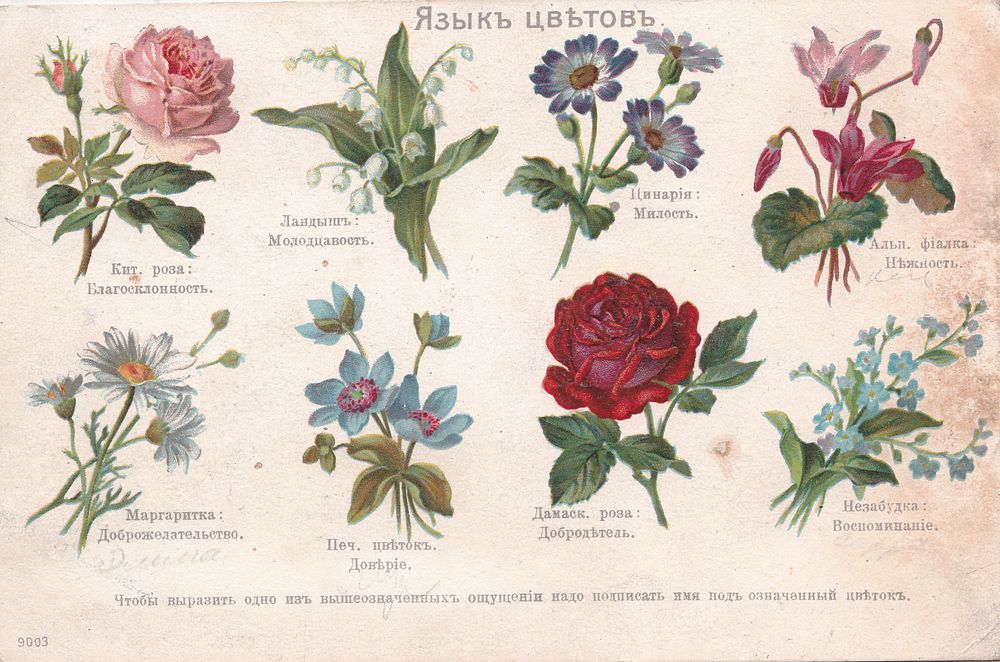
Antique Postcard “The Language of Flowers”. Russian Empire, Early 20th Century. - Colour lithographic postcard. Green-grey title panel; handwritten pencil inscription. Open postcard. No. 9003. Original. Dimensions: 8.8 × 14 cm. This charming postcard belongs to the popular Language of Flowers series, a genre that enjoyed widespread popularity in Europe during the late nineteenth and early twentieth centuries. The concept of the Language of Flowers originated in the East, where symbolic associations enabled emotions, sentiments, and poetic messages to be conveyed indirectly through references to plants and flowers. During the Victorian era, this system was enthusiastically adopted in Europe and developed into a sophisticated cultural code. In the socially restrained atmosphere of nineteenth-century society, flowers became a discreet means of expressing affection, admiration, friendship, longing, or devotion when such feelings could not be communicated openly. The phenomenon flourished first in Britain during the reign of Queen Victoria (1837–1901) and soon spread throughout Europe. Entire floral dictionaries were published, explaining the symbolic meaning of individual flowers and plants. Beyond the species themselves, details such as the arrangement of a bouquet or even the inclination of a flower could alter the intended message. Symbolic meanings often varied between countries and traditions. For example, the phlox could represent both submission and agreement, while simultaneously serving as a symbol of passionate love. Postcards devoted to the Language of Flowers became especially popular at the turn of the century. They combined decorative illustration with sentimental symbolism and often served as personal tokens of affection. Owners could write messages on the reverse, send them as correspondence, or even cut out and present specific floral motifs as symbolic gifts. Today, such postcards are valued as evocative examples of Imperial Russian ephemera, reflecting the romantic sensibilities, visual culture, and social customs of the late Victorian and Edwardian eras. They also represent an important chapter in the history of philocarty and the international fascination with floral symbolism at the beginning of the twentieth century.