Bidspirit auction | Antique Postcard “The Language of
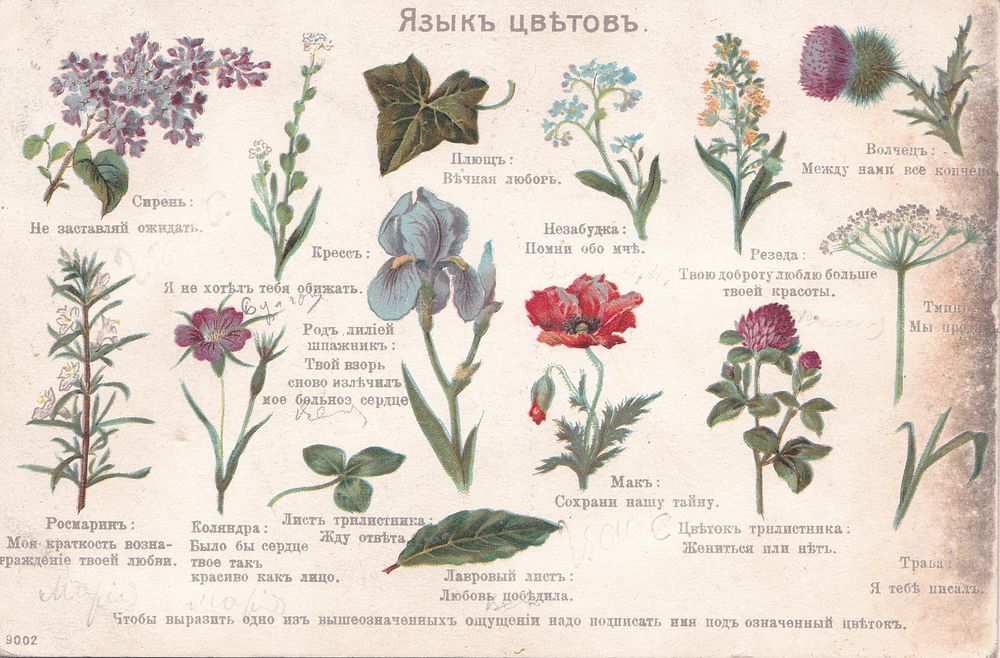
Antique Postcard “The Language of Flowers”. Russian Empire, Early 20th Century. - Colour lithographic postcard. Grey-green title panel. Unused. Open postcard. No. 9002. Original. Dimensions: 8.8 × 14 cm. This postcard belongs to the celebrated Language of Flowers series, a popular cultural phenomenon that flourished throughout Europe in the late nineteenth and early twentieth centuries. The tradition of the Language of Flowers originated in the East, where symbolic associations allowed emotions and poetic sentiments to be communicated through references to plants and flowers. This system later inspired the development of a sophisticated floral symbolism in European culture. During the Victorian era, a period marked by strict social conventions, romanticism, and an appreciation for symbolism, flowers became an accepted means of expressing feelings that could not be openly spoken. Initially embraced in Britain during the reign of Queen Victoria (1837–1901), the language of flowers soon spread throughout Europe and became familiar to fashionable society. Floral dictionaries were published to explain the meanings associated with particular flowers, while bouquets and floral arrangements served as coded messages. Not only the choice of flower but also its arrangement and even the angle at which it was presented could alter its meaning. Interpretations often varied between countries and traditions. For example, the phlox could symbolize submission and agreement, while elsewhere it was understood as an emblem of ardent passion. Illustrated postcards devoted to floral symbolism became especially popular during this period. Combining decorative design with sentimental meaning, they were used as keepsakes, correspondence, and tokens of affection. Owners could write personal messages on the reverse or, in some cases, cut out individual floral motifs and present them as symbolic gifts. Today, these postcards are valued as charming examples of Imperial Russian ephemera and as documents of a broader international fascination with symbolic communication, romantic culture, and decorative arts at the turn of the twentieth century. They remain highly collectible among enthusiasts of philocarty, social history, and period graphic design.