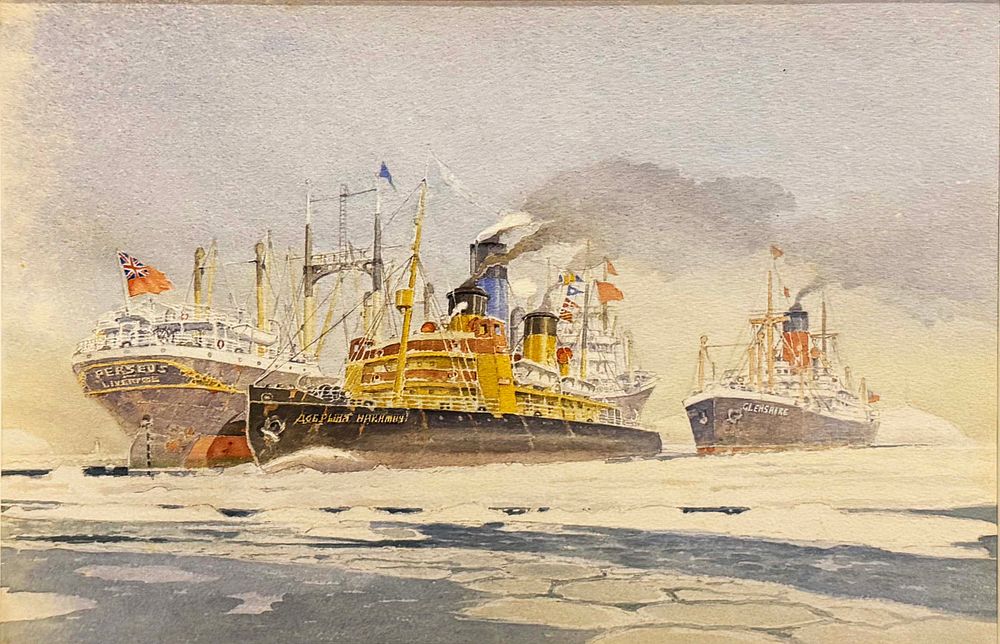
Bidspirit auction | Pavel Pavlovich Kuyantsev (1912–1997). Icebreaker
Pavel Pavlovich Kuyantsev (1912–1997). Icebreaker Dobrynya Nikitich. 1989. - Watercolour on paper. Framed with mat and museum glass. Framed dimensions: 46 × 57 cm. Pavel Pavlovich Kuyantsev (1912–1997) was a Russian sea captain, explorer, and artist whose life and work became inseparably linked with the maritime history of the Russian Far East. Born in Vladivostok on 3 March 1912 into the family of a hereditary sailor, Kuyantsev chose to follow in his father’s footsteps. Although he showed a lifelong interest in painting, he initially pursued a maritime career. After graduating from nautical school as a navigator, he worked his way up from cabin boy and assistant stoker to become a ship captain at the age of twenty-six, one of the youngest captains in the Soviet merchant fleet. His career was dramatically affected during the Stalinist purges when his father was arrested and later executed as an “enemy of the people.” As a consequence, Kuyantsev was removed from command and reassigned as an officer on coastal vessels. During the Second World War, however, the shortage of experienced captains led to his return to active service. He served aboard the steamship Dalstroy, making wartime voyages to the United States and Canada, acting as senior officer and participating in military operations in Korea and on Sakhalin Island. For his service, he was awarded the Order of the Red Banner. In 1952, after being fully reinstated as a captain on international routes, Kuyantsev learned that his father had been executed in 1938. Despite these personal hardships, he continued to pursue both navigation and art with remarkable dedication. A lifelong dream of reaching Antarctica was fulfilled in 1961 when, already recognized as the Best Captain of the Ministry of the Merchant Fleet, he joined the vessel Kooperatsiya bound for the Soviet Antarctic station Mirny. During this expedition, he painted more than one hundred studies directly from nature, creating an invaluable visual record of the Antarctic landscape. Kuyantsev credited much of his artistic development to Nikolai Maksimovich Shtukenberg, a fellow sea captain and professional artist, who recognized his talent and encouraged him to refine his technique. Until his retirement in 1972, Kuyantsev continued to command cargo and passenger vessels. His final ship, the motor vessel Primorye, carried Soviet tourists to the Kuril Islands and Kamchatka. After each voyage, he would organize exhibitions of works inspired by his travels. An exceptionally prolific artist, Kuyantsev is believed to have created approximately two thousand works, many of which he generously donated. Sixty-seven works alone were presented to the Vladivostok Art Gallery. Today, his paintings are held in nine museums across Russia, including three in Vladivostok, as well as in two museums in Japan. Marine painting formed the core of his artistic legacy. His seascapes and depictions of ships chronicle both the history and contemporary life of the Russian fleet, combining the precision of a professional sailor with the sensitivity of an accomplished artist. In 1970, the Far Eastern film studio Daltelefilm dedicated a documentary to his life and work. In 1992, a major retrospective exhibition was held in Vladivostok to celebrate his eightieth birthday. Pavel Kuyantsev passed away in February 1997 and was laid to rest in the city's Marine Cemetery. Today, he is remembered as one of the most remarkable figures in the cultural history of the Russian Far East—a captain whose artistic legacy preserved the spirit of the sea for future generations.