Bidspirit auction | Evgeny Fyodorovich Dimura (1929–2004) Rabbit Island,
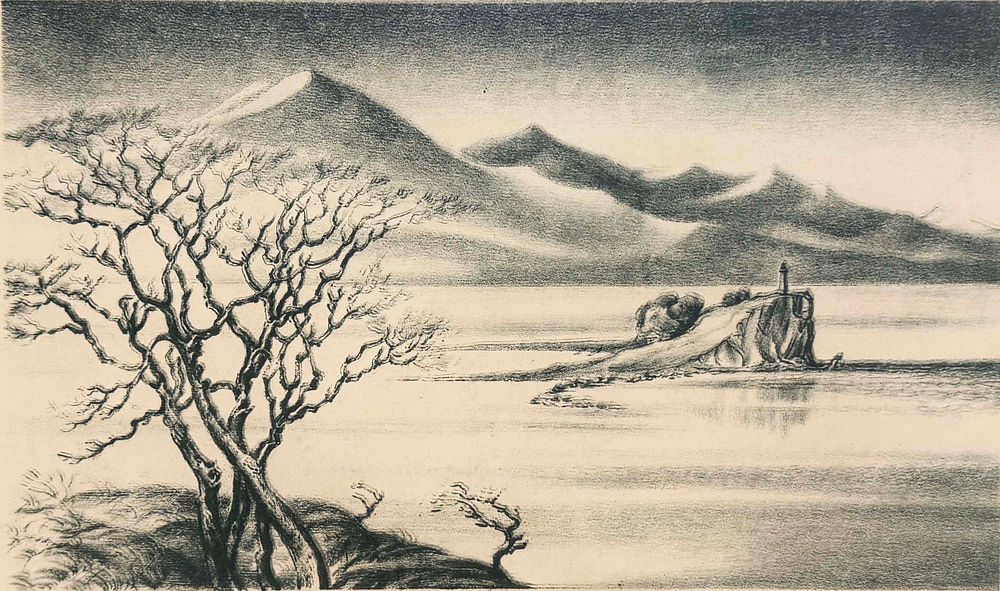
Evgeny Fyodorovich Dimura (1929–2004) Rabbit Island, Sidimi (Bezverkhovo). 1970s–1980s - Linocut on paper. Sheet: 23 × 35 cm. Museum glass and mat. Framed dimensions: 36.5 × 48 cm. Evgeny Fyodorovich Dimura (1929–2004) was a Russian graphic artist, designer, landscape painter, marine artist, and portraitist. Born in Novosibirsk, he spent most of his life and artistic career in Vladivostok. In the 1950s, Dimura lived for approximately two years in Komsomolsk-on-Amur, where he first became involved in artistic practice through a local art studio. Over time, he established himself as one of the notable graphic artists of the Russian Far East. Dimura worked extensively in the techniques of lithography, linocut, and drawing. His mastery of printmaking allowed him to develop a distinctive visual language characterized by clarity of form, expressive line, and a strong sense of composition. A significant turning point in his artistic career came between 1974 and 1980, when he participated in five Antarctic expeditions aboard vessels of the Far Eastern fishing fleet company Dalmoreprodukt. These voyages profoundly influenced his artistic vision and permanently connected his work with the sea, maritime history, Antarctica, and the exploration of the Russian Far East. He became a member of the Union of Artists of the USSR in 1981 and subsequently the Union of Artists of Russia. From 1967 onward, he participated in all major regional, zonal, and national exhibitions. In 1990–1991, he joined the Goodwill Games and Russian America expeditions aboard the historic frigate Pallada. The artist's oeuvre is distinguished by its close relationship with maritime culture and coastal landscapes. Whether depicting remote islands, historic ships, or northern seas, Dimura approached his subjects with both documentary precision and poetic sensitivity. Rabbit Island, Sidimi (Bezverkhovo) is executed in the linocut technique, a relief-printing process in which the image is carved into a linoleum surface and printed from the remaining raised areas. The resulting contrast between black and white lends the composition a striking graphic clarity, emphasizing the rhythm of forms and the atmosphere of the coastal landscape. Today, Dimura's works remain important visual documents of the maritime history and natural environment of the Russian Far East, preserving a unique artistic perspective on one of the country's most distinctive regions.