Bidspirit auction | Set of Three Postcards. Nikolai
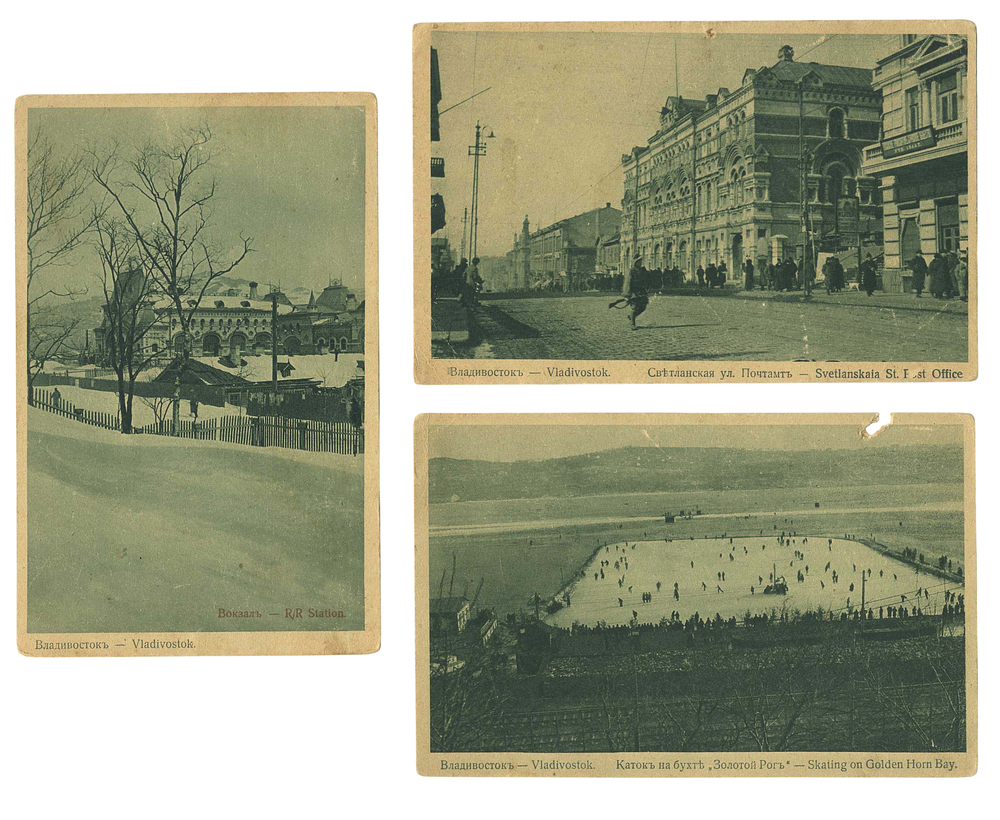
Set of Three Postcards. Nikolai N. Ivanov. No. 7. Vladivostok. Published in New York, USA, 1922. - Colour-printed postcards. 1. Vladivostok. Railway Station Green-tinted postcard. 14 × 9 cm. View of the Vladivostok Railway Station, designed in the Neo-Russian style. The building acquired its present appearance following the reconstruction of 1910–1912 and was intentionally conceived as an architectural counterpart to the Yaroslavsky Railway Station in Moscow, emphasizing Vladivostok’s role as the eastern terminus of the Trans-Siberian Railway. 2. Svetlanskaya Street. Post Office Green-tinted postcard. 9 × 14 cm. A city view of Vladivostok’s principal thoroughfare, featuring the Post Office building. The postcard documents the commercial and administrative heart of the city in the early twentieth century. 3. Ice Rink on Golden Horn Bay Green-tinted postcard. 14 × 9 cm. A rare depiction of everyday urban life in Vladivostok. The caption identifies the scene as: “Ice rink of the Golden Horn Ice Sports Society; in the distance, the track of a passing icebreaker.” The image records a little-known aspect of winter recreation on the frozen waters of Golden Horn Bay. This series is of particular historical interest because it was published not in Vladivostok, but in New York in 1922 by the Russian émigré publisher Nikolai N. Ivanov. Each postcard bears bilingual Russian-English captions, indicating that the edition was intended not only for Russian-speaking audiences but also for foreign collectors, émigrés, and international communities connected with the Russian Far East. The set is a valuable example of early twentieth-century philocarty, documenting the architectural, social, and cultural history of Vladivostok during a transformative period. At the same time, it reflects the publishing activity of the Russian émigré community abroad and the preservation of memory about the Russian Far East within the diaspora. Today, such postcard sets are prized both as visual records of pre-revolutionary Vladivostok and as artifacts of Russian émigré publishing culture in the early 1920s.