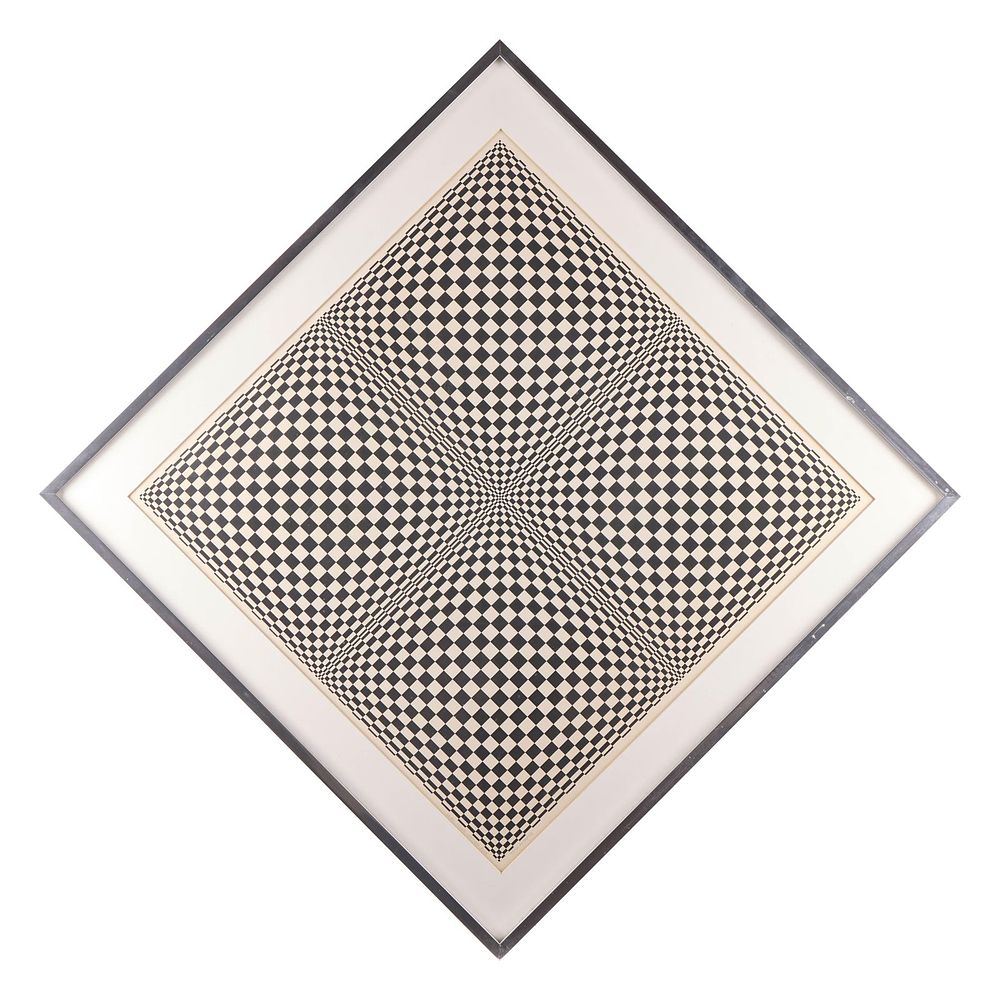
Bidspirit auction | Edna Andrade ”Color Motion 5-65”
Edna Andrade ”Color Motion 5-65” Serigraph - Edna Andrade (American, 1917-2008). Serigraph on paper print titled ”Color Motion 5-65” depicting an op-art composition of red and white squares. Pencil signed, titled, and numbered 24/50 along the lower corner as well as the verso. Lot Essay: Edna Andrade was an American abstract artist and a pioneering figure in the Op Art movement. Born in Portsmouth, Virginia, she studied at the Barnes Foundation, the University of Pennsylvania, and the Pennsylvania Academy of Fine Arts, where she was influenced by the Bauhaus movement and German modernism. She spent most of her life in Philadelphia, where she taught for three decades at the University of the Arts. Andrade's early career included working on propaganda materials during World War II and creating public artworks for institutions like the Free Library of Philadelphia. Her early artistic output consisted of watercolor collages and abstracted landscapes before she transitioned to geometric abstraction in the 1950s. As a key figure in Op Art, Andrade’s work explored perception through geometric precision, symmetry, and color contrasts. Her paintings, such as Motion 4-64 and Turbo I, create optical illusions that engage the viewer’s visual experience. Influenced by artists like Paul Klee and Piet Mondrian, as well as disciplines like mathematics and philosophy, Andrade’s work was highly structured yet visually dynamic. Though she received significant recognition later in life, including awards for teaching and artistic achievement, her contributions were somewhat overlooked during her lifetime by the dominant New York art scene. Her legacy continues through retrospectives and scholarships, such as the Edna Andrade Emerging Artist Award, which supports female artists in their careers. Sight; height: 39 1/4 in x width: 39 1/4 in. Framed; height: 48 3/4 in x width: 48 3/4 in x depth: 1 3/4 in. Condition: The sheet is toned. There are no visible tears, creases, losses, or repairs. Housed under an acidic mat. Framed under glass. Light wear to the frame. Not inspected out of frame.