Bidspirit auction | 18 Pcs Worc. Dragon in
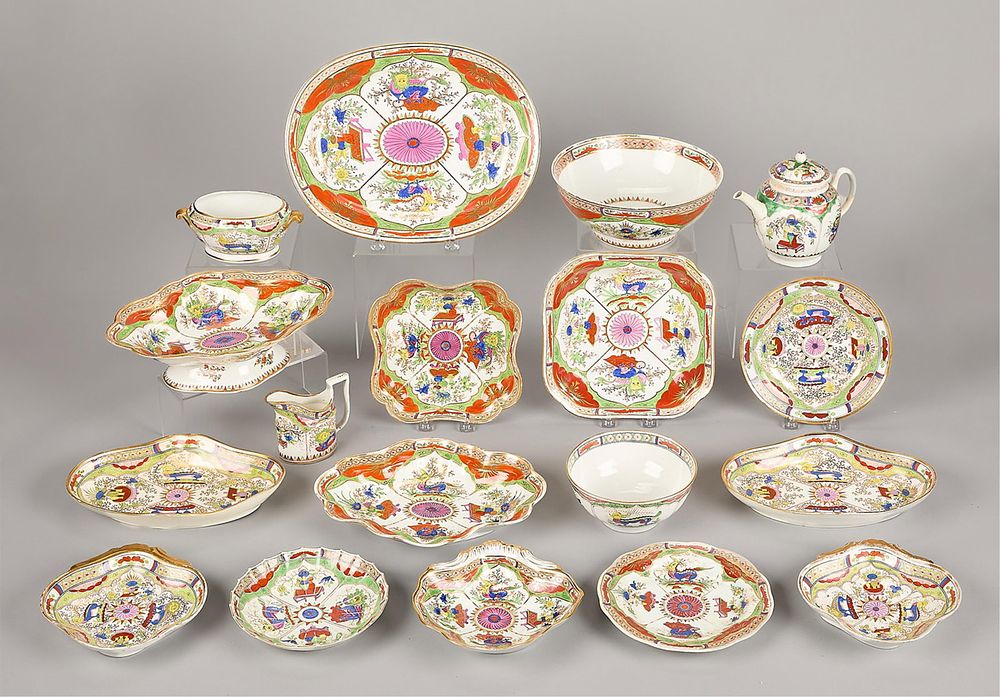
18 Pcs Worc. Dragon in Compartment Serving Dishes - Chamberlain's Worcester, England. Group of eighteen ”Dragon in Compartment” pattern no. 75 porcelain serving wares, ca. 1815. The pattern also known as ”Kylin” or ”Bengal Tiger.” Including: one lidded teapot, a large serving bowl, a smaller serving bowl, a large oval tray, a sauce tureen (lacking lid), a compote, a quatrefoil dish, a square dish, a creamer, a large plate, three shell-form plates, a lobed plate, a circular plate with a scalloped rim, and three large lobed oval trays. Some marked in handwritten script along the underside. Provenance: The Distinguished Collection of Leo & Doris Hodroff. Worcester began producing this design in the 1770s. The name comes from the auspicious mythical creature set in the compartments, the Qilin, depicted uniquely with a large mouth emanating with with gilt fire or vapor. A similar creature more akin to a Foo Dog features in the opposite compartment, depicted standing on a plinth holding an object. In the compartments between these two fierce beasts are still lifes of vases and floral sprays. Surrounded by vibrant red, green, and gilt decoration in the borders. The central motif is a chrysanthemum, a symbol of longevity. Overall the pattern is rife with auspicious symbols and motifs. The pattern draws heavily from Chinese Kangxi examples, showcasing the Western desire for imported goods. This pattern is also an excellent example of the cross-cultural exchange that occurred as a result of the import of porcelain goods, showing how Western eyes interpreted Eastern symbology. This is especially evident in the names given to the pattern, ”Bengal Tiger” or ”Dragon in Compartment, ” showing how these mythical creatures were interpreted into known animals in the Western world. Height ranges from 1 in to 7 in; width ranges from 4 3/4 in to 14 1/4 in; depth ranges from 2 1/2 in to 11 1/4 in. Condition: There are signs of repair to one of the rounded trays, particularly along one quadrant of the rim and the underside; these areas fluoresce under UV light. To one of the trays, there is a minute hairline crack along the rim; the crack extends downward approximately 1/4 inch. To another of the trays, there are two small chips along the rim; there is a minute hairline crack radiating from one of the chips, measuring approximately 1/4 inch in length. There is a possible minute hairline crack radiating from one of the linear firing flaws along the tray's rim. To one of the smaller ovoid platters, there are scattered signs of restoration or repair throughout. To the other smaller ovoid platter, there are scattered signs of restoration or repair along one half of the platter. To the larger, oval platter, there is a hairline crack along rim which extends downward approximately 2 inches; there are signs of restoration or repair surrounding the crack. To the scalloped oval platter, there are two hairline cracks: one along the rim that extends downward approximately 2 inches, and one toned hairline crack along the underside of the platter that measures approximately 2 3/4 inches in length. To the compote, there is a small hairline crack, or possibly a scratch, along the rim that extends downward approximately 1/4 inch. To the creamer, there is a linear firing flaw along the interior; along the footrim of the creamer, there is an additional Y-shaped firing flaw. To the teapot, there are repairs to the handle, rim, and spout. There is a toned and rounded crack along the base of the spout, which corresponds to signs of repair. To the lid of the teapot, there are signs of repair or restoration to the finial and along the rim. Along the inner rim of the lid, there are small to moderate chips and losses. To the refuse bowl, there is a loss along the footrim that has been glazed over. Small chips, or possibly rounded firing flaws, along the interior of the bowl. To the square platter, there are signs of restoration along one corner of the rim, specifically, the gilt and glaze is toned and appears to have been retouched; additionally, the area fluoresces under UV light. To some pieces, there are scattered signs of possible restoration, particularly, small areas along the surfaces and undersides that fluoresce under UV light. Additionally, to some of the pieces, there are small, scattered areas of restoration, specifically areas where the gilt or glaze has been touched up. Some pieces with fleabite to small-sized chips along the rims and footrims. Scattered rounded and linear firing flaws. Crazing to the glaze. Fleabite to moderate chips along the footrim. Wear to the gilt and glaze, including losses. Light scratches along the surfaces.