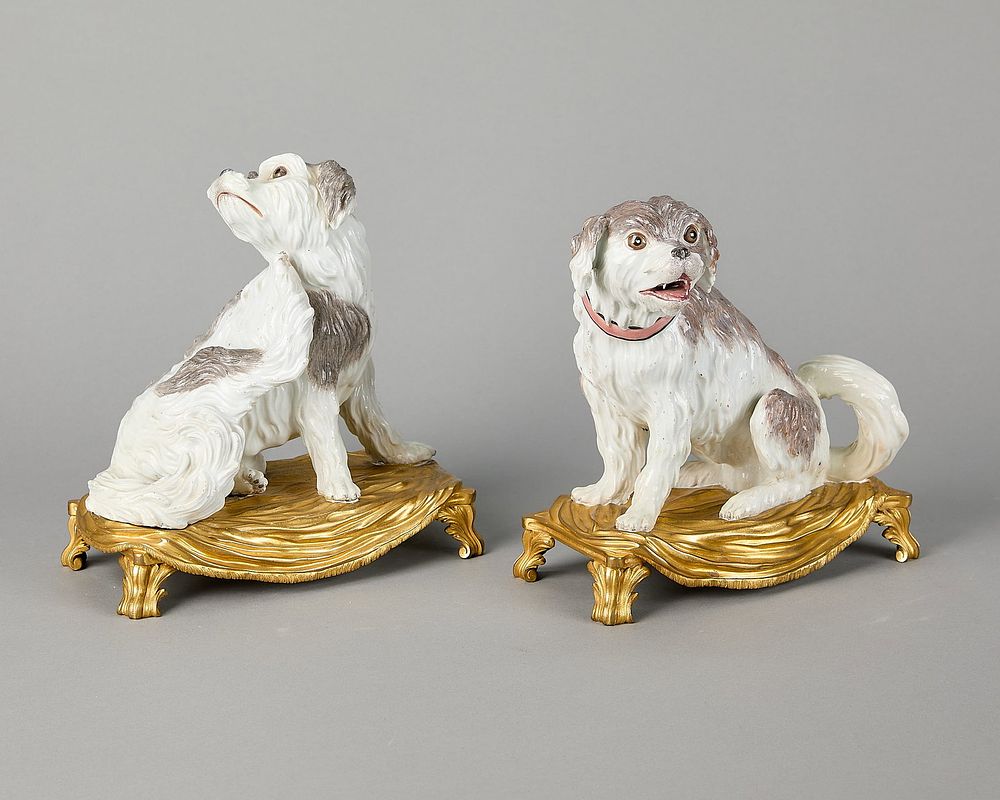
Bidspirit auction | Pair Meissen Bolognese Dogs ca.
Pair Meissen Bolognese Dogs ca. 1765-70 - Meissen, Germany. Modelled by J.J. Kandler. A pair of porcelain ormolu-mounted dogs, variously described as Bolognese, Wachtelhund (German Spaniels), or Terriers. First designed by Kandler ca. 1740-44, this example made ca. 1765-1770. Both pups modelled with shaggy coats painted with brown-gray detail. Each is seated on a gilt bronze tabouret modelled with drapery. One dog is seated and wears a pink collar, model 333, while the other scratches its chin, model 335. The scratching dog is marked with crossed swords with a small dot along the visible underside. Provenance: Partridge Fine Arts Ltd., London, June 8, 1988; The Distinguished Collection of Leo & Doris Hodroff. Bolognese dogs are modelled in numerous Meissen sculptures. The dogs were members of many notable European courts. Phillip II, King of Spain (1556-1598), was gifted two Bolognese dogs from the Duca d'Este. Madame de Pompadour, Catherine the Great, and Empress Maria Theresa were also owners of Bolognese dogs. Some of the Meissen examples were painted or modelled after the real dogs of court members. In one work journal from December 1743, Kandler notes a dog “painted from nature in the most accurate manner” for the Countess Mozinska. Instances of Kandler painting dogs for court ladies appear numerous times throughout his work journals. While most were pugs - popularized by the founding of The Order of the Pug - many others were Bolognese or other undefined dog breeds. These particular models are recorded in Kandler's Taxa or work records for 1740-1744 as follows: '2. Pologneser oder Zottligte Hunde, gegen einan der sehend auff Camine zu sezen, davon einer sich krazet, der andere aber auffrecht sizet, pro 1. Stuck...4. Thlr.' [2 Bolognese or shaggy dogs, to set on a chimney looking at each other, one of which scratching itself, the other sitting upright...4. Thlr.]. (Each) Height: 9 1/2 in x width: 9 in x depth: 4 1/2 in. Condition: The legs and tails of both dogs fluoresce under UV light and show signs of restoration. Some losses of claws to the paws to both dogs. Some touch-up repainting to the gilt bases. The terrier scratching itself has been reattached to the base; to the underside of this base there is surplus of the material that was used for reattachment that has come through holes and a cutaway.