Bidspirit auction | Paper Money Tokens - Palestine
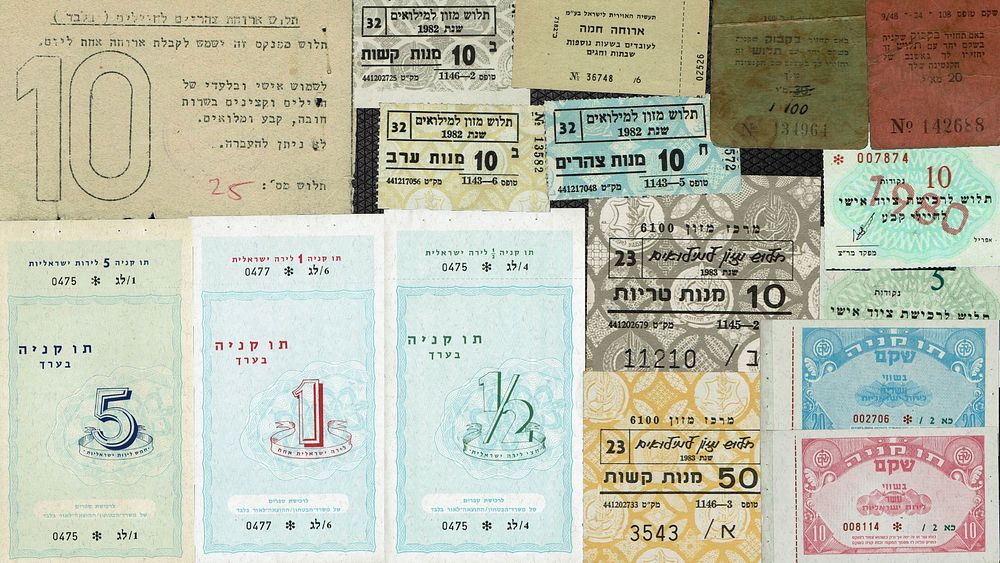
Paper Money Tokens - Palestine / Eretz Israel - Lot of 27 Paper Money Tokens in Subject of Security Forces - The items are graded for rarity according to the catalog “Catalog of Paper Payments Tokens in Israel” by Alexander Golberg. R - 6 to 10 known pieces RR - 3 to 5 known pieces RRR - 1 to 2 known pieces Item details: United Nations Freedom Forces, Gaza Strip - 5 PT (RR), Cigarettes (RR) Ministry of Defense - Purchase Voucher - ½ Israeli Lira (RRR), 1 Israeli Lira (RRR), 5 Israeli Lira (RRR) Ministry of Defense - Catering Division - Breakfast (RRR) IDF (Israel Defense Forces) - Shabbat voucher – Tempo (R), Shabbat voucher – Tempo (R), Shabbat voucher – Mint Candies (R), Shabbat voucher – Fruit Toffee (R), Shabbat voucher – Wafers (R), Shabbat voucher – 1 Wafer (R), Shabbat voucher – Juice Bottle (R), Shabbat voucher – 1 Black Beer (R) IDF - Lunch voucher (RR) IDF - Reserve Duty Food Voucher - 10 Lunch Meals (R), 10 Dinner Meals (R), 10 Dry Meals (not listed in catalog, very rare) IDF - Food Center - 10 Fresh Meals (not listed in catalog, very rare), 50 Dry Meals (RR) IDF - Personal Equipment Purchase Voucher for Regular Soldiers - 5 Points (R), 10 Points (R) IDF - Shekem, Canteen and Cafeteria Services - 20 M.E. (not listed in catalog, very rare), 100 M.E. printed as 30 M.E. (not listed in catalog, very rare) IDF - Shekem Purchase Voucher - 10 Lira (R), 20 Lira (R) Israel Aircraft Industries Ltd. (IAI) - Hot Meal (RRR) Throughout the periods - from the Ottoman rule, through the British Mandate, and up to the early years of the State of Israel - a wide variety of means of payment developed in the Land of Israel, many of which served as substitutes for actual money. Due to a chronic shortage of small change, and in order to facilitate trade and daily transactions, various institutions, cooperatives, factories, and private businesses issued value tokens, payment vouchers, deposit certificates, promissory notes, and trade coupons, which functioned in practice as alternative currency. These forms of payment were often redeemable for cash or goods and services - sometimes only within a specific community or organization - and became an essential part of the evolving local economy. The use of such instruments reflected the spirit of initiative and economic independence that characterized the Jewish community in Palestine, and the aspiration to establish a self-sustained Hebrew financial system even before the birth of the State of Israel and its national currency.