Bidspirit auction | Follower of Buonarroti Michelangelo, Renaissance
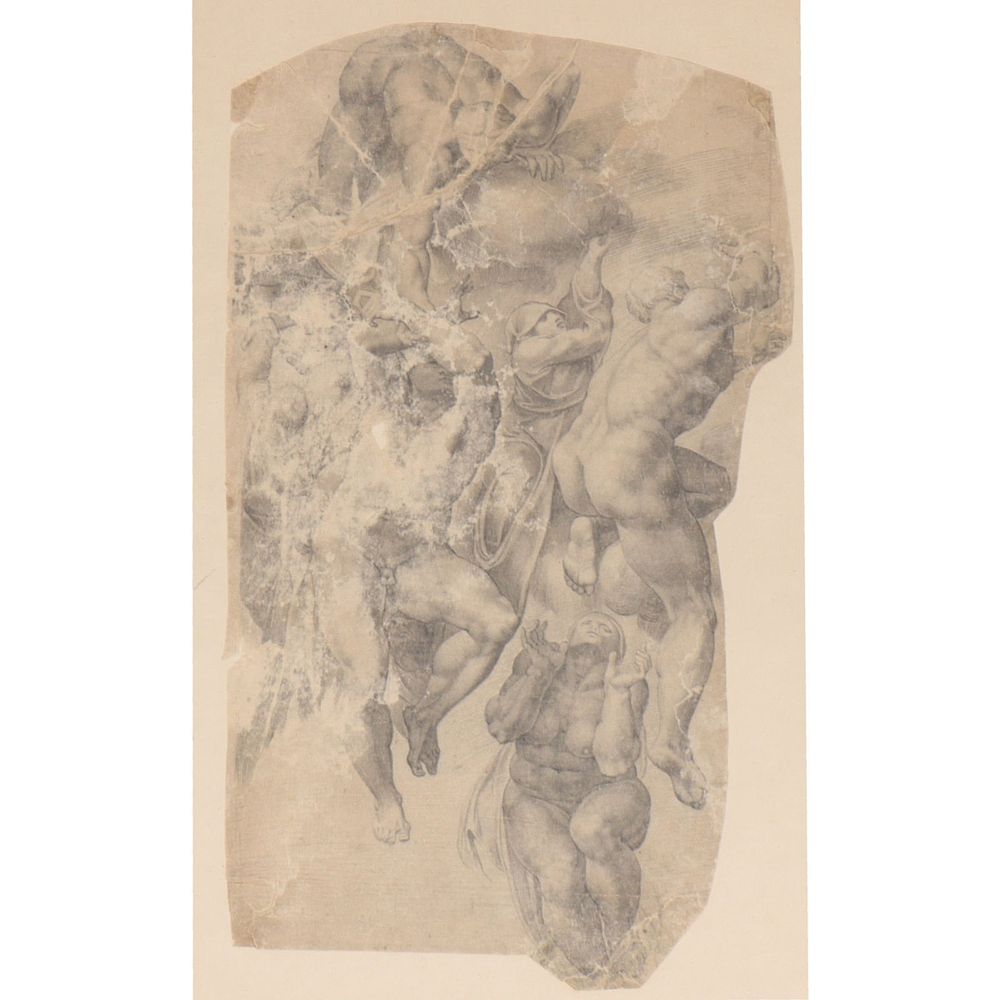
Follower of Buonarroti Michelangelo, Renaissance School (Italy, 16th Century), study after the Last - Follower of Buonarroti Michelangelo Renaissance School (Italy, 16th Century) study after the Last Judgement graphite on laid paper affixed to stabilizing paper unsigned. A highly finished pencil drawing, This is a study of multiple figures on the centre left portion of Michelangelo's 'Last Judgement' fresco in the Sistine Chapel, in the section representing the resurrection of the dead. The drawing is very carefully worked. There are very old repairs and wear to the paper. This work is believed to be completed before actions were taken in 1564 to cover the nudity in the work by decree of the Congregation of the Council of Trent.Michelangelo's The Last Judgment was initially criticized for its rampant nudity and controversial imagery, which went against the reforming ideals of the Council of Trent (1545–1563). While not a direct commission or product of the council, the painting's problematic elements led to a 1564 decision by the Congregation of the Council of Trent to have the nude figures painted over, a task completed by Daniele da Volterra. The Last Judgment was one of the first art works Paul III commissioned upon his election to the papacy in 1534. The church he inherited was in crisis; the Sack of Rome (1527) was still a recent memory. Paul sought to address not only the many abuses that had sparked the Protestant Reformation, but also to affirm the legitimacy of the Catholic Church and the orthodoxy of its doctrines (including the institution of the papacy). The visual arts would play a key role in his agenda, beginning with the message he directed to his inner circle by commissioning the Last Judgment. The decorative program of the Sistine Chapel encapsulates the history of salvation. It begins with God?s creation of the world and his covenant with the people of Israel (represented in the Old Testament scenes on the ceiling and south wall), and continues with the earthly life of Christ (on the north wall). The addition of the Last Judgment completed the narrative. The papal court, representatives of the earthly church, participated in this narrative; it filled the gap between Christ?s life and his Second Coming. The composition Michelangelo?s Last Judgment is among the most powerful renditions of this moment in the history of Christian art. Over 300 muscular figures, in an infinite variety of dynamic poses, fill the wall to its edges. Unlike the scenes on the walls and the ceiling, the Last Judgment is not bound by a painted border. It is all encompassing and expands beyond the viewer?s field of vision. Unlike other sacred narratives, which portray events of the past, this one implicates the viewer. It has yet to happen and when it does, the viewer will be among those whose fate is determined. 20 3/4”H x 14”W Dimensions: 20.75 x 14 in