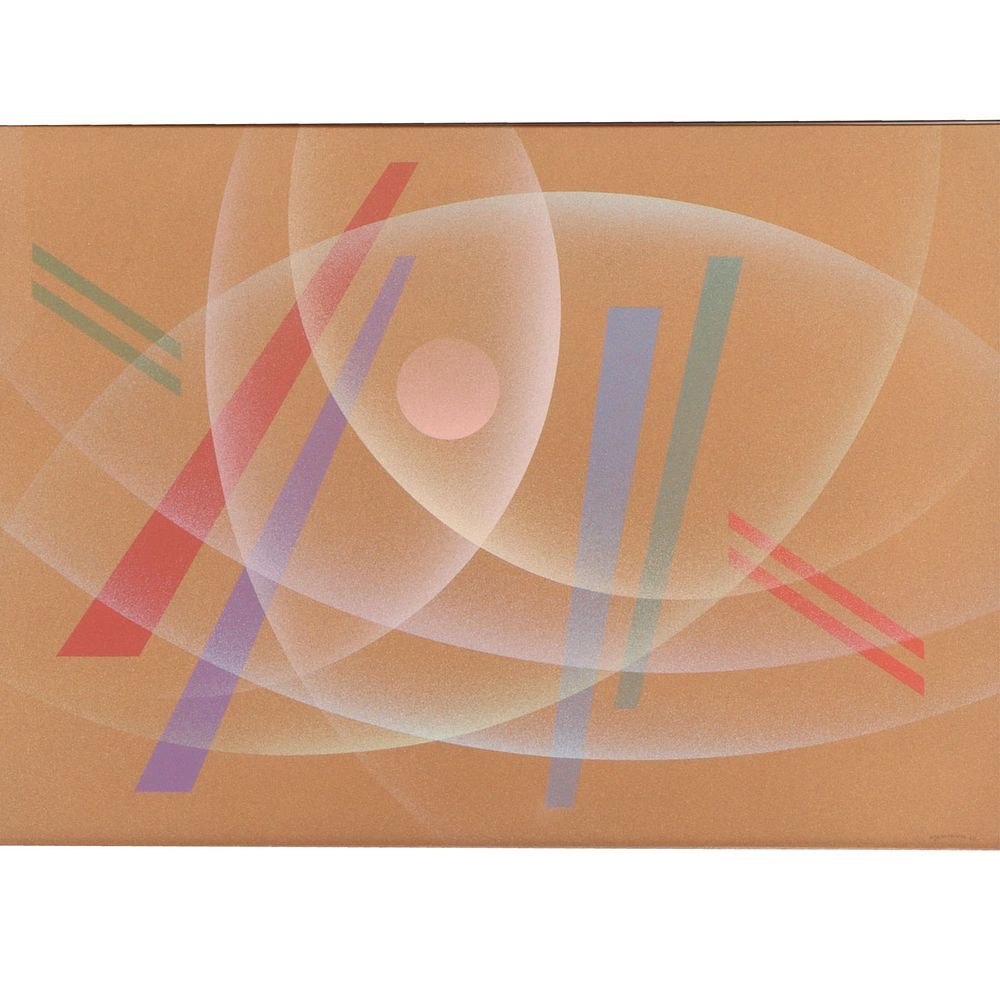
Bidspirit auction | Raymond Jonson, American (1891 -
Raymond Jonson, American (1891 - 1982), untitled no. 11, 1948, watercolor on paper, 19”H x - Raymond Jonson American (1891 - 1982) untitled no. 11, 1948 watercolor on paper Signed and dated lower right. Provenance: Addison Rowe Gallery, Santa Fe, NM; Boise Art Association Collection Biography from Addison Rowe Fine Art: Raymond Jonson was one of the foremost 20th century nonobjective painters in America. Although his celebrity was not that of other painters who traveled to New Mexico, such as Georgia O?Keeffe or Marsden Hartley, his contributions to art were on par with the most celebrated Modern artists. He founded many artist groups in both Chicago and New Mexico, including the Transcendental Painting Group and Cor Ardens. Greatly influenced by Wassily Kandinsky and the Bauhaus artists, he advanced new technologies in American art (e.g. the use of the airbrush and polymer paints), and devoted himself to exploring the spiritual in art. The Jonson Gallery, founded in the 1950, was a permanent exhibition space dedicated to the progression and exhibition of spiritual-nonobjective art. It was not solely Raymond Jonson?s art which made him noteworthy, but his contributions to Art as an innovator, teacher, curator, and mentor. Raymond Jonson was born Carl Raymond Johnson on July 18th, 1891 in Chariton Iowa. Both his parents were Swedish immigrants, and his father, Gustav, was a reverend in the Baptist church. Gustav?s duties to the church required the family to relocate often (Raymond was the eldest of six). Raymond grew up all over the American west and was intimately familiar with the landscape. Raymond?s mother taught him to read and write; he did not attend school until 1899 when his family lived in Colorado Springs, Colorado. In 1902, his family settled permanently in Portland, Oregon (Hartel 20). Johnson showed an interest in the arts from an early age. He was the first student to register for classes at the Portland Art Association School of Art when it opened in 1909. In 1910, at the age of nineteen, Jonson moved to Chicago to continue his art training at the Chicago Academy of Fine arts. During the two years he attended, he received formal art training in composition, color theory, anatomy, drawing from a nude model, oil painting, and commercial design and illustration (Hartel 29). In 1911, Jonson met B.J.O. Nordfeldt who was a teacher at the Academy. Nordfeldt was a mentor and friend to Jonson for the rest of his life and was responsible for converting Jonson to modernist modes of visual expression (Hartel 38; Garman 14). 1913 was a seminal year for Jonson. He viewed the Armory Show the day it opened in Chicago?it left him feeling that, ?artists could now make paintings that freely express their temperament, ideas, and views of the world, and their experiences of the physical reality around them? (Hartel 48). In the same year, he had his first public art exhibition at Third Annual Exhibit of Swedish-American Artists at the Swedish Club in Chicago. There he met Swedish-American painter Birger Sandz?n, who became a lifelong friend and mentor (Hartel 78, 91). Also in 1913, Jonson began working at the Chicago Little Theatre. Hired upon the recommendation of Nordfeldt, his duties included stage-designer, stage-manager, stage-carpenter, scene-painter, sceneshifter, electrician, and, on occasion, actor (Garman 26). He worked at the theatre until it closed in 1917. In 1916, Jonson met Vera White, an amateur musician who worked for the Chicago Little Theatre as a secretary. The two married on December 25, 1916 (Hartel 30). In 1920, Jonson (spelled Johnson at the time) looked through a Chicago phonebook and realized his exact name was only one of many. As an emerging artist, he wanted a way to distinguish himself, yet not dissolve ties to his family and past (Ware interview). When his father immigrated to the United States, he changed his surname from the Swedish Jonsson to the Americanized Johnson. Raymond settled on Jonson [pronounced JOAN-sen] to blend his need for individuality with his past (Hartel 20). Jonson received a copy of Kandinsky?s The Art of Spiritual Harmony in August of 1921. He first viewed works by Kandinsky in 1913 at the Armory show, and the book confirmed many thoughts that he had developed independently. Foremost was Jonson?s fundamental belief that art was a spiritual endeavor and that paintings should be an expression of the spirit. Additionally, Jonson thought of himself as akin to a musician?his wife, brother, sister-in-law, and brother-in-law were all musicians. While working at the Chicago Little Theatre, he manipulated the light for plays as a composer would musical notes (Ware 33). He transferred this concept into his paintings?color wasn?t a stagnant and transparent detail, but a physical object with its own weight and presence: ?Some of us want to do the same thing with color, line, and shape that a musician can do with sound.