Bidspirit auction | David Alfaro Siqueiros, Mexico (1896-1974),
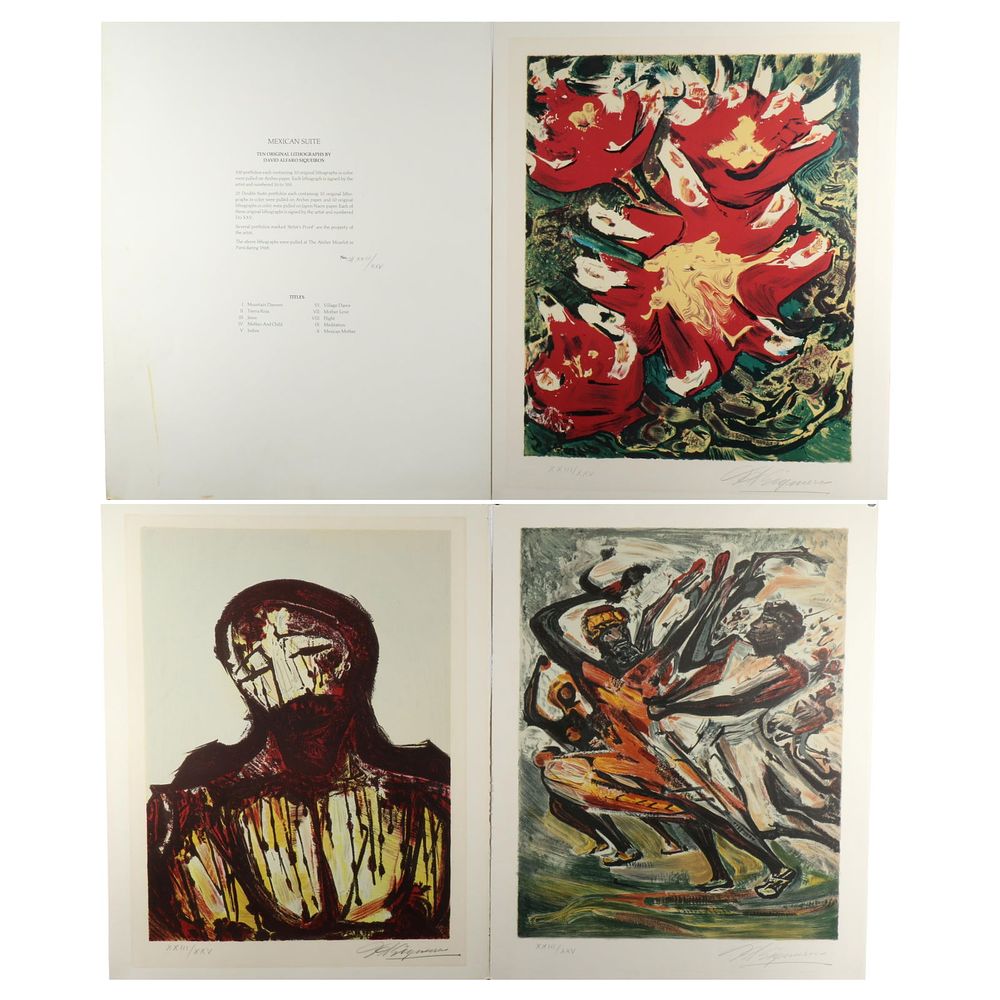
David Alfaro Siqueiros, Mexico (1896-1974), 3 prints from Mexican Suite portfolio, 1968: Tierra - David Alfaro Siqueiros Mexico (1896-1974) 3 prints from Mexican Suite portfolio, 1968: Tierra Roja, Jesus, Village Dance color lithographs on paper all signed and numbered, XXIII/XXV. Atelier Mourlot, Paris. Biography from Lost Art Gallery: One of the three founders of the modern school of Mexican mural painting (along with Diego Rivera and Jos? Clemente Orozco), David Alfaro Siquerios has a style that merges the aesthetics of socialist realism, pre-Columbian art, Cubist handling of forms, and surreal imagery to create compelling and often politically-charged content. For example, in the print Heroic Voice (1971), the artist depicted a statesman surrounded by socialist imagery representative of the struggle of the proletariat. Born on December 29, 1896 in Chihuahua City, Mexico, Sigueriros was a political activist since his youth. He studied at the San Carlos Academy of Fine Arts, Mexico City, before leaving in 1913 to fight in the army of Venustiano Carranza during the Mexican Revolution. Shortly thereafter, Siqueiros moved to Paris where he met Diego Rivera and came under the influence of artists like Paul C?zanne and Pablo Picasso. He then returned to Mexico City and worked as a muralist for ?lvaro Obreg?n?s revolutionary government, during which time he joined the Syndicate of Revolutionary Mexican Painters, Sculptors, and Engravers in support of the recent revolution. In 1922, after returning to Mexico, Siqueiros helped paint the frescoes on the walls of the National Preparatory School and also began organizing and leading unions of artists and workingmen. During the Spanish Civil War (1936?39), Siqueiros commanded several brigades for the Republicans. Over four decades, his labour-union work and his communist political activities led to numerous jailings and periods of exile. In 1940 he was involved in the attempted assassination of Trotsky living in exile in Mexico. Most of Siqueiros?s large murals are in government buildings in Mexico. His murals are distinguished by great dynamism and compositional movement, monumental size and vigour, sculptural treatment of forms, and a limited colour range that is subordinated to dramatic effects of light and shadow. Siqueiros and his followers produced thousands of square metres of vivid wall paintings in which numerous social, political, and industrial changes were portrayed from a left-wing perspective. He commonly used synthetic lacquer colours sprayed from paint guns in order to speed up the process of decorating large public buildings. He also did many easel paintings, the best-known of which is perhaps Echo of a Cry (1937). At the end of his life, Siqueiros participated in the Venice Biennale. The artist died on January 6, 1974 in Cuernavaca, Mexico. Today, his works are held in the collections of the Art Institute of Chicago, The Museum of Modern Art in New York, the National Gallery of Art in Washington, D.C., and the Tate Gallery in London, amongst others. 21”H x 15 1/2”W (Plate), 25 1/2”H x 19 1/2”W (Sheet)