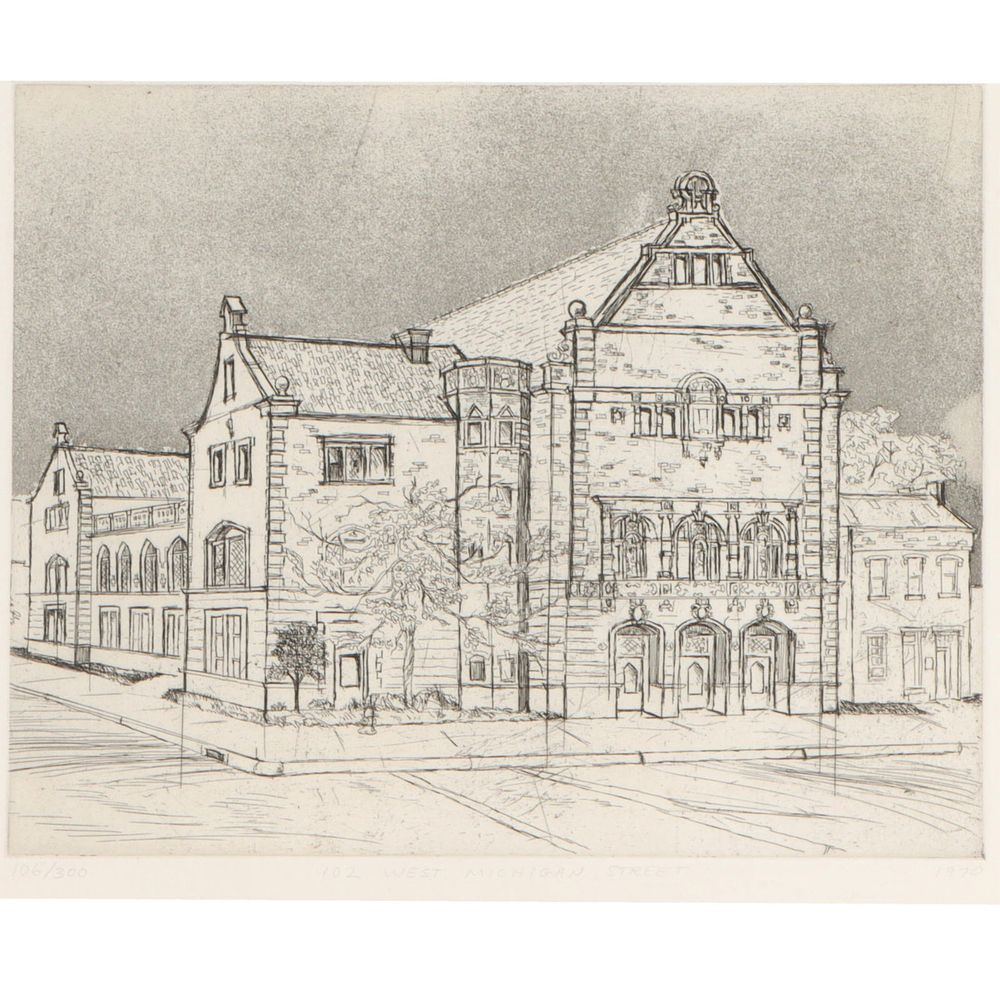
Bidspirit auction | Indianapolis Maennerchor building etching, 102
Indianapolis Maennerchor building etching, 102 West Michigan Street, 1970, Indianapolis Athenaeum. - Indianapolis Maennerchor building etching, 102 West Michigan Street, 1970, Indianapolis Athenaeum. Edition 106/300. Sam Smith Fine Art Display Systems, Indianapolis, IN label verso. Provenance: From the estate of Jim and Anna White, Indianapolis, IN From Historic Structures: The Maennerchor Society had it origins among the Germans who had come to the United States after the revolutions of 1848 in Europe. Among the ways that they sought to retain the culture of the country they had left was to sing the old songs and accustom themselves to American beer. In June, of 1854 a small group formalized their relationship and formed the Maennerchor. They gave their first concert on May 28th, 1855. During the rest of the nineteenth century the Maennerchor occupied several buildings in the downtown Indianapolis. The decision to allow non-participating members in the organization resulted in an increase in membership and wealth for the Maennerchor. They used this new ability to finance the Maennerchor Building; a headquarters designed especially for their musical and social needs. In the middle of June 1906 the cornerstone was laid for the new building with pomp, ceremony, and singing. The presence of Vice-President Charles W. Fairbanks, James Whitcomb Riley, and German Ambassador Baron Von Storberg, as honored guests and speakers attest to the importance of the event. The new building enabled the Maennerchor to continue its tradition of bringing world renown performing artists to Indianapolis. John P. Frenzel, Benefactor and music lover, went to Europe to engage performers for the Maennerchor. Until the mid 1930's when Frenzel's death marked the end of both his financial and personal help the Maennerchor saw three to six major concerts each year in addition to their regular singing programs. Among those who came there were the Flonzaley String Quartet which appeared almost yearly from 1911 to 1928, Pablo Cassels and his wife, Susan Metcalf Cassels in 1917, Gregor Piatigorsky in 1928, Joseph Szigti in 1927, 1928, and 1929, Georges Ensco in 1929, and 1932, Vladamir Horowitz in 1935, and the Budapest String Quartet in 1935. In 1935 the Maennerchor began rehearsing the Athenaeum and in December of 1936 they gave their first concert there. This marked the end of the association of the Maennerchor and the Maennerchor building although the Maennerchor Society still meets and sings in Indianapolis. Incidental to its long-range development the Maennerchor became a symbol of anti-German feelings during World War I, when the name Maennerchor and the script verse were removed from the building and replaced with the ”Acadamy of Music” on April 15th, 1918. During World War II, the building served as a local Service Men's Center and was a nightclub for a short time. In 1946 the Maennerchor started a new career when Indiana University made it the home of their Indianapolis law school. They moved to a new building in 1970. The Maennerchor, along with the Athenaeum serves as an example of the importance of German-Americans in Indianapolis and of what these people thought was important to society. It was the building in which some of the best music heard in Indianapolis was presented. For twenty-four years many Indiana lawyers received their education in the Maennerchor. In 1974, the American States Insurance Company purchased the landmark building and promised to donate it to any group that could find a use for it. A company spokesman said ”You don't have to worry about us tearing the building down, I'm sure you can come up with a workable solutions. We actually want you to do something with the Maennerchor.” American States Insurance placed a six month deadline on its offer, a very short time to develop plans and raise funds for restoration. A coalition of art and historic preservation groups obtained sufficient funds to meet the taxes and maintenance costs of the building for one year if the company would defer demolition. The American States Insurance Company refused, and had the building demolished. 12 1/2”H x 15 1/4”W(sight), 18 3/4”H x 21”W(frame)