Bidspirit auction | Byron Leslie Burford, American (1920-2011),
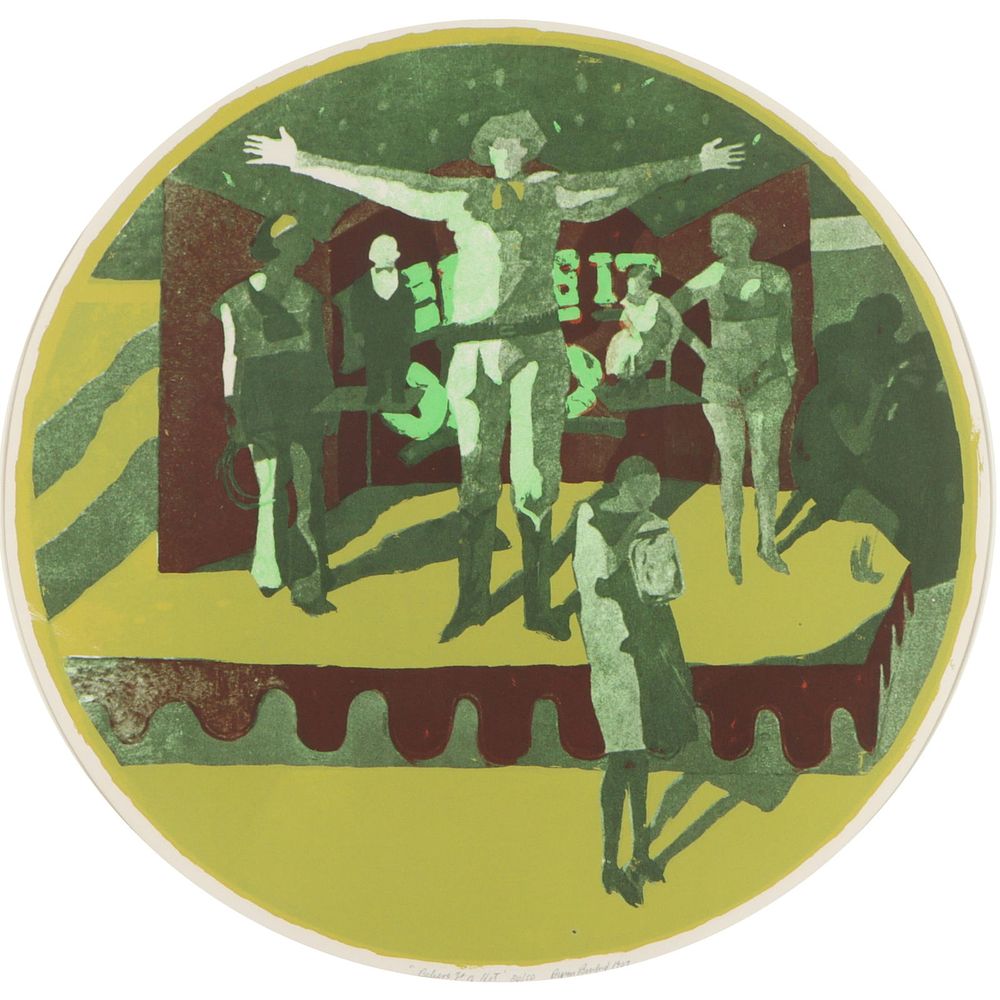
Byron Leslie Burford, American (1920-2011), Believe it or Not, 1967, screenprint, 21 1/2”Diam. - Byron Leslie Burford American (1920-2011) Believe it or Not, 1967 screenprint Pencil signed and dated lower right, edition 30/50. Biography from the Archives of askART: Byron Leslie Burford (1920- ) was born and raised in Mississippi but adopted the Midwest as his lifelong home after attending college at the University of Iowa. Soon after graduation, he accepted an invitation from department chairman Grant Wood to join the faculty, where he became head of Painting until his retirement in 1985. Although influenced by the Midwest Regionalist* movement, Burford essentially is a figurative* artist with a distinct and recognizable realist style that often places his subjects in their own defining context: circus performers at work, beachcombers gazing out to sea, explorers at leisure in their cramped cabin, jazz musicians with their instruments, a publisher picking through the ruins of his letter press after a mob has destroyed it, etc. A prolific oil painter, he has also worked in a wide variety of other media from limited edition prints and engravings to acrylic and even hot wax on canvas. The size of his works has been equally varied, ranging from huge, double-panel oils to tiny miniatures. Over a long and productive life, the sense and subject matter of his works have varied, as well. His earliest drawings, silk screens*, stone lithographs*, and oils include what might be termed a ”Mississippi protest” period peopled by ordinary but oppressed African-Americans, of which few drawings and prints are believed to have survived; and a ”blue period” characterized by a variety of shades of blue and purple that often cast a dark and somber mood. Later periods include a miniature period of very small paintings; his notable ”Antarctic explorer” series of paintings and prints about boyhood hero Robert Scott; the ”Jazz” series of musicians and orchestras; and the well known and widely exhibited ”Circus” paintings and prints, inspired by Burford's summer travels with a regional circus (with whom he sometimes performed, himself, as the circus band's drummer.) After retirement as an art professor, perhaps in an unconscious counterpoint to his early ”blue period, ” Burford began creating a series of oils, acrylics, and prints suffused with bright reds, oranges, pinks, yellows, and greens. Byron Burford has received multiple prestigious awards and grants, including from these Sources include: American Academy of Arts and Letters Purchase Awards; Tamarind Fellowship; National Endowment for the Arts Grant; Yaddo* Fellowship; American Federation of Arts Grant; National Institute of Arts and Letters Grant 1972; J.S. Guggenheim Fellowship; Ford Foundation Award; and the Julius Rosenwald Fellowship*. His works are included in many U.S. and foreign collections open to the public. In the U.S. this includes the National Museum of Art, the Smithsonian, the Walker Art Museum (Minneapolis), the Nelson Gallery (Kansas City), the Guggenheim Foundation (New York), the San Francisco Museum of Art, the Des Moines Art Center, the Joslyn Art Museum (Omaha), the Davenport Municipal Art Gallery, Eastman House (Rochester, NY), the High Museum of Art (Atlanta), the Sheldon Memorial Art Gallery (Lincoln) and the University of Iowa Art Gallery. Submitted November 2003 by John Barrett who wrote: ”I have collected a few Burford works over the years and knew one of his daughters 40 years ago. 21 1/2”Diam. (sight), 28”H x 27 3/4”W(frame)