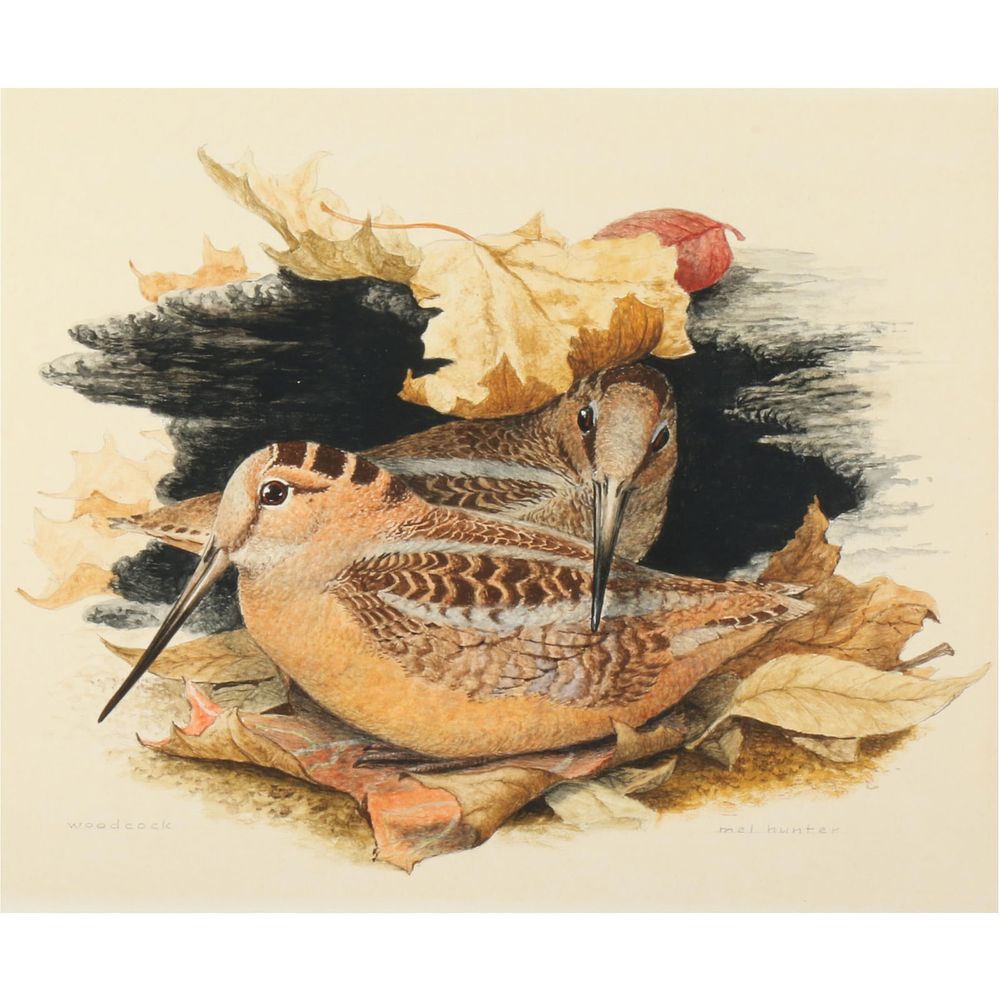
Bidspirit auction | Mel Hunter, Vermont (1927-2004), Woodcock,
Mel Hunter, Vermont (1927-2004), Woodcock, gouache on board, 8”H x 10”W (Board) - Mel Hunter Vermont (1927-2004) Woodcock gouache on board signed lower right. Biography from the Archives of askART: He entered college a year early. After college, he held a variety of jobs, from pumping gas to writing copy for an insurance firm and selling insurance on a Fair circuit. Eventually he traveled to the West Coast in search of employment. In 1950, Mel made up his mind to pursue a career in art and decided to teach himself illustration skills, which he did after work, on weekends and all other spare time, working at his kitchen table. Following three years of steady effort, the self-taught artist sold his first color cover idea to Galaxy Magazine. He also talked himself into a job as technical illustrator at Northrop, where he painted pictures for the Pentagon of advanced interceptors and pilot less bombers in hypothetical combat situations. During this time he was a member of a group of Science Fiction greats such as Isaac Asimov, Sprague deCamp, Robert Heinlein, Fred Pohl, Lin Carter, L. Ron Hubbard and John Campbell, Jr. among others. From 1955 to 1971, among many other themes, Mel painted 15 covers for the Magazine of Fantasy and Science Fiction depicting a lone robot ( The Last Man) moving through bleak landscapes that suggested a post-nuclear holocaust, bravely acting out human rituals. These Cold-War images have received quite a bit of interest during the ensuing years. A year later he resigned and moved to New York as a free-lance illustrator for magazines and books. He launched a career of scientific illustration, doing such technically accurate subjects as 26 paintings of celestial objects in 1964 for the Hayden Planetarium and later recording such advanced technological developments as drawing board jet bombers, missile launchings at Cape Kennedy and a revolutionary lunar manned base. His scientific drawings and paintings appeared in dozens of major publications. In the early 1960's Hunter also wrote the documentary text and shot photographs for two successful books of photojournalism published by Doubleday; The Missilemen and Strategic Air Command. He flew with SAC crews, talked with the pilots, stood on alert with them in Spain, flew a refueling mission about the Arctic Circle, sat in a honeycombed blockhouse observing the countdown on an Atlas SM-65 and traveled more than halfway around the world to get the full story-in text and photograph- of the men, the weapons and the strategy of Strategic Air Command. Mel spent fifteen years traveling the world on assignments as a major magazine and advertising illustrator specializing in the physical sciences, astronomy and advanced space and weapons technology. He produced over nine hundred drawings and paintings in those fields. In the late 60's, Mel owned and distributed the Cessna/Wren seaplane from the North Star Airpark in Brooklyn. After 17 years of successful science illustration, Mel moved from New York City to Chester, in southern Vermont during the summer of 1967. He established his home and studio in a farmhouse high on a forested hill where he began depicting the land, animals birds and changing seasons of his rural, semi-wild environment. During that first winter, he tells of having to wear gloves to eat dinner, since frigid wind blew through cracks in the walls. The following year, Abercrombie & Fitch Galleries and Massachusetts Audubon Society commissioned Mel to do a series of more than 130 watercolors of Birds of the Northeast and in 1970, he signed a contract with World Publishing Co. for the development of a series of 13 ecological books for children. Titles dealt with the beginning of the earth, mankind, plants, birds, mammals and insects. He produced an entire ecology calendar for General Motors in 1974. For the World project, Mel pioneered techniques for pre-separated color drawings using DuPont Mylar as a drawing surface. This process greatly reduced the cost of color-illustrated books and furthered his career by opening the way for his later fine art lithography prints. However, over the next four years, he created 54 editions using traditional stone lithography techniques. Since 1971, Mel received commissions for scores of multi-color lithographic editions Some of his publishers have been Circle Gallery, Roten Collection, Mill Pond Press, Franklin Mint, HMK Fine Arts, Fine Arts 260 as well as his own Atelier North Star and Polaris Press. In 1975, Mel and his wife moved to Grafton, Vt., a foundation-funded, revitalized community where he founded Gallery North Star and Atelier North Star. Over the next eight years Gallery North Star successfully featured prints from his then 82 limited editions and selected work from other artists. Mel did his own printing in the Atelier, at first using the traditional technique of drawing on thick blocks of Belgium limestone. This meant hauling stones which often weighed 400 pounds,