Bidspirit auction | Historic Discovery! Sefer Eitz Chaim
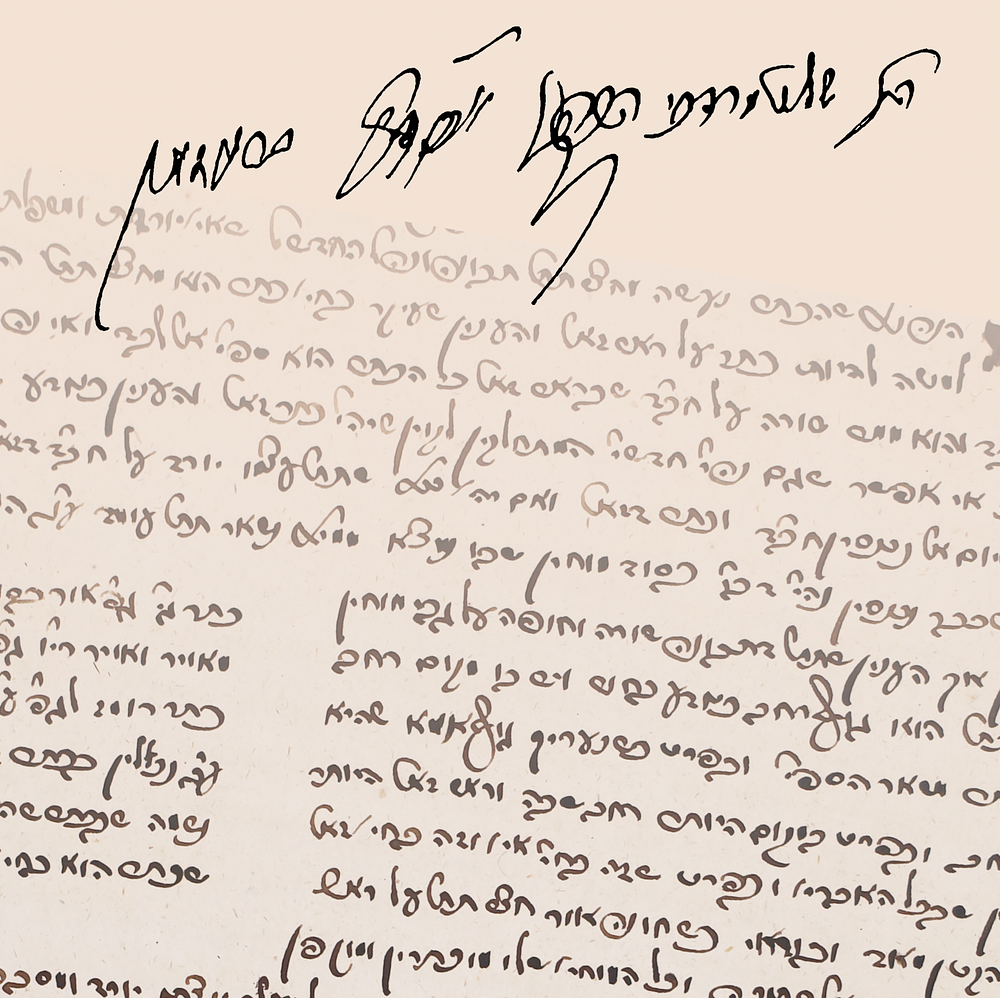
Historic Discovery! Sefer Eitz Chaim – R. Chaim Vital – Large Folio Manuscript – Central Europe 18th Century, Personally Owned by The Maharsham of Berezhany and R. Moshe Aryeh Freund - We are pleased to present this historic and important treasure which is being offered here on auction for the very first time. The importance of this manuscript cannot be overstated. Besides for its unparalleled Rabbinical provenance, as detailed below, it also contains textual variations not found in the printed editions, making this manuscript a true treasure for researchers, scholars and collectors alike. The manuscript is written in beautiful Ashkenazic script, in a style typical of the mid-18th century, on thick high-quality paper. As mentioned above, it contains textual differences from both the first edition (Koretz 1782), as well as from the Shklov edition which appeared in 1800. Please refer to the Hebrew description for a small sampling of the textual variations. Seen on several pages of the manuscript are handwritten glosses, likely from the late 18th century, in various hands. ************************** This manuscript was owned by R. Shalom Mordechai Hakohen Schwadron – also known as “The Maharsham”, and author of Da’as Torah (and others), with his personal autograph on the flyleaf. It was presented to him as a gift, a member of the community, who writes as follows: “In honor of our holy master Maharsham Hakohen, this is a gift from Avraham Yehuda ben Feiga”. Beneath that inscription, the Maharsham adds his holy autograph: “Hakatan Shalom Mordechai Hakohen Av Beis Din Berezhany”. Please refer to the Hebrew translation of this description for the original transcription of the text. Interestingly, see Da’as Torah (Yoreh De’ah Siman 36), where he quotes “my disciple R. Avraham Yehuda…” – can this be the same disciple who presented him with the manuscript? Slightly beneath his autograph is the ownership stamp of R. Moshe Aryeh Freund, who owned this manuscript while serving as Rav of Satmar. Although we cannot reach any conclusive findings, it would be reasonable to assume that R. Yoel Teitelbaum – who served as Rav of Satmar during this period – would have likewise used this very manuscript too, as R. Moshe Aryeh was his close disciple and confidant. This volume contains Shearim 1-24 (Sha’ar Haklalim through Sha’ar Derushei Hatzelem); the second volume is not present. We do not know if in fact it ever reached the hands of The Maharsham. R. Shalom Mordechai Hakohen Schwadron (1835-1911), one of the foremost Poskim throughout Galicia and Poland during the late 19th and early 20th centuries. He was known as the “Rabban shel Kol B’nei Hagolah” – leader of all diaspora, and he was quite literally so, as Halachic queries were sent to him from all around the globe. During his youth, he was a staunch follower of R. Shalom Rokeach of Belz – The Sar Shalom, and in later periods, he frequented the courts of Seretin and Ziditchov. R. Moshe Aryeh Freund (1903–1996), Av Beis Din of the Eidah HaChareidis in Jerusalem from 1979 until his death. He was born in Bonyhad, Hungary, to R. Yisroel Freund, the local Av Beis Din, and grandson of the Admor of Nasod, R. Yehoshua Freund. Prior to the outbreak of WWII, he served as Rosh Yeshiva and Av Beis Bin in Satmar, Romania. He was the sole survivor of his family, as his wife and nine children were murdered by the Nazis. Rebuilding his life after the war, he immigrated to Eretz Yisroel in 1951, leading the Satmar community in Jerusalem and authoring the seminal halachic work Ateres Yehoshua, by which he was affectionately known. Renowned for his piety, zealotry, and unyielding commitment to traditional Judaism, he influenced generations of students and was succeeded by R. Yisroel Moshe Dushinsky and R. Yaakov Fisher upon his passing at age 92. ************************** Manuscript Description: [126] leaves, handwritten on thick, high-quality paper. Measures approx. 38.5cm. Bound in a late 19th or early 20th century simple cloth binding. Ownership inscriptions are seen on the opening leaf, which indicates that this was the very binding as used by the Maharsham. The opening [8] leaves were intentionally left blank, with ownership stamps appearing on most of them. Pages 9-126 are fully handwritten in neat Ashkenazic script. Handwritten corrections are seen on some pages, with marginal glosses scattered throughout by unidentified writers. Light staining and some worming seen on some pages, not affecting text. Cloth spine slightly damaged.