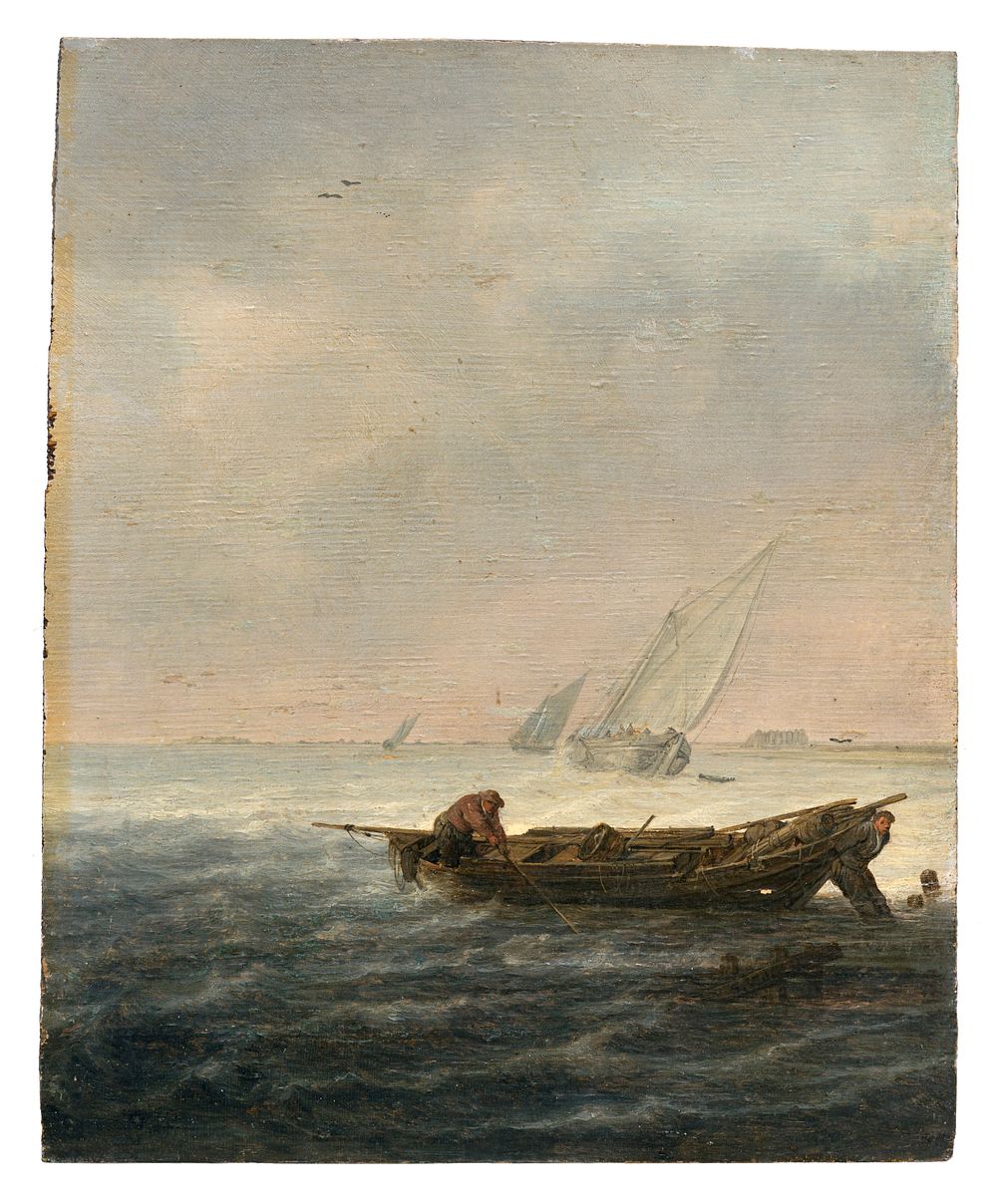
Bidspirit auction | Simon Jacobsz de Vlieger
Simon Jacobsz de Vlieger - Simon Jacobsz de Vlieger ”Küstenlandschaft” (costal landscape) of the collection of George V., last king of Hannover. 1630''s or early 1640''s.. Simon Jacobsz de Vlieger um 1601 Rotterdam – um 1653 Weesp Georg V. von Hannover 1819 Berlin – 1878 Paris Jacobus Reimers 1850 Hatshausen – 1914 Berlin Wilhelm von Bode 1845 Calvörde – 1929 Berlin Paul Cassirer 1871 Breslau – 1926 Berlin Hugo Helbing 1863 München – 1938 ebenda Oil on oak board. Right section of a formerly larger painting. Panel shortened on the left and top edges. Later cradled. In a black varnish frame with a brass plate inscribed ”Simon de Vlieger” and with the provenance information ”Erwerb a.d. Braunsch. Lünebg. Fideikom. Galerie”. Not in the Kelch catalogue raisonné Kelch. Will be included in the Tak Labrijn catalogue raisonné. Provenance: Private Collection Dresden; 1926 Auction Berlin; 1886 Provinzialmuseum Hannover; 1872 – 1886 exhibited in the Landschaftsstraße 3, Hannover; 1869 Welfenmuseum, Herrenhausen Castle; 1862 Welfenmuseum, Hannover; Private Collection of the House of Welf. Registered in: RKD, The Hague, RKDimages Lite database, no. 212512. Paul Cassirer; Hugo Helbing: Alte und neuere Meister der Fideikommiss-Galerie des Gesamthauses Braunschweig-Lüneburg: Versteigerung 27./28. April, Berlin 1926, cat. no. 171. Jacobus Reimers (ed.): Katalog der zur Fideikommiss-Galerie des Gesamthauses Braunschweig und Lüneburg gehörigen Sammlung von Gemälden und Skulpturen im Provinzialmuseum zu Hannover, Hannover 1905, cat. no. 579. Oskar Eisenmann: Gemälde-Sammlung, in: Katalog der zum Ressort der Königlichen Verwaltungs-Kommission gehörigen Sammlung […] im Provinzial-Museumsgebäude, Hannover 1891, pp. 64–255, cat. no. 583. Das Königliche Welfen-Museum zu Hannover im Jahre 1863, Hannover 1864, cat. no. 86 with p. 18 (for the provenance). The ”Coastal Landscape near Biervliet” and the Collection of King George V of Hanover In 1861—1862, on the initiative of King George V of Hanover, the Royal Welfenmuseum (Museum of the House of Welf) was founded in Hanover (initially on Jägerstraße, since 1862 on Adolfstraße) to present old Welf collections. The present ”Coastal Landscape” was part of that. Due to the Prussian annexation of Hannover after the German-Austrian War in 1866, George V left his kingdom. From then on, the art collection was administered as an entail by the city of Hanover (called Fideikommiss des Gesamthauses Braunschweig-Lüneburg). The artworks, however, remained in the museum. In 1869, the Welfemuseum was moved to Herrenhausen Castle, where it was merged with a ”family museum” (founded 1852). From 1872 to 1886, the painting was temporarily stored in a gallery building on Landschaftsstraße 3, Hanover. When the extension (Prinzenstraße) of the Provincial Museum Hannover (Sophienstraße) was completed in 1886, the collections, including the ”Coastal Landscape”, were henceforth exhibited there. 1892–1893 negotiations took place between Duke Ernst August of Hannover and public institutions. It was agreed that the paintings – as a temporary loan – would remain in the Provincial Museum and presented as The Gallery of the entailed Estate of the House of Brunswick and Lüneburg (i.e. the House of Welf). In 1925, however, the entail was dissolved, allowing the Welfs to sell off parts of their property. ”The Coastal Landscape near Biervliet” was auctioned in 1926 by Hugo Helbing and Paul Cassirer in Berlin. In the foreword to the auction catalogue, the painting was explicitly authorized as authentic by Wilhelm von Bode. See: Otto Jürgens, Die Entstehung der stadthannoverschen Museen, Hannoversche Geschichtsblätter 13 (1910), pp. 248—255, here pp. 211—219. Simon Jacobsz de Vlieger – A journey to Biervliet Gillis Tak Labrijn An overcast sky and a strong wind form the scenery for peaceful everyday activities such as fishing and shipping. Although they are only suggested in a few brushstrokes, the presence of fortifications in the background bears witness to an imminent military threat. These defenses were part of the Dutch-Spanish Lines, a chain of fortified towns and forts along the borders of the Dutch Republic and the Spanish Netherlands, particularly in the Scheldt Delta covering the provinces of Zeeland and present-day North Brabant. Along these borders, Spanish troops fought with the armies of the successive Stadtholders, Princes Maurice and Frederik Hendrik of Orange-Nassau, during the Eighty Years'' War. Even if the painter restrains from depicting landscape details, the scene nevertheless lends itself to topographical identification. Considering that the stone fortress on the horizon must be of substantial size and situated almost directly on the water, in addition to the absence of urban details such as tall church towers, as well as the apparent width of the river, the fortress of Biervliet presents itself as the most likely option. By lack of convincing resemblance,