Bidspirit auction | Jean-Jacques Spoede
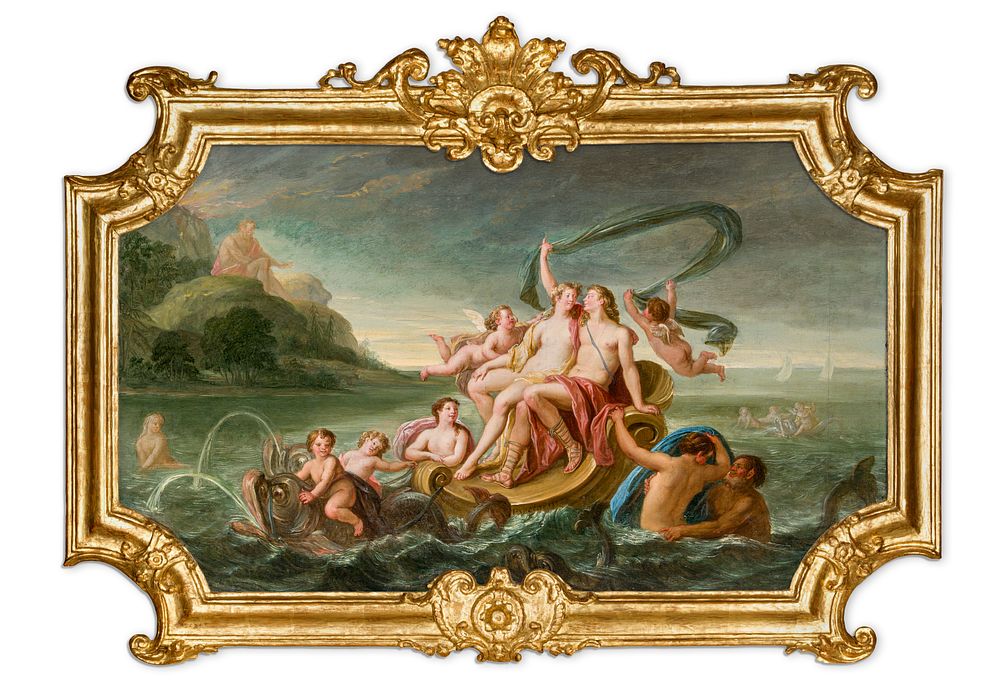
Jean-Jacques Spoede - Jean-Jacques Spoede, Acis and Galatea. 1723 or 1725.. Jean-Jacques Spoede circa 1680 Antwerp – 1757 Paris Oil on canvas. Signed and partly indistinctly dated ”J. Spoede 1723 [25?]” on the base of the shell boat. Verso in fibre-tip pen with a younger numbering ”108363” upper right, on the central stretcher bar with the brand-stamped numbering ”I”. In the magnificent, original, carved and gilded Rococo ornamental frame. Possibly originally conceived as a supraporte in an interior context. Provenance: German private collection; Weichmann Art Auction, Wiesbaden, 1976. For stylistically comparable paintings by the artist, cf. RKD, The Hague: ”The four elements represented by Jupiter and Juno (air), Neptune (water), Vulcan (fire) and Ceres (earth)”, 1726, oil on canvas, 69 x 89 cm, rkd.nl.images/24387. ”Apollo and the seven Muses”, undated, oil on canvas, 79 x 63 cm, rkd.nl.images/27650. as well as: ”L' Hommage à Cérès”, 1726, oil on canvas, 88.5 x 117 cm, Christie's, Paris, Intérieurs parisiens, 15.07.2020, Lot 115. The story of Acis and Galatea originates from Greek mythology, handed down in Ovid's Metamorphoses. The Nereid Galatea falls in love with the handsome shepherd Acis, a mortal youth from Sicily. However, the Cyclops Polyphemus also loves the sea nymph, but his love remains unrequited. When he sees the two lovers together, he is seized by raging jealousy and tears a huge boulder from the mountain to hurl it at Acis. The young shepherd is killed. Galatea, distraught over the death of her beloved, saves him at least partially and transforms his blood into a river, which from then on bears his name – the river Acis in Sicily. The present painting shows the moment of happiness of the loving couple, before Polyphemus, observing them from a distance sitting on a rock, hurls the boulder. ”The name Jean Jacques Spoede does not appear in most histories of French art, although he was a friend of Watteau and gained reputation during his career, eventually becoming director of the Académie de Saint-Luc in Paris. [...] Most scholars writing about Watteau have only mentioned Spoede in passing. Apart from occasional references to the still lifes and mythological subjects he exhibited during his lifetime or that were in private collections, no serious attempt has been made to define his oeuvre. This situation has changed dramatically, especially in the last 25 years. Today, the catalog of Spoede's surviving paintings and drawings has expanded considerably. Yet despite this numerical increase, we know very little about this Flemish-born artist, especially about his early years in Paris. On a previous occasion, I put forward the thesis that there was a connection between his work and that of Claude Gillot and Antoine Watteau. These conclusions can now be supported by the discovery of a large collection of Spoede drawings in the Bibliothèque nationale, which clarifies the relationship between the three men.” (quoted from: Martin Eidelberg: Jean Jacques Spoede, Gillot's Forgotten Assistant and Watteau's Special Friend. In: Watteau and his circle. 2020. http://watteauandhiscircle.org/Spoede.html, accessed on 24.04.26). Lit.: Martin P. Eidelberg: Jean Jacques Spoede: Watteau's ”Special Friend”. In: Gazette des beaux-arts. Series 6, Vol. 136, 2000, pp. 179–196. Support old-relined, browned verso. Paint layer with inconspicuous age-related craquelure and slight climate edge. Several small, professionally executed retouches distributed over the picture surface, e.g. in the angel's wing centre, and lower left in the background landscape. Frame overgilded with gold leaf, a few small retouches and two horizontal cracks at the frame joints lower left and lower right. Dimensions: 49.5 x 81 cm, Frame 68.5 x 92 cm. Jean-Jacques Spoede circa 1680 Antwerp – 1757 Paris Also Johan or Jan Jacob. Son of the sculptor Jacobus Verspoeden and brother of the printer Jean-Baptiste Spoede. Moved to Paris before 1709 and joined the Franco-Flemish artistic community. Associated with A. Watteau and Claude Gillot, among others; Edme Gersaint referred to him as Antoine Watteau's ”special friend” in connection with the sale of a painting to the art dealer Pierre Sirois. Studied at the Académie royale. Entered the Académie de Saint-Luc, where he exhibited from 1751–53 and later received the permanent directorship. Versatile artist, painted history paintings as well as still lifes, genre scenes, and animal pieces, also known as a draughtsman. Traditionally considered Maurice Quentin de La Tour's teacher, in reference to J. P. Mariette, who probably confused his name with that of Dupouch, with whom La Tour, as we now know, apprenticed.