Bidspirit auction | Raffael Sanzio da Urbino
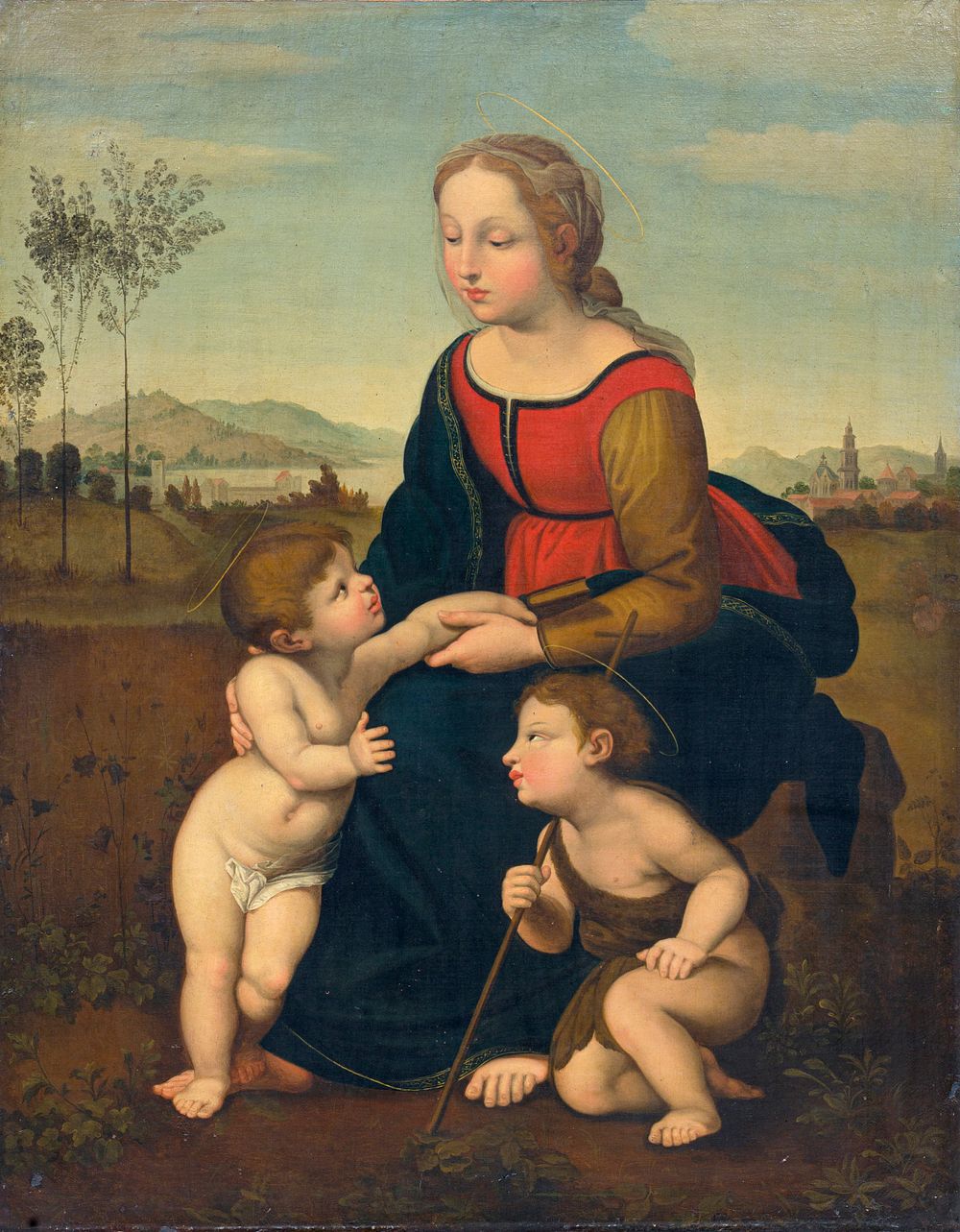
Raffael Sanzio da Urbino - Raphael Sanzio da Urbino (after) ”Madonna with Child and St. John the Baptist”. Circa 1507/1508. Format-altered copy from the early 19th C.. Raphael Sanzio da Urbino 1483 Urbino – 1520 Rome Oil on canvas, relined. Unsigned. Framed in a gold-coloured, mass-ornamented decorative frame with corner and centre-emphasising décor. The original by Raphael, also known as ”La Belle Jardinière”, was created shortly before the artist moved from Florence to Rome. It is the last of a small group of similarly conceived depictions of the Virgin Mary, created in Florence between 1504 and 1508. Cf. Musée du Louvre, Paris, Inv. No. 602 and MR 433 (oil on canvas, 122 x 80 cm). Stretcher edges of the support with continuous paper lining. Paint layer partially with early shrinkage craquelure. Pinpoint small paint losses, some toned without filling. Several old retouches under the varnish, including a circular one (approx. 4–5 cm) right middle in the background. Varnish yellowed, with small specks on the surface. Stretcher frame renewed during a restoration. Dimensions: 114 x 89 cm, Frame 128 x 105 cm. Raphael Sanzio da Urbino 1483 Urbino – 1520 Rome With his idealistic pursuit of beauty, Raphael became the most important painter of the High Renaissance in Italy. The talented boy probably received his first artistic training from his father Giovanni, who, however, died in 1494 – three years after Raphael's mother. As an orphan, he thus entered Perugino's workshop, whose work he initially emulated (e.g., The Marriage of the Virgin, 1504, Milan, Pinacoteca di Brera), but already at 17, he worked as an independent master in his Umbrian homeland. Between 1504 and 1508, he stayed longer in Florence and finally came to Rome in 1508, where he created his most famous works: e.g., the frescoes of the Vatican Stanze (1509–1517), the Sistine Madonna (1512/13, Dresden, Gemäldegalerie Alte Meister) and, of course, the Transfiguration of Christ (1516–1520, Vatican Museums).