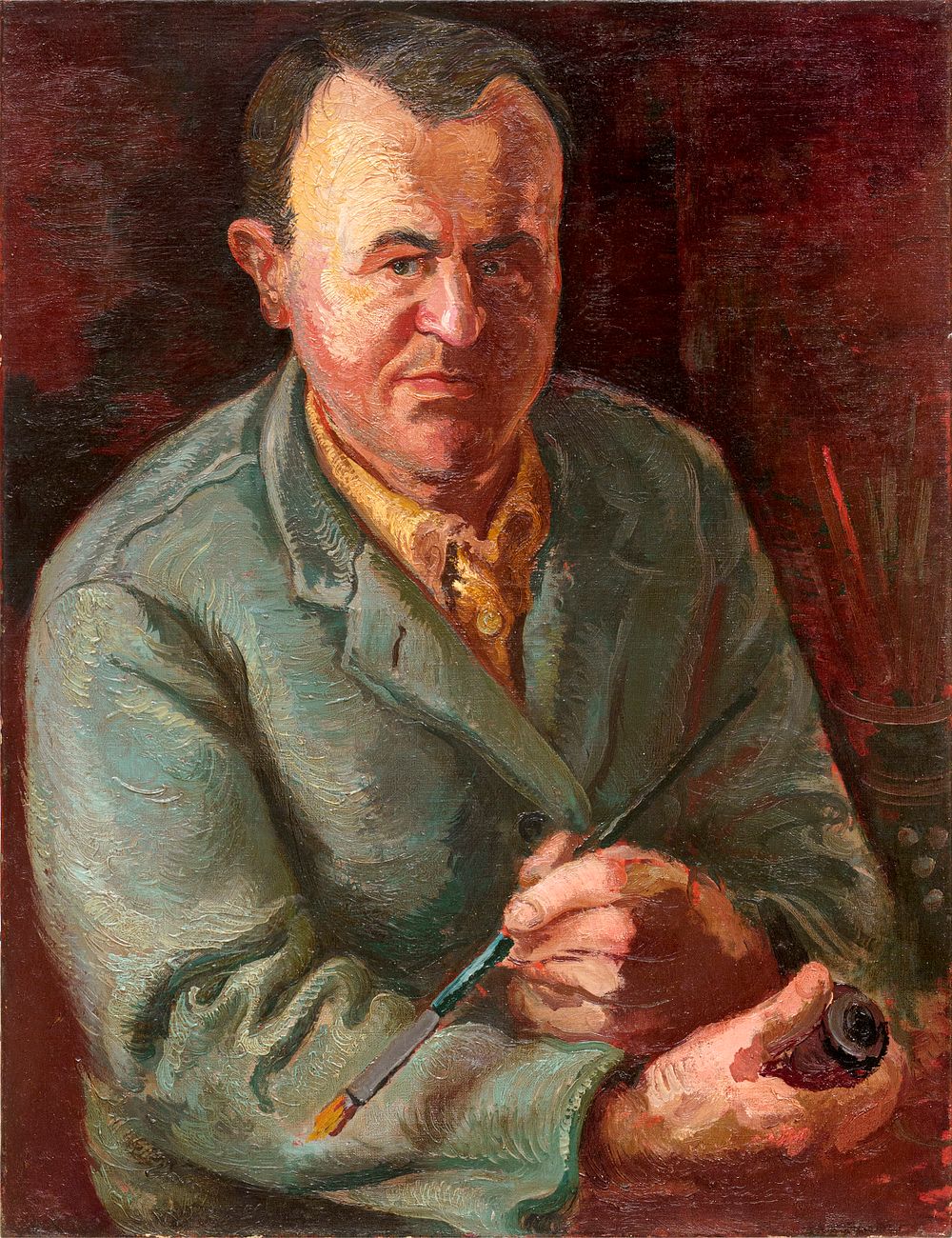
Bidspirit auction | George Grosz
George Grosz - George Grosz ”Self-portrait with Paintbrush” (Self-portrait with brush). 1938.. George Grosz 1893 Berlin – 1959 there Oil on Parisian canvas. Verso upper center signed in black brush, dated and inscribed with place ”George Grosz 1938 January DOUGLASTON L[on]g. Isl[and]” and lower right with the artist's estate stamp and numbering ”1/7/6”. On the upper stretcher bar, probably by the artist's hand, numbered ”X-II” in black ballpoint pen, titled, and right numbered ”B. 8350” in blue pen. The side stretcher bars with various numberings in white chalk, the lower one with a manufacturer's label ”20 Paris deposé P / 73 x 54” and again with the estate number ”1/7/6”. On the central stretcher bar numbered ”CK 158” in blue chalk, a numbered adhesive label ”MUN 7513”, a title struck through in brown paint, and an indistinct inscription in lead. Framed in an ebonized, cove molding with a gold-colored sightline. Provenance: German private collection; Galerie Jörg Maaß, Berlin, 2011; Sheldon Ross Gallery, Birmingham, Michigan; Artist's estate. Exhibited in: George Grosz. Works from five decades. Berlin, Kunsthandel Jörg Maaß, 2011, cat. no. 23, illustrated p. 79 and on the cover. The marking on the reverse Parisian manufacturer's label refers to a French standard size for painting canvases (Châssis), which was established in the 19th century. ”20” stands for a standardized edge length (73 x 54 cm) and ”P” for Paysage (landscape). Many artists, including Vincent van Gogh and Pablo Picasso, used canvases in exactly this ”20 P” format for their works. In mid-January 1933, George Grosz left National Socialist Germany to escape the political developments in his homeland and build a new life in America for several years. Two weeks later and just one day after Adolf Hitler's seizure of power, on January 31, SA troops stormed Grosz's apartment and studio in Berlin. The artist was declared an opponent of the regime, his works were confiscated, and on March 8, he was denaturalized. In New York, Grosz earned his living by teaching at ”The Art Students League”. In 1937, he received the two-year Guggenheim Fellowship, which gave him some financial independence. Meanwhile, his works were defamed in Germany as part of the touring exhibition ”Degenerate Art”, 283 works were removed from German museums, and Grosz was reviled as ”one of the most evil representatives of degenerate art”. These developments in his homeland deeply affected the artist and thematically entered his new works – as apocalyptic landscapes or war depictions. ”Many things dissolved in me that Germany had frozen, and I rediscovered the joy of painting anew in America. I deliberately burned a part of my past with care. [...] If I temporarily suffered from deep depressions, it had nothing to do with America. It was like a twitching and threatening weather phenomenon, like distant conflagrations and the smell of blood. I painted these visions of ruins where the fire still raged. That was long before the war. [...]. (Grosz, p. 347). However, the change of location meant for Grosz not only a geographical but also a stylistic and substantive transformation. Initially, Grosz devoted himself only to illustration, but from 1934 he turned back to painting. Characteristic of this period is a stronger turn to traditional painting methods and classical techniques that he had learned as a student under Richard Müller. His style became more naturalistic, and he reduced caricatured exaggerations. ”At that time, while I tried to provide the Americans with what they wanted from me and to sell them what they knew of me, a change unexpectedly occurred within me [...]. I was simply interested in people, as individuals with their funny characteristics, no longer as before [...]. It was not an escape; it was an approaching and entering.” (ibid., pp. 281f). The present self-portrait shows the artist as an isolated figure. Thoughtful. Doubting? This pensiveness underlines the attribute of the pipe. The calm composition, in which the figure fills the entire image format, creates a feeling of self-confidence. And yet the portrait appears menacing due to the blood-red coloring of the background and parts of the flesh tones. Grosz also described this ambivalence in his memoirs: ”Terrrors still live within me, but these visions, these dreams are no longer distorted images. Nor are they invented or imagined or ”seen internally” [...]. They are made of apocalyptic material and tell of the dualism of the world and of its other side – not that of flourishing, no, of murder, fire, horror and death. I feel, I believe I can say, a good legacy of old German tradition within me. It is due to this tradition that I always see the dichotomy – life and death – and no longer just optimistically shout: ”Life! Life! Life!”” (ibid., p. 283). Juerg Judin, Ralph Jentsch, George Grosz, Barbara McCloskey: George Grosz: the years in America 1933 – 1958;