Bidspirit auction | Georg Tappert
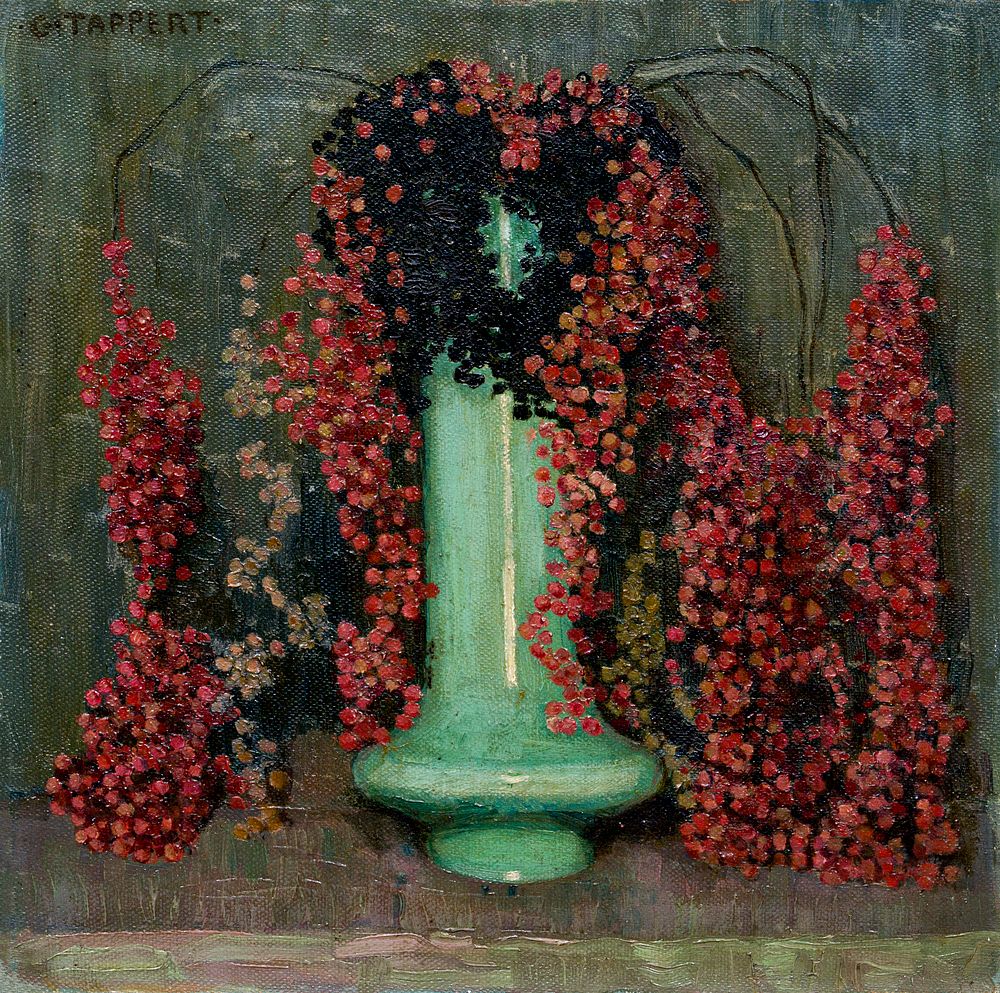
Georg Tappert - Georg Tappert ”Light Green Vase with Japanese Berries”. 1906–1909.. Georg Tappert 1880 Berlin – 1957 ibid. Oil on canvas. Signed upper left ”-G-TAPPERT-”. Verso on the stretcher with the remains of a label, probably with numbering and typographical inscriptions. Framed in a white-painted, coved molding. This verso upper left with the label ”[...]ion Berlin 1906”. WVZ Wittek 46. ”If anywhere in his Worpswede years, then he [Georg Tappert] found inspiration, if not even direct models, for his work with Paula Modersohn-Becker. Thus, after a first collective exhibition held in December 1906 at the Kunsthalle Bremen, he was already considered 'a very peculiar phenomenon' and from then on [...] undisputed as 'the most significant force of the younger generation'. Above all, it was his numerous still lifes, most of which are now lost, that provoked discussion: 'One has the impression that the things are painted with unbroken pure colors, hardly mixed.' Emil Waldmann, the later director of the Kunsthalle Bremen, particularly emphasized his planar conception and confident design, while [...] Karl Schäfer [...] even directly pointed out the commonality that his still lifes share with those of Paula Modersohn-Becker: 'They are woodcut-like, planar, constructed with a very specific weighing of contrasting color patches.' [...]” (cited after Gerhard Wietek: Georg Tappert: 1880 – 1957. A Pioneer of German Modernism. Munich 1980. p. 13). Varnish slightly yellowed and with fibrous inclusions in the lower part of the vase. Inconspicuous, tiny rounded paint layer flakes upper center. Frame slightly bumped, miter joints slightly opened. Dimensions: 39.3 x 39.6 cm, frame 49 x 49 cm. Georg Tappert 1880 Berlin – 1957 ibid. German painter and graphic artist. 1900–1903 studied at the Grand Ducal Baden Academy of Fine Arts in Karlsruhe, including under Ludwig Schmid-Reutte and Carl Langhein. 1904/05 assistant to Paul Schultze-Naumburg at the Burg Saaleck Art School. From 1905 freelance artist in Berlin, first solo exhibition at Paul Cassirer. 1906–1909 stay in Worpswede, also taught Wilhelm Morgner there. Contact with Heinrich Vogeler and Paula Modersohn-Becker. 1910 co-founder of the ”Neue Secession”, second chairman and chief organizer. Until World War I, large expressionist works were created: women's portraits, depictions of dancers, portraits and nudes. 1912 participated in the International Sonderbund Exhibition in Cologne and the 2nd Exhibition of the ”Blauer Reiter” in Munich. 1918 co-founder of the Novembergruppe and the Workers' Council for Art. 1919–37 professor at the State Art School Berlin, from 1945–54 at the HfBk Berlin.