Bidspirit auction | Albert Ebert
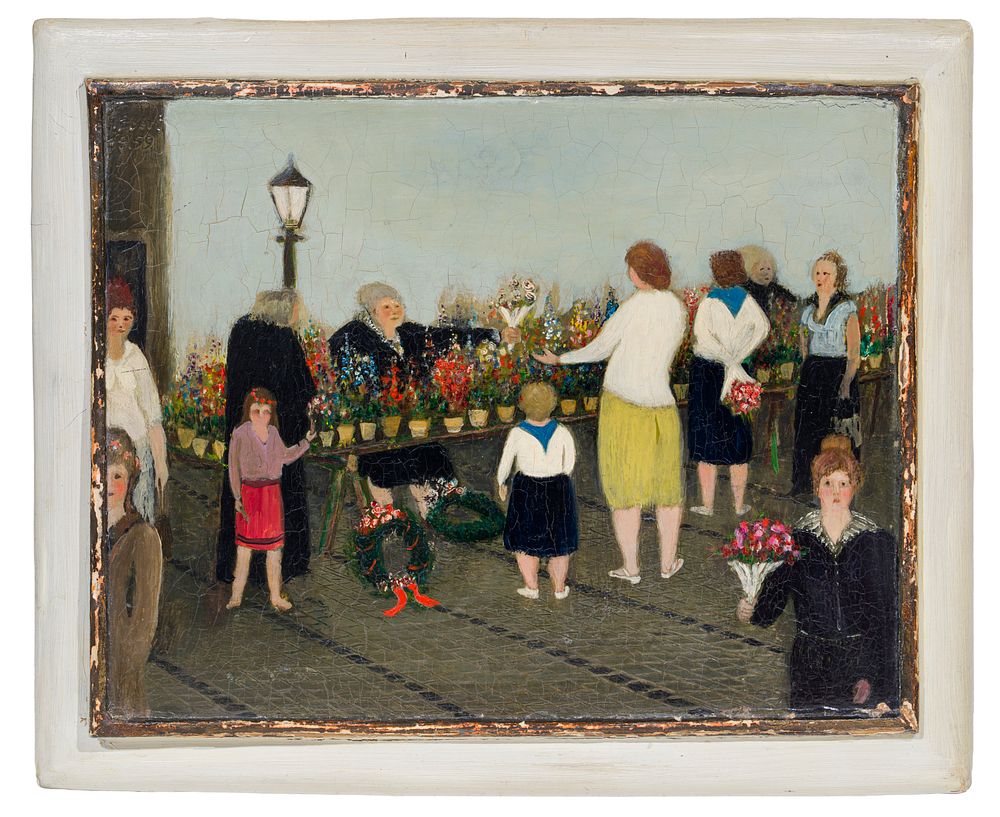
Albert Ebert - Albert Ebert ”Flower Market II (Flower Seller)”. 1959.. Albert Ebert 1906 Halle – 1976 there Oil on wood. Upper left incised signed and dated ”A. Ebert 1959”. Verso with the exhibition label ”Unser Zeitgenosse”, Berlin, 1964. Provided by the artist's hand with a narrow frame strip and mounted on a framing, grayish-white painted frame plate. WVZ Litt 59–31, cf. motivically also WVZ Litt 57–8 ”Blumenmarkt I”. Exhibited in: Albert Ebert Exhibition. Städtische Kunstsammlungen Görlitz. 1960. Cat. No. 14. 1000 Years of Halle. Halle Artists of the VBKD exhibit. Neuerzentrum ”Gustav Zabel”, Halle. Halle (Saale) 1961. Without Cat. No. albert ebert, halle. new paintings in the Thuringian Museum Eisenach, castle. Eisenach 1962. Cat. No. 8. Our Contemporary. National-Galerie Berlin. Exhibition of the Ministry of Culture, the German Academy of Arts and the Association of Visual Artists of Germany. Berlin (East) 1964. Without Cat. No. (with catalog, ibid. p. 101). With his first exhibition in the pavilion of the ”Berliner Zeitung”, Albert Ebert, who until then had only been considered an ”insider tip”, suddenly became famous. His unmistakable, poetic and politically innocuous art with a special mixture of naivety and precision appealed to a broad collector base in both the GDR and the FRG. The Städel Museum in Frankfurt purchased a painting by Ebert, and in 1966 his artistic work was shown in a solo exhibition in Karlsruhe. Albert Ebert's artistic work, like that of his teachers Charles Crodel and Kurt Bunge, is characterized by everyday scenes. Colorful street scenes executed in glaze painting, interiors, circus or variety show motifs become silent stages on which human life unfolds in a quiet, sometimes melancholic way. His figures often appear simplified, almost childishly reduced, but are simultaneously executed with great care in the details. Ebert's small-format to miniature-like works are characterized by a clear, often planar composition; perspective rules are not strictly adhered to, rather spaces appear slightly shifted or deliberately constructed. These ”inconsistencies” are part of his artistic strategy: they create a dreamlike atmosphere in which reality and imagination merge. In the artistic context of the 1950s, Ebert's work holds a special position and is independent of the politically and ideologically motivated debates about formalism and realism. He adheres to the pictorial subject in a special way, his proximity to so-called ”naive art” is palpable. Charles Crodel also confirmed to him ”a primitiveness of Rousseau-like character”. However, his works are not naive in the sense of a lack of reflection, but a consciously chosen reduction that directs the gaze to the essential. Lit.: Dorit Litt: Albert Ebert. 70 Panel Paintings, Childhood Memories and Fragments, as well as the Catalogue Raisonné of Paintings. Leipzig 2001. S. 170f. Picture support and frame plate slightly warped, the mounting joints left and bottom partly with drying cracks, there frame and picture panel separated and with minor losses of the paint layer. Paint layer with early shrinkage cracks. At the transition from the picture edge to the narrow half-round molding of the frame, a fine drying crack in the area of the sky and another inconspicuous one in the upper left corner. Small retouching in the lower right corner. Bronze-colored half-round molding with losses of the paint layer and abrasion. Small bumps on the corners of the white outer frame. Dimensions: 18.8 x 23.8 cm, frame 23.5 x 29 cm. Albert Ebert 1906 Halle – 1976 there German painter and graphic artist. 1946 began studying at Burg Giebichenstein with Charles Crodel and Waldemar Grzimek. After two semesters, left the university without a degree. 1948 first exhibition ”Das Werk” in the artists' association ”Die Fähre”. From 1951 member of the Association of Visual Artists, studied with Kurt Bunge. 1954–56 auxiliary worker and stoker at Burg Giebichenstein. Supported by fellow artists and a scholarship from the Christian Democratic Union, Ebert was able to fully dedicate himself to painting from 1956. With his first solo exhibition in Berlin in 1957, where he sold almost all of the 50 presented paintings, he achieved his breakthrough. Due to an eye condition, Ebert had to give up painting prematurely, but he nevertheless remained actively involved in the art scene.