Bidspirit auction | Manfred Kastner (Beerkast)
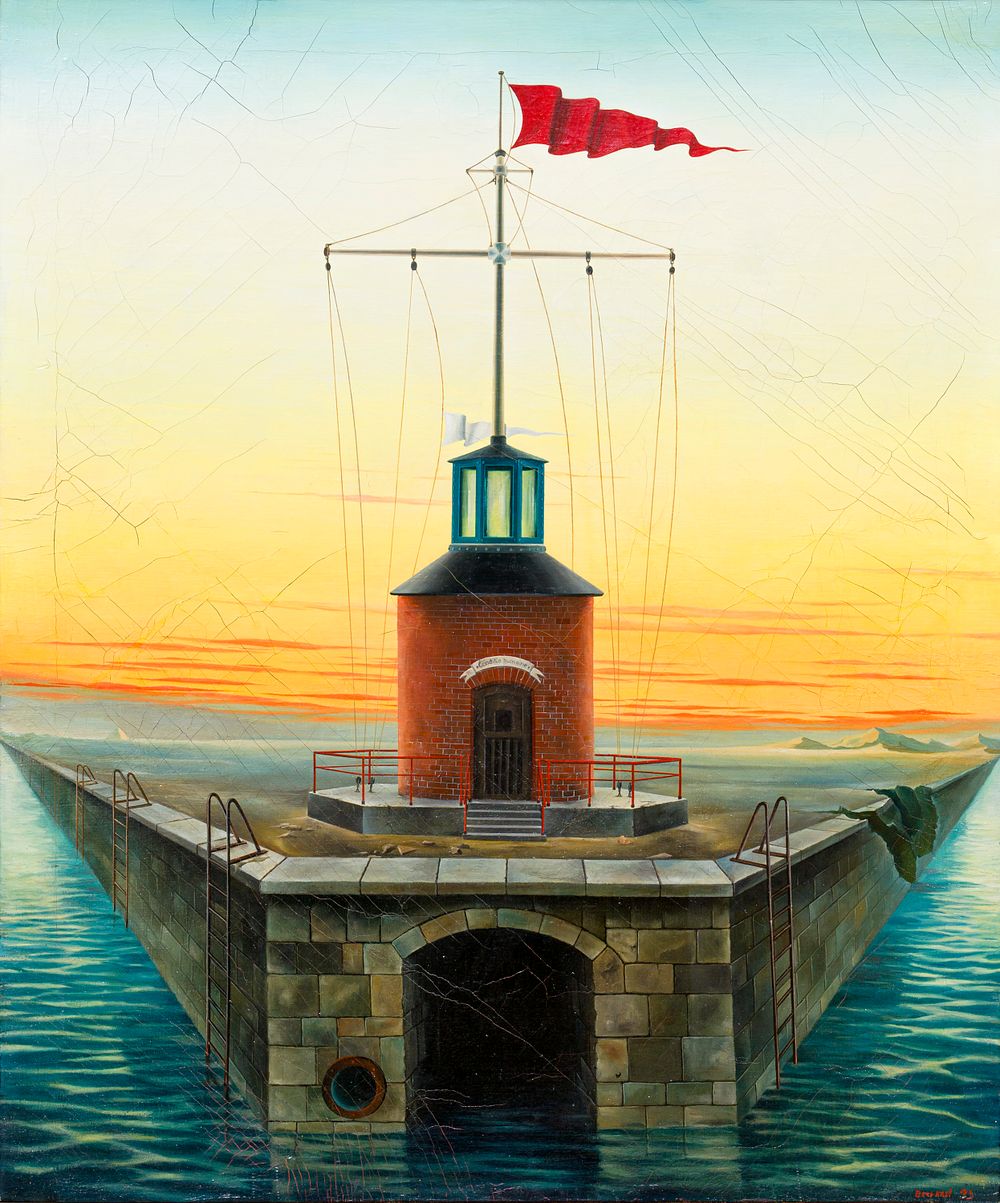
Manfred Kastner (Beerkast) - Manfred Kastner (Beerkast) ”Conditio humaine”. 1973.. Manfred Kastner (Beerkast) 1943 Gießhübel/North Bohemia – 1988 Juliusruh on Rügen Oil on canvas. Signed and dated ”Beerkast 73” lower right. Titled verso. Framed in a narrow, brown glazed wooden frame with a shadow gap. The painting is registered in the forthcoming WVZ Priem. The almost motivically identical paintings ”Wozu Gewißheit” (Why Certainty), 1975, and ”Seezeichen” (Sea Mark), 1975, illustrated in: Sylvia Kastner, Rudolf Kunze, Bernfried Lichtnau: Manfred Kastner Painting 1965–1988. Kunstverein Wiligrad e.V. Three volumes. Schwerin 1997. No page reference. Cf. motivically also the color lithographs ”Seezeichen” and ”Leuchtturm” (Lighthouse) from 1979. We thank Mr. Torsten Priem, Handorf, for his kind references. Manfred Kastner intensively explored the theme of human existence and transience in his artistic work. In varying series of motifs of lighthouses and sea marks, of train stations, factories, harbor facilities, castles and barracks, he staged dream-real, mostly deserted landscapes. Human existence is only visible through waving flags, smoking chimneys, and mounted antennas; crumbling architecture hints at abandonment. In this painting, as in other works, Kastner used the inherent early shrinkage crackle as a stylistic device to emphasize transience. ”Kastner shaped all of this into a vanitas poetry of transience, of becoming and passing away, behind which one could suspect melancholic resignation, indeed existential helplessness and hopeless abandonment, a destructive 'condition humaine', for whose overcoming the artist repeatedly engaged” (Klaus Tiedemann in: Klaus J. Albert (ed.): Manfred Kastner – Grafik 1977–1988. Schwerin 1997. S. 3). The artist himself formulated his motif finding as follows: ”My main theme in painting is architecture in the landscape. […] This is probably also due to the fact that in my hometown Stralsund, architecture, especially the Gothic, plays an outstanding role. From afar, one can already see the mighty buildings rising. Especially when approaching by water, it is an overwhelming sight. So it is no wonder that architecture dominates my works, as it stands as a sign of human self-assertion and greatness. Especially in the flat North German landscape, also seen from the sea, this architecture is a signpost, a visible mark. This North German landscape is not very lovely; especially in the dark seasons, this landscape is quite harsh. But the light, when spread over this land, is of a clarity that almost blinds the eyes and of such an abundance and purity of color that I can admire the beauties of my homeland again and again. The combination of still very pristine landscape with the pure light of the North and the towering architectures is one of the foundations of my inspiration.” (cited after Manfred Kastner, conversation note, SAdK, Slg. Kastner, leaflet for the exhibition Museum Schloß Moritzburg, Zeitz, August 1984). Lit.: Birgit Dahlenburg: Artistically admired and persecuted by the Stasi – the surrealist Manfred Kastner (1943 – 1988). Greifswald 2008. From the early work of Manfred Kastner (Cuni van den Beerkast): Drawings, paintings, letters, poems, text fragments. Langenweißbach 2021. Beatrice Vierneisel: The Stralsund painter Manfred Kastner and the district association of visual artists Rostock in the seventies. In: Zeitgeschichte Regional, 2004, Issue 2, S. 29–40. Lower middle and right middle above the horizon, two small areas with professionally executed retouches, as well as other isolated, very small retouches on the picture surface. Early shrinkage crackle inherent to the work and intended by the artist. Dimensions: 86 x 71 cm, Frame: 89.5 x 75 cm. Manfred Kastner (Beerkast) 1943 Gießhübel/North Bohemia – 1988 Juliusruh on Rügen Self-taught painter and sculptor of Surrealism in the GDR. 1958 Apprenticeship as a turner, then worked at the Volkswerft Stralsund until 1962. Engaged in zoology, ornithology, nature photography. Until 1970 as a taxidermist at the Stralsund Maritime Museum. 1970–74 Head of equipment and stage designer at the Stralsund Theater. Later worked freelance as a painter and graphic artist in Stralsund, residing in Juliusruh from 1985. Due to the discrepancy of his works with the official cultural policy of the GDR, he was classified as ”hostile to socialism”, harassed and persecuted. Kastner died in a car accident in 1988.