Bidspirit auction | Carl Marx
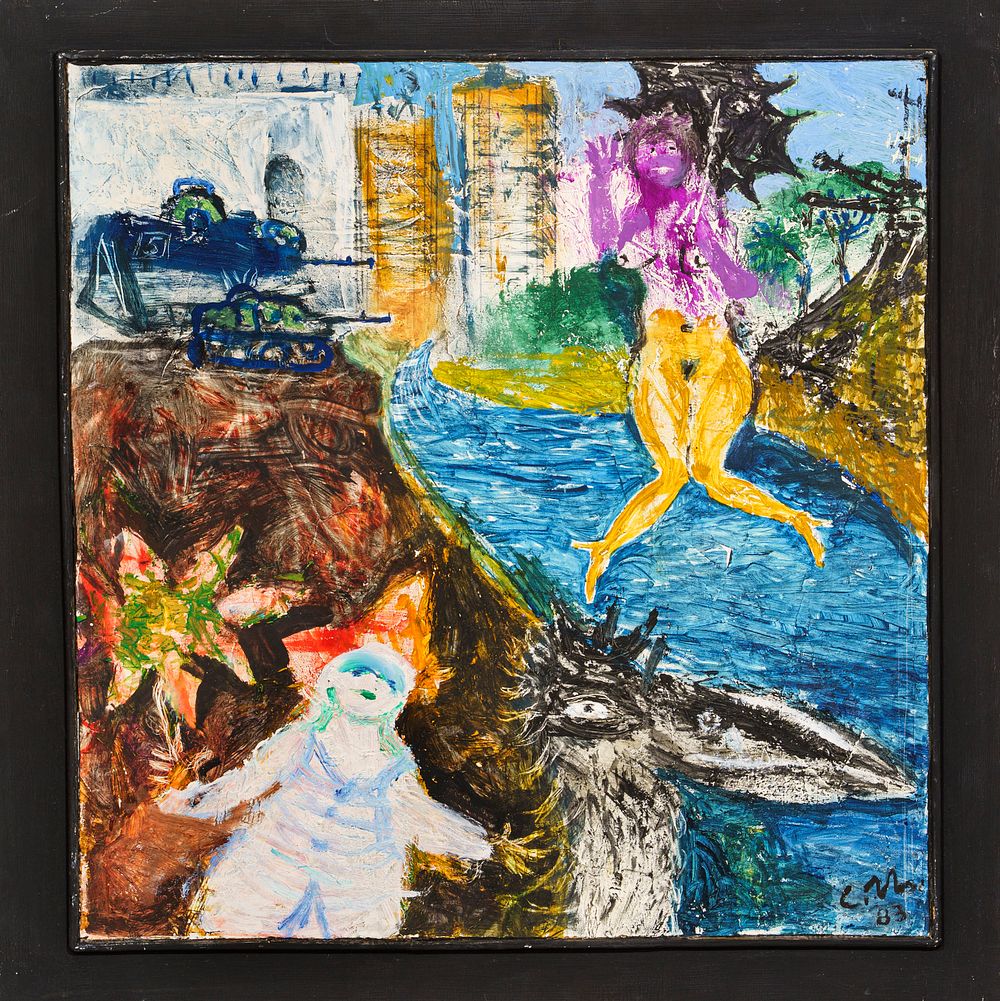
Carl Marx - Carl Marx ”The Border River”. 1983.. Carl Marx 1911 Göttnitz – 1991 Dessau Oil on plywood. Monogrammed and dated ”C.M. 83” lower right. Presumably permanently mounted by the artist's hand in a black-painted panel frame. Verso with a paper label, titled, inscribed with technique, dated, and marked with the estate stamp, numbered ”M69”. Provenance: Thuringian private collection; 2013 Galerie Hebecker; Artist's estate. ”Carl Marx united several contradictions within himself and his art. The comedic, cheerful nature of his paintings is repeatedly permeated by serious, even angry diagnoses of the times: ''No, I am not a comedian, I don't have a hairdresser's salon, but an X-ray laboratory''. Initially, the critical paintings were certainly in line with GDR politics, but in unusual designs: ''General Atom'', 1957, ''Latin American Picture Book'', 1970. Then the formulations became more ambiguous: ''Will the world remain inhuman forever?'', 1980, ''Border River'', 1983. And finally, a considerable amount of bitterness is no longer to be overlooked. [...] But the painter did not become a pessimist. [...] The ascetic Marx, who managed with minimal living comfort, was at the same time a connoisseur and revelled lavishly in colors. Apart from the narrative elements of his art, the paintings offer a wealth of the most wonderful color experiences. [...] (quoted after Andreas Hüneke: Carl Marx, freche, gute Bilder. Werke aus dem Nachlaß. Potsdam 2011. S. 11f). The work has not been unframed. Paint layer with professional retouching below the female nude. Very fine scratches in the lower right edge area. Frame with small missing pieces of the paintwork at the edges. Dimensions: 42 x 41 cm, Frame 48.5 x 48 cm. Carl Marx 1911 Göttnitz – 1991 Dessau German painter. 1926 apprenticeship as a decorative painter in Dessau, where he joined the Socialist Workers' Youth in 1927. 1931–33 studies at the Bauhaus in Dessau and Berlin. After various manual activities, he was drafted for military service and discharged as severely disabled in 1942. After the war, he joined the SED but was expelled in 1953 due to a lack of conformity. In 1947, the first exhibition of his works took place in Dessau; since then, he worked independently in Dessau, interrupted in 1953 by an activity as a concrete worker, and participated in various exhibitions.