Bidspirit auction | A FINE MID 19TH CENTURY
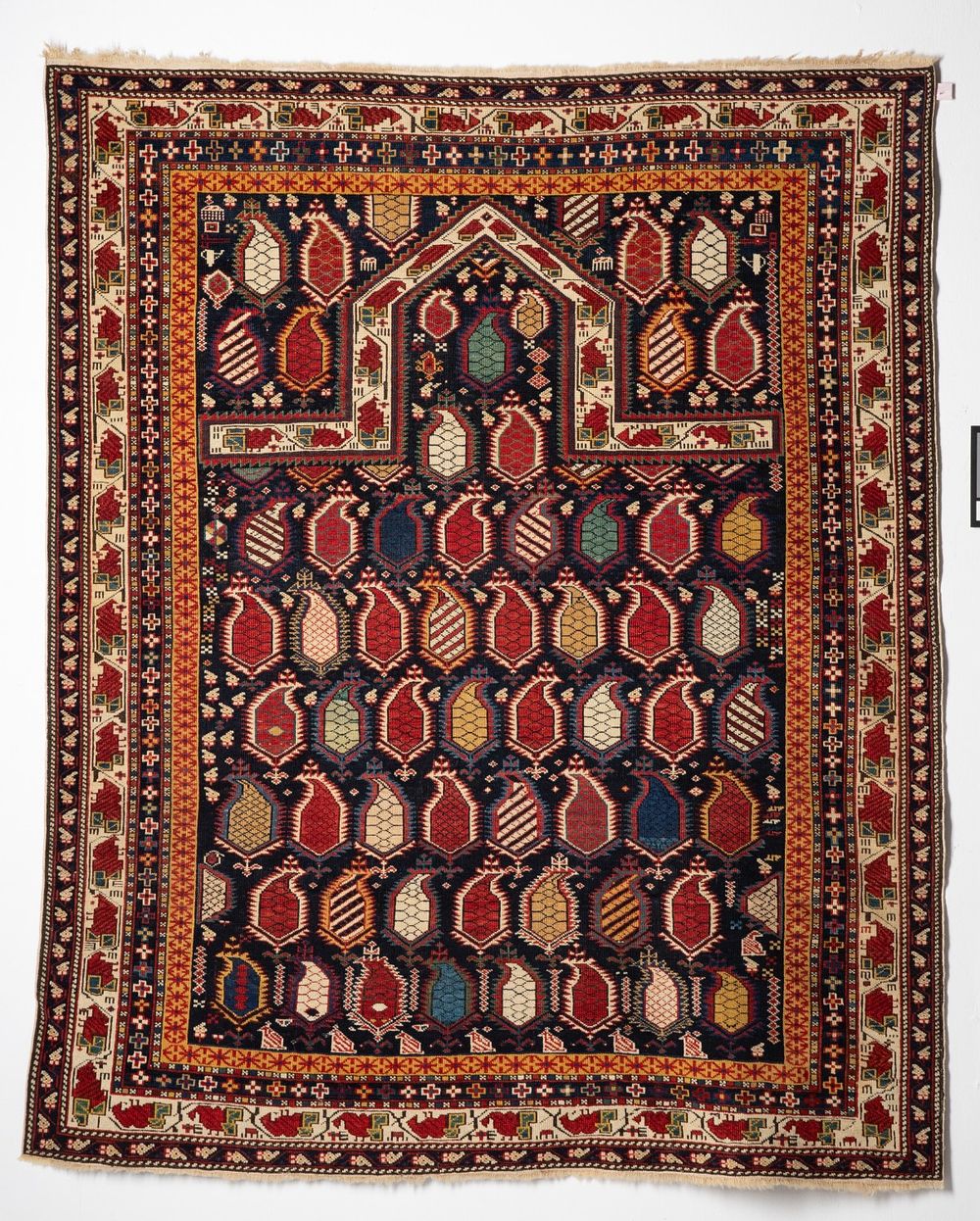
A FINE MID 19TH CENTURY MARASALI PRAYER RUG - The dark indigo mihrab with offset alternating rows of polychrome serrated botehs below an ivory keel-arch of angular stylised floral vine, dark indigo spandrels with alternating rows of boteh and small flora forms, a saffron continuous star inner guard border within an ivory border enclosing angular stylised floral vine. This fine Northeast Caucasian prayer rug displays all the attributes of a small, significant recognisable group, defined as Marasali. This is the classic type of 'black' Marasali prayer rug with large boteh with their multifarious polychrome interiors and serrated frames set against the black field as if standing out like flashing lights, such a contrast is spectacular. The botehs on this group are invariably free standing, whereas weavings with other ground colours; (ivory, yellow, or red), almost always displaying a diamond lattice within which the botehs are usually arranged in chromatic patterns. Many examples from this significant group are dated, and although this rug is not dated bears notable similarities to dated known examples. See Christies, London, October 16th, 1997, lot 43. This published rug was dated AH 1274/1857 AD. The most well known example from this defined group, and arguably the best known of this type is in the Textile Museum, Washington DC., formerly in the Jerome a Straka collection (Straka, Jerome A., and Mackie, Louise, W., The Oriental Rug Collection of Jerome and Mary Jane Straka, New York, 1978, no.102, p.104-105 and cover). This rug similarly has alternating facing rows of well- spaced polychrome boteh and the angular boteh vine border. These features particular apply to earlier examples from this group. An even earlier example dated AH 1254/1838/39 AD is published by Herrmann, (Eberhart; Asiatische Teppich und Textilkunst, Band 4, Munich, 1992, p. 108-109, pl. 48). In the later examples the boteh become more crowded, angular and the boteh start to face the same direction. This more crowded rendering can be seen in a dated example, 1870, which was sold at Sotheby's, New York, December 15, 1994, lot 89. Whilst there is consensus, that prayer rugs from this small group were woven in Marasali in the Shirvan district, they do conform to the same structure as Shirvan rugs. Suffice to say, this small group of prayer rugs were produced in Northeast Caucasus by weavers creating prized rugs of superior quality, design and using a comprehensive range of fabulous, harmonic jewel like colours. Measures 59 x 47 inches; 4ft.11.x 3ft.11 inches 150 x 120cm. Without proof of exemption, be aware that internet sales tax applies to all Internet transactions and local sales tax may apply to local pick-up transactions. We happily provide seamless in-house packing and shipping services on nearly everything we sell. Until further notice, we cannot offer international shipping in-house. Dimensions Measures 59 x 47 inches; 4ft.11.x 3ft.11 inches 150 x 120cm. Condition Sound overall condition. Sides good, ends good, short flat woven ends present, slight loss, short fringe ends extant. Pile good with negligible wear. Provenance The Estate Collection of John Adair Jr. Atchison, Kansas and Tokyo, Japan