Bidspirit auction | Samuel Kirk (1793-1872)
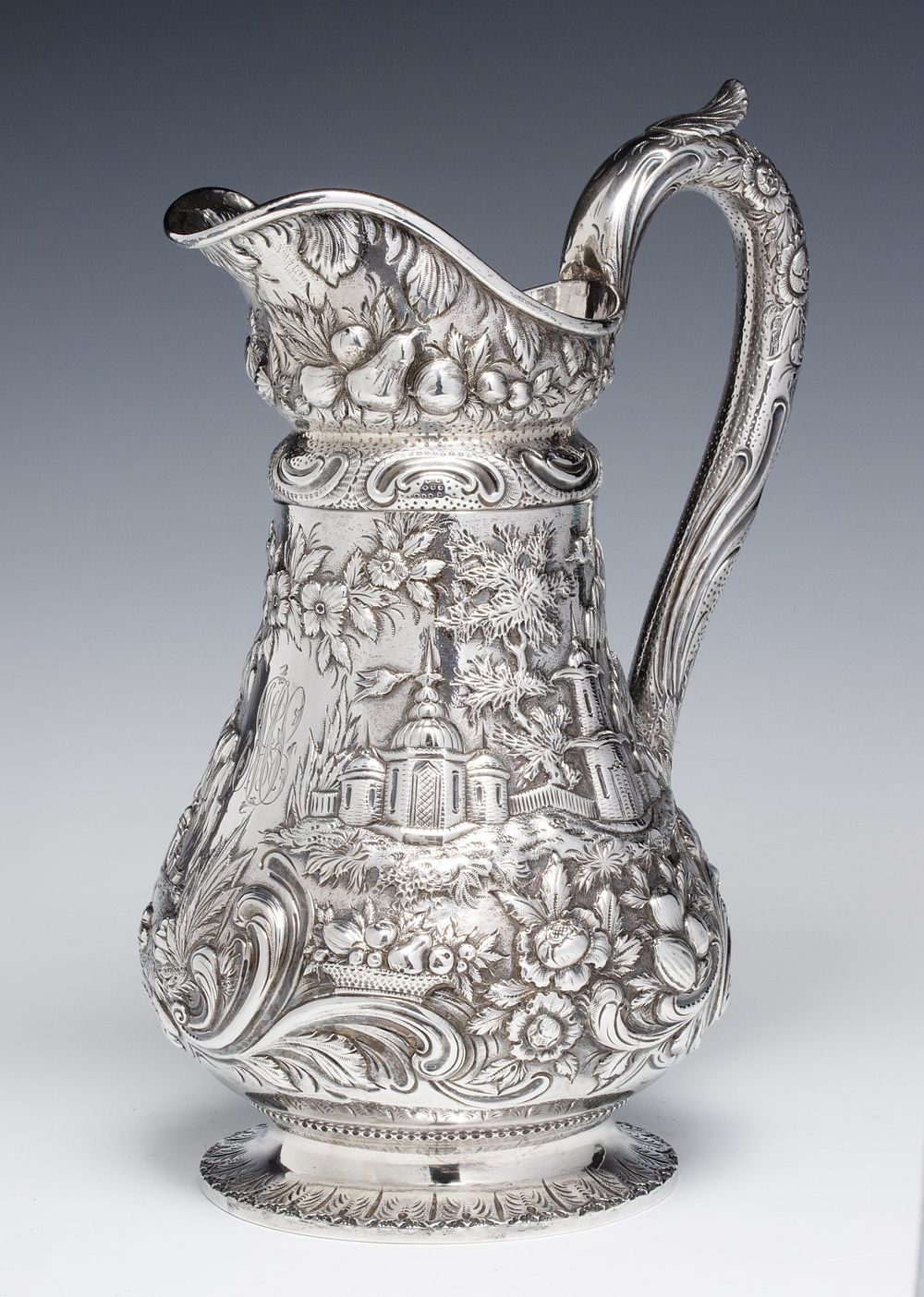
Samuel Kirk (1793-1872) - AN IMPORTANT SAMUEL KIRK 'ETRUSCAN' COIN SILVER PITCHER. Samuel Kirk (1793-1872) Etruscan 1828 This outstanding example of Baltimore-Style silver by Samuel Kirk is not only a masterwork of repousse', but a noteworthy artifact of American silver history as well. Dating to 1828, this Etruscan pattern variation coin silver water pitcher exhibits a pronounced spout, ornate scroll handle, and bulbous form on flared circular foot. The body is masterfully decorated in a split-hemisphere composition with repousse and chased decoration of Chinoiserie ornament on one side with an exotic pagoda-style dome and architectural towers against a landscape of dense foliage. The other half transitions to a classical vignette depicting Greco-Roman architectural ruins with columns and crumbling arches. Both landscapes are framed by heavy rococo-revival floral, fruit, and foliate motifs with butterflies and birds. The spout and handle display flowers and fruit on a finely stippled ground. Found in outstanding condition with crisp detail, the pitcher's base retains an undisturbed deep blue, purple, and gold patina rarely, if ever, seen. The historical notoriety comes form the Maryland law of between 1814 and 1830 when all silver produced or sold locally had to be officially tested for purity and stamped by an appointed city assayer, Baltimore is unique as the only city in the history of the United States to operate a mandatory, government-regulated hallmarking system resembling the British hallmark system. Samuel Kirk was based in Baltimore and this pitcher is a rare artifact from that period. Stamped with the maker's mark 'S Kirk' inside a rectangular cartouche alongside SK and the 11.0 purity mark, certifying the Baltimore quality standard of 91.7% pure silver, it further bears the official Baltimore Assay Office stamp featuring the Maryland coat of arms paired with the Dominical letter 'F.' During the year 1828, the Maryland coat of arms mark lacked the diagonal 'bend dexter' stripe. Historical records show the assay office temporarily removed the bend dexter from the stamp in 1828 before reintroducing a modified version in 1829. This brief stylistic departure, combined with the letter 'F', provides definitive proof of the year 1828. This important piece of American silver was recently found in the home of a fifth generation descendant of Ann Eliza Cairns who, in 1835, inherited the 18th century colonial estate The Glass House Farm which originally stretched from roughly 35th to 42nd Streets along the Hudson River. The MS(?) monogram, stylistically of a later period, could be that of Ann Eliza Cairns' granddaughter Virginia Stuart Mackay Smith (1849-1936), or her great granddaughter Helen Stuart Mackay Smith (1882-1969). Measures 11.5 x 8.5 x 6 inches with a total weight of 32.05 ozt. Without proof of exemption, be aware that internet sales tax applies to all Internet transactions and local sales tax may apply to local pick-up transactions. We happily provide seamless in-house packing and shipping services on nearly everything we sell. Until further notice, we cannot offer international shipping in-house. Dimensions Measures 11.5 x 8.5 x 6 inches with a total weight of 32.05 ozt. Condition Very good condition, noting two very shallow line-form dents that appear as, in one case, a very subtle and shallow 1/4 inch long crease underside of the bulbous portion just above the foot. The other is merely a hint of an indentation. No other damage, no repair, fine detail remains throughout with crisp chasing and engraving remaining on the high points and in the subtle decoration. Provenance Descended through a prominent New York family, previous owners of Glass House Farm, an 18th century home on the Hudson River,