Bidspirit auction | Thomas Hart Benton (1889-1975)
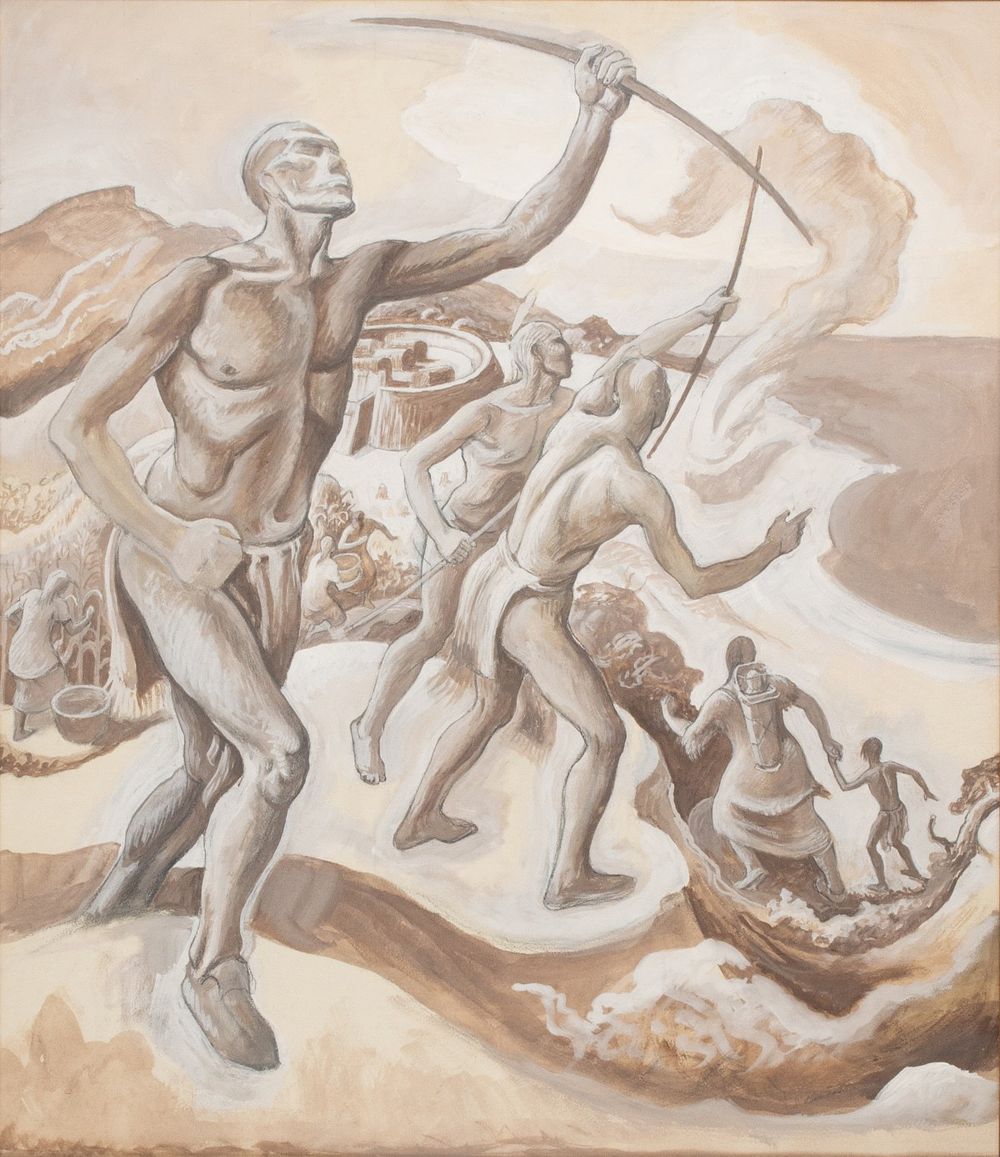
Thomas Hart Benton (1889-1975) - THOMAS HART BENTON (1889-1975) LARGE CASEIN STUDY, 1956. Thomas Hart Benton (1889-1975) Study for ''The Iroquois (Seneca) Discover the French'' 1956 - 1957 The large working study painted in casein over graphite on illustration board is signed in pencil lower right front and again verso, It anticipated one half of a two-panel mural for the New York Power Authority building in Masena, New York, completed in 1957. See the Nelson-Atkins Museum collection for two very similar working iterations of this preliminary study. The New York State Museum where the mural now resides on long term loan provides the following: In 1956 Benton was commissioned by Robert Moses, chairman of the New York Power Authority, to create two murals for the powerhouse building of the state's first hydropower facility in Massena. They feature Jacques Cartier's explorations of the St. Lawrence River and the Gulf of St. Lawrence. Alternately titled The Seneca Discover the French and Jacques Cartier Discovers the Indians, the murals depict the 16th-century encounters from two points of view. Thomas Hart Benton routinely went to great lengths in preparing for the final versions of his major paintings. It's quite easy to underestimate how much research, fieldwork, sketching, modeling and revision went into any mural or easel painting. One would never know without reading a behind-the-scenes account like this story about the present work and the mural it preceded. WYANDOTTE, OKLAHOMA., Feb. 23, 1957. - Thomas Hart Benton opened a broken-down gate leading off a country road, walked a quarter of a mile on a muddy trail, crossed a creek on a bridge made of a log and climbed a rough path up a limestone bluff. At the top of the bluff was the 2-room cabin of Levi Spicer, a Seneca Indian. Benton wanted to look at Spicer's face. (Bob Sanford Staff Reporter, The Kansas City Star, February 1957.) Benton and fellow artist Charles Banks Wilson were hiking the Seneca-Cayuga communities around Wyandotte, Oklahoma. They visited homes, studied faces, and made sketches from life, convinced that specific facial structures of these Western tribe Iroquois would provide a better picture of the Iroquois faces and bodies encountered by Jacques Cartier in modern day New York four centuries earlier. Benton believed that the Iroquois remaining in New York had become too intermixed with French, Canadian, and other ancestries to provide the physical characteristics he sought for his mural figures. The trip was undertaken in preparation for Benton's two murals commissioned by the New York Power Authority in 1956, That trip produced a number of good models including the young man named Ernest Soldier seen seated in Charles Banks Wilson's studio as Wilson stands holding a study very similar to the work being offered here, and Benton paints at an easel (see the attached image). That sketching trip in Oklahoma also resulted in the likeness of Bob White, an Indian dancer whom Benton chose as the model for the dramatic standing figure that rises prominently within this work up for bid and the composition of The Iroquois Discover the French. The figure's uplifted arm and animated posture became one of the mural's most recognizable and primary compositional elements. In the newspaper photo, Wilson holds the sketch of Mr. White's figure study. Without a doubt, Benton was a very hard working artist. The sheer number of studies that exist serve as testament. This is to say nothing of the clay models he created of compositions, just so he could study the play of light on figures. ''Every detail of every picture is a thing I myself have seen and known. Every head is a real person drawn from life.'' he once said. In preparing for the Truman Library mural, he again teamed up with Charles Banks Wilson to track down genuine Seneca Indians on their reservation in Oklahoma, rather than using white models. As Benton commented: ''It is nearly impossible to simulate Indian bodies by the use of white ones.'' He put the same amount of research and effort into depicting costumes and accoutrements accurately. He once told his sister Mildred: ''In painting Indians, if you get one bead on a moccasin that isn't right, you will hear from somebody.'' This dynamic work is displayed in a fine frame with title plaque and open backing to expose the original medium, and the second signature. Sight size measures 25 x 21.5 with a framed size of 35 x 31 inches. Without proof of exemption, be aware that internet sales tax applies to all Internet transactions and local sales tax may apply to local pick-up transactions. We happily provide seamless in-house packing and shipping services on nearly everything we sell. Until further notice, we cannot offer international shipping in-house. Dimensions Sight size measures 25 x 21.5 with a framed size of 35 x 31 inches. Condition Very good to very fine original untouched condition. There are no issues of scratches,