Bidspirit auction | Ekster A.A.
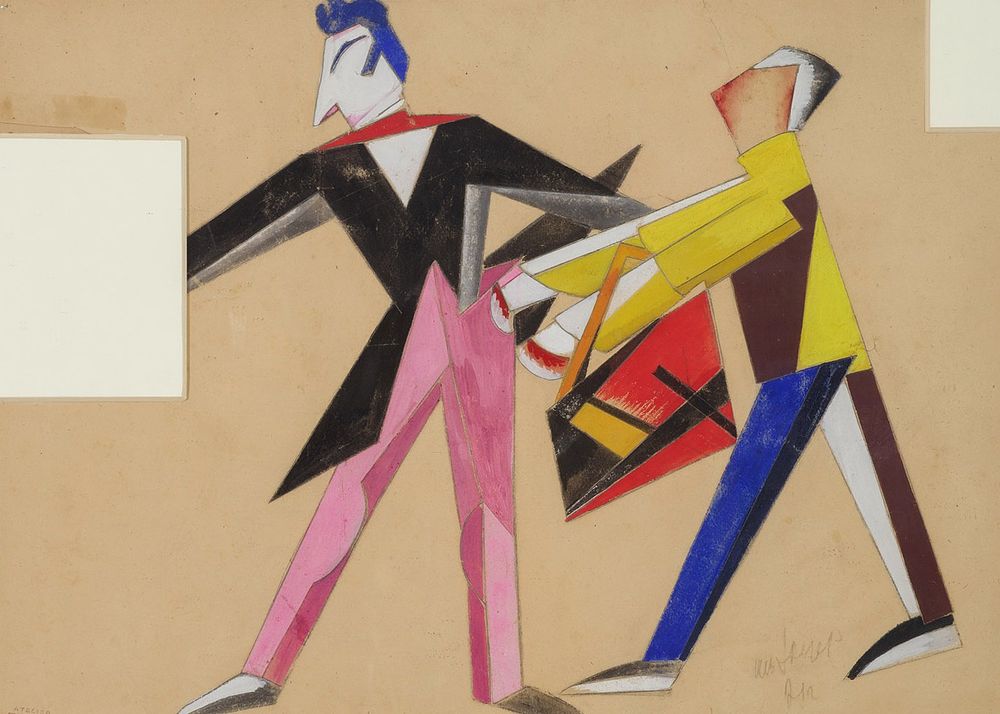
Ekster A.A. - Costume design sketch for Dmitry Smolin's production of ”Comrade Khlestakov.”. Year: 1921 Technique: Graphite pencil and gouache on paper. Size: 48.2x67. Descripton: The work comes from the collection of the Sapitani Gallery (Italy). Published in the books: J. Tugendhold, ”Alexandra Exter as a Painter and Stage Designer”, Berlin: Zarya, 1922; Alexandra Exter, Max Milo Edition, 2003. P. 89. Exhibited at the following exhibitions: The Milano Modern art show (Milan, May 2003); ArtVerona05 (Verona, October 2005); Alexandra Exter. Retrospective, MMOMA (Moscow, June-August 2010). Expertize: Certificate of P.M. Tretiakov Independent Research Examination. Ekster Alexandra Alexandrovna (1882 – 1949) Painter, graphic artist, theater and film artist, designer. Representative of the Russian and Ukrainian avant-garde. Founder of the Art Deco style. In 1901 she began attending classes at the Kiev Art School. In 1903, having married lawyer N. E. Exter, she set up a salon-workshop in her house, which later became the center of Kyiv avant-garde art. In 1907, Exter went to Paris, where she studied for some time at the private academy La Grande Chaumiere. In Paris, she met representatives of modern French art - G. Apollinaire, J. Braque, P. Picasso, M. Jacob, and Italian futurists. In 1908-14. Exter lived in Kyiv, Moscow, St. Petersburg, Paris, traveled throughout Italy and Switzerland, maintaining constant contacts between Russian and European “left-wing” artists. She was a participant in almost all avant-garde exhibitions in Russia: Salon of V. A. Izdebsky in Odessa (1909/10, 1911), “Wreath-Stephanos” and “Triangle” in St. Petersburg (1910), “No. 4” in Moscow (1914). In 1910 she joined the “Jack of Diamonds” association and participated in its exhibitions; in 1913 she became a member of the Youth Union. In 1914, she organized the avant-garde exhibition “The Ring” in Kyiv. Exter's works were also demonstrated abroad: at the Parisian Salon of Independents and at the International Free Futurist Exhibition (1914). In 1915, Exter joined the group of K. S. Malevich in Moscow. The most striking page in the artist’s creative biography was her work at the Moscow Chamber Theater. She owned the paintings of the theater lobby and curtain, the design of the drama ”Famira Kifared” by I. F. Annensky (1916), ”Salome” by O. Wilde (1917), ”Romeo and Juliet” by W. Shakespeare (1921). In the post-revolutionary years, Exter was engaged in teaching: in 1918, at the Odessa Children's Art School, and then in her own studio in Kyiv. In 1921-22. she taught at the Moscow Vkhutemas. Among her students were A. G. Tyshler, I. I. Nivinsky, I. M. Rabinovich and others. In the 1920s. the artist, like many figures of the constructivist movement, turned to practical work: she took part in the design of the First All-Russian Agricultural Exhibition (1923). In 1924, the artist was entrusted with the design of the Soviet pavilion at the XIV International Exhibition in Venice, where her works were also shown. After Venice, Exter went to Paris to work on the exhibition of the Soviet department of the World Exhibition of Decorative Arts. The theatrical works presented there received a gold medal. Exter never returned to Russia; she remained in Paris, and in 1929 she settled in Fontenay-aux-Roses. Abroad, Exter was engaged in theatrical and applied works, creating costumes for ballet productions by B. F. Nijinska, E. Kruger and others. In 1925-30. at the invitation of F. Dezhe taught at the Academy of Modern Art in Paris, and also gave private lessons. Her work has been shown in numerous exhibitions. At the end of her life, the artist became interested in creating handwritten books.