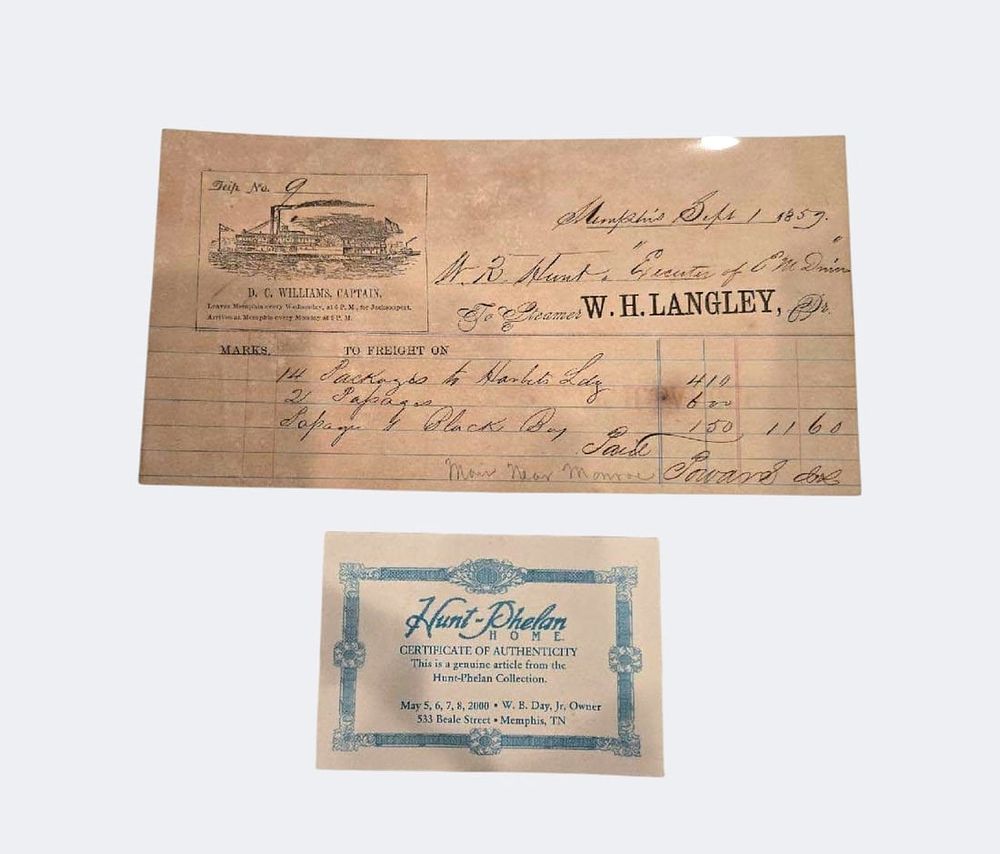
Bidspirit auction | 1857 Steamboat Passage Bill Including
1857 Steamboat Passage Bill Including Enslaved Boy - Printed bill of lading from the Steamer W. H. Langley, dated September 1, 1857, addressed to W. R. Hunt, Executor of the Driver Estate, listing household goods and “one negro boy” among the freight transported downriver. Signed by the steamboat’s captain. The document reflects the continuing river commerce of the Hunt and Driver families and their role in the Memphis trade network on the eve of the Civil War.Historical Context: The Hunt–Phelan–Driver Archive: Slave Documents and Related Antebellum Papers, 1839–1858This extraordinary group of original manuscript documents spans nearly two decades of the antebellum South, chronicling the intertwined business and family relationships of Eli M. Driver and William R. Hunt, two men whose lives and transactions came to define the early commercial and social fabric of Memphis, Tennessee. Drawn from the archives of the Hunt–Phelan Mansion, these papers trace the expansion of the region’s plantation economy and river trade through direct, authenticated records of slave purchases, bills of sale, and transportation receipts.The earliest documents, dated 1839–1842, show Eli M. Driver’s slave transactions in Alabama, Kentucky, and Mississippi, recording the purchase of men, women, and children—some named Ben, Allen, Cornelius, Frank, Polly, and Flora. Driver’s business dealings predate his later familial and commercial alliance with the Hunts, and the repetition of his name across multiple states highlights the mobility and scale of the domestic slave trade in the decades leading to the Civil War.By the early 1850s, the papers transition to W. R. Hunt, whose purchases, loans, and estate records document Memphis’s economic rise on the eve of war. The 1854 sale of an enslaved girl, Laura, purchased by Hunt for $600, and the 1852 sale of Granville, reflect the continuity of property and labor transfers between the Driver and Hunt estates. The 1858 “Deed of Trust”—a formal eight-page legal instrument in which Hunt loaned $4,600 to A. K. Taylor, secured by fifteen enslaved individuals—demonstrates the capitalization of human lives as financial assets at the peak of the Southern credit economy.Complementing these legal papers are the riverboat receipts—including one from the Steamer W. H. Langley (1857) and another from the Kate Frisbee (1858)—showing how enslaved persons were transported along with household goods and commercial freight on the Mississippi and White Rivers. These rare surviving documents vividly illustrate how slavery, trade, and river commerce were intertwined in everyday Memphis business.Together, these papers form a continuous chain of documentation connecting Alabama, Kentucky, and Mississippi to Memphis, centered on two families whose estates would later merge through marriage. The Hunt–Phelan House, long a landmark on Beale Street, became a gathering place for Confederate General Leonidas Polk, Union officers, and Civil War planners. These manuscripts, preserved from that same household, provide a hauntingly tangible record of the economic and social networks that shaped both the city’s prosperity and its place in the national tragedy of slavery.Provenance: All items from the Hunt–Phelan Mansion Collection, Memphis, Tennessee.Period: 1839–1858.