Bidspirit auction | Manuscript on Parchment: Milchemet Hashem
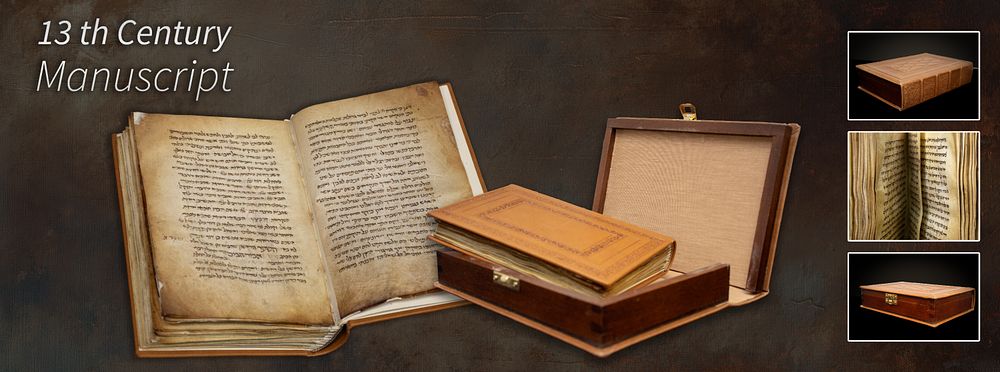
Manuscript on Parchment: Milchemet Hashem by Rabbi Yaakov (Tam) ben Reuven. Polemic Against Christianity. 13th Century. - Manuscript on parchment – Milchemet Hashem by Rabbi Yaakov (Tam) ben Reuven – A Jewish Polemic Against Christianity [Byzantine Script, Greece–Turkey Region, circa 13th Century] A rare and significant polemical manuscript opposing Christianity, authored by Rabbi Yaakov (Tam) ben Reuven—one of the early Jewish polemicists and a contemporary of Maimonides. Little is known about the author; he is believed to have been born either in 1136 or 1150, and the composition of this work is dated to 1170. The text presents a fictional dialogue between HaMeyached (“The Unifier” – representing the Jewish position) and HaMechached (“The Denier” – representing the Christian). According to the introduction, the author was exiled from his homeland and settled in the city of “Kashkonia” (possibly Gascony, southern France), where a personal theological dispute with a Christian priest—who had befriended him—prompted him to compose this treatise. A decorative title appears at the beginning of the manuscript. The manuscript opens with a poetic preface beginning with the line ”Yarei Yachid Alili Al Kehillot”, featuring a double acrostic of the author's name. The manuscript also feature ornamental catchwords. Manuscripts of this nature, especially polemics against Christianity, are exceedingly rare. While this work was printed by Dr. Yehuda Rosenthal in Milchemet Hashem (Mossad HaRav Kook, Jerusalem, 1963) based on several manuscripts, the present manuscript was unknown to the editor and contains numerous textual variants not found in the printed edition. Chapter 11 is of particular importance, offering a systematic critique of the New Testament—considered by Rosenthal (Introduction, p. XV) to be the earliest known Jewish critique of the New Testament composed in Christian Europe. 78 leaves. 21 cm. Overall good condition. Some staining and creasing; a few leaves are smaller from the outset, or have natural holes, with text carefully written around them. In several instances, marginal segments were trimmed—possibly for reuse of parchment—resulting in minor textual loss. Newly bound in modern leather. Expert authentication and dating by Prof. Rabbi Elazar Hurvitz (Yeshiva University) and Prof. Menachem Schmelzer (Jewish Theological Seminary, NY); letters available upon request.