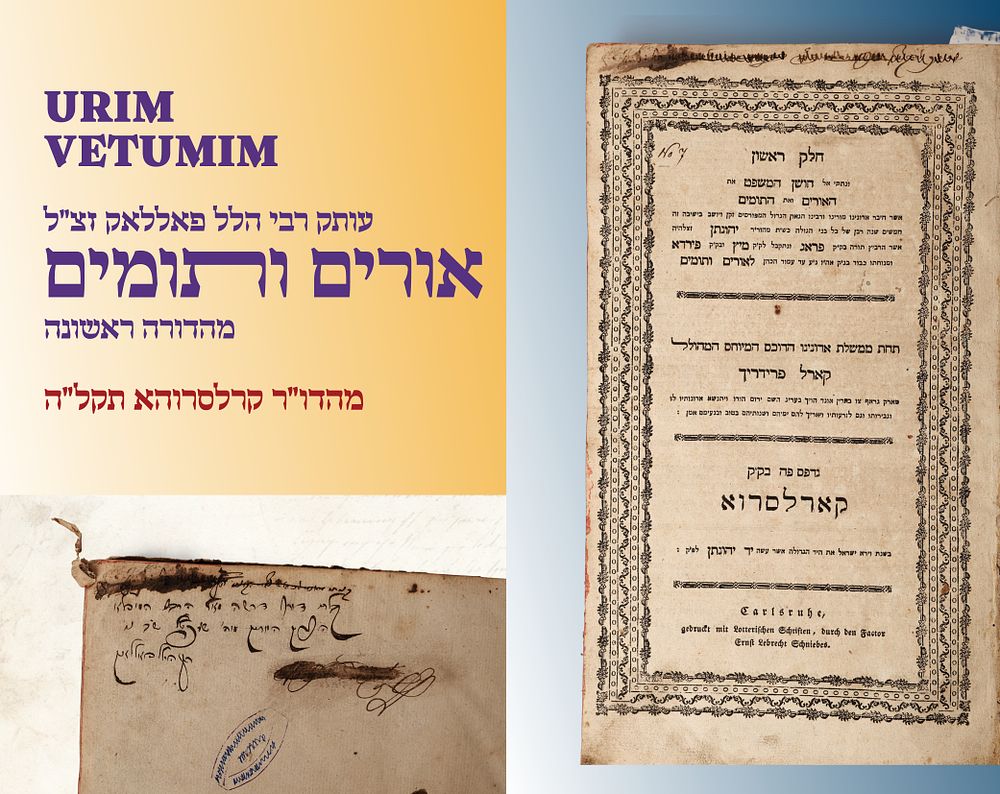
Bidspirit auction | Urim VeTumim, Karlsruhe, 1775. First
Urim VeTumim, Karlsruhe, 1775. First Edition, Pedigree Copy, - Copy of the Holy Gaon Rabbi Hillel Pollak, Av Beit Din of Sasregen, one of the foremost disciples of the “Chatam Sofer, ” author of Kodesh Hillulim. In his holy handwriting: ”I received this derashah as a gift from the wondrous rabbi, the righteous and venerable Rabbi Sheftel... signed: Hillel Pollak.” While studying at the Pressburg Yeshivah, he was a beloved disciple of the “Chasam Sofer, ” who held him in great esteem for his pure piety. The sefer Likutei Chaver Ben Chaim by Rabbi Chizkiyah Feivel Ployt, Av Beit Din of Shuran, relates: “The gaon Rabbi Hillel Pollak was a second cousin of the gaon Rabbi Hillel Lichtenstein of Kolomyia and learned from his ways; they were like brothers. Once, when they came on the eve of Yom Kippur to receive a blessing from the Chatam Sofer, he proclaimed regarding them: ‘Kodesh Hillulim LaHashem.’” The Satmar Rebbe, Rabbi Moshe Teitelbaum (“Be’er Moshe”), wrote in his approbation to Kodesh Hillulim: “One of the great luminaries of the holy generation, the gaon and tzaddik Rabbi Hillel Pollak, Av Beit Din of Sasregen, beloved disciple of the teacher of Israel, the holy Chasam Sofer.” Urim VeTumim The work was published after the author’s passing by his grandson, Rabbi Yisrael Eybeschutz, who devoted himself to printing the writings of his illustrious grandfather. Rabbi Yonasan began authoring Urim VeTumim during his rabbinate in Metz and continued editing it while serving the communities of AHU (Altona, Hamburg, and Wandsbek). He chose this title in order to clarify matters of halachic jurisprudence and to explain the rulings of the Sema and the Shach. In his introduction to Keresi U’Pleisi, the author explains that publication of the work was delayed due to the high costs of printing and the hardships of war, leading him to publish his commentary on Yoreh De’ah first. The special importance of this work also lies in its establishment of the authoritative text of the author’s teachings. During his lifetime, his Torah insights circulated through manuscript copies prepared by students, often resulting in confusion and conflicting versions. The printed edition was intended to remove this “great perplexity” and present his rulings and novellae exactly as they emerged from the author’s own hand. [1] 1–204. Staining. Minor worming to the final leaves. Very good condition.