Bidspirit auction | Copy of Rabbi Avraham Azulai,
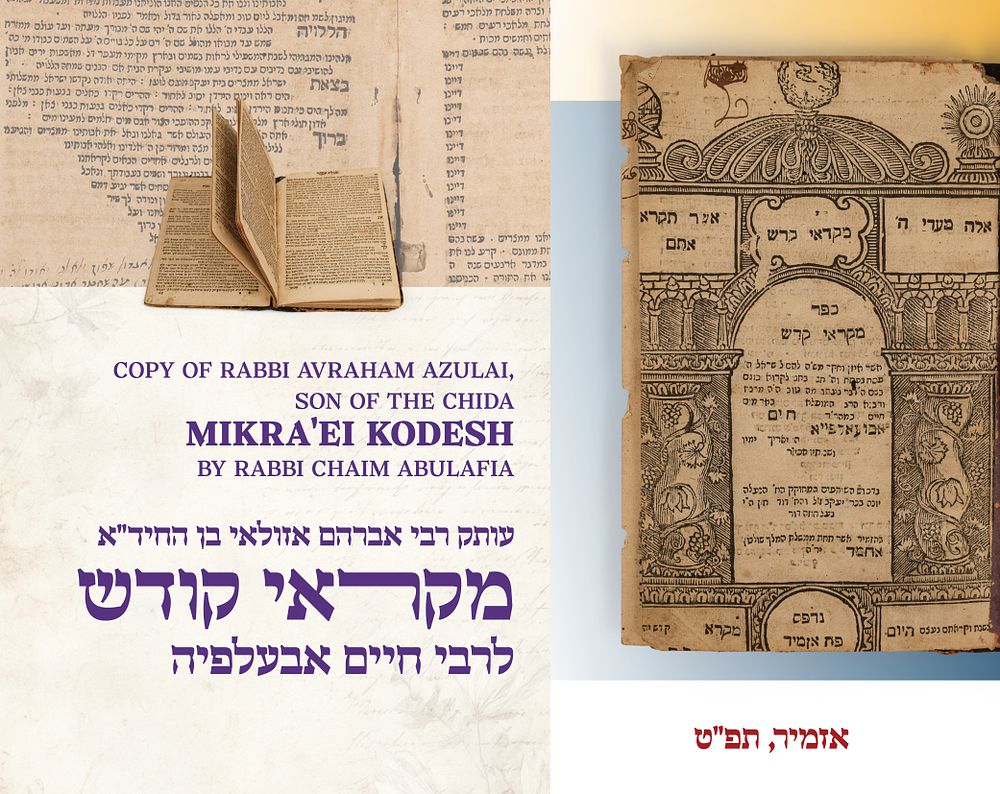
Copy of Rabbi Avraham Azulai, son of the Chida – Mikra’ei Kodesh by Rabbi Chaim Abulafia. Izmir, 1729. First edition. - Mikra’ei Kodesh – commentary on Megillas Esther and the Haggadah of Pesach, together with novellae on the festivals in Shas and the Rambam, by Rabbi Chaim Abulafiah. Printed by Yonah [Ashkenazi] and David Chazan, Izmir, 1729 (Taf Kuf Pei Tes). First edition. Rare. On the title page appears the calligraphic signature of Rabbi Avraham Azulai, son of the Chida. On the following leaf his signature appears again, partially trimmed by the cutting of the pages. At the end of the Haggadah section there is a marginal gloss in Eastern script, possibly in his own handwriting. Rabbi Avraham ben Chaim Yosef David Azulai (5513–5559) was among the sages of Eretz Yisrael and one of its leading rabbis, residing in Yerushalayim, Tzfas, and Chevron. The second son of the Chida, who greatly praised him, calling him: “the light of my eyes, my beloved son, the complete and encompassing scholar.” He engaged in Torah study and its dissemination, undertaking several missions to North Africa and Europe, and was involved in bringing his father’s writings to print, adding his own annotations and glosses. He passed away during his father’s lifetime in 5559. It is told that at the time of his passing, the Chida was in Livorno and, through his ruach hakodesh, sensed the moment of his son’s death and observed mourning. The author of the sefer, the Gaon Rabbi Chaim Abulafiah (5420–5504), Av Beis Din of Tzfas, Izmir, and Tiberias, and among the leaders of the reestablishment of the Jewish settlement in Tiberias. A disciple of Rabbi Moshe Galanti in Yerushalayim and a colleague of the Pri Chadash. Author of Yosef Lekach, Etz HaChaim, Yashresh Yaakov, Shvut Yaakov, and other works. [4], 24, [4] leaves. Incomplete copy: the present example includes only the commentary on Megillas Esther and the Haggadah of Pesach, and does not include the section Zevach Pesach – the author’s commentary on the Haggadah. Two leaves at the beginning of the book (indexes) and four leaves at the end (Haggadah text) are detached from the binding. Title-page border trimmed. Minor worming in the margins. Condition: fair.