Bidspirit auction | Copy of the grandfather of
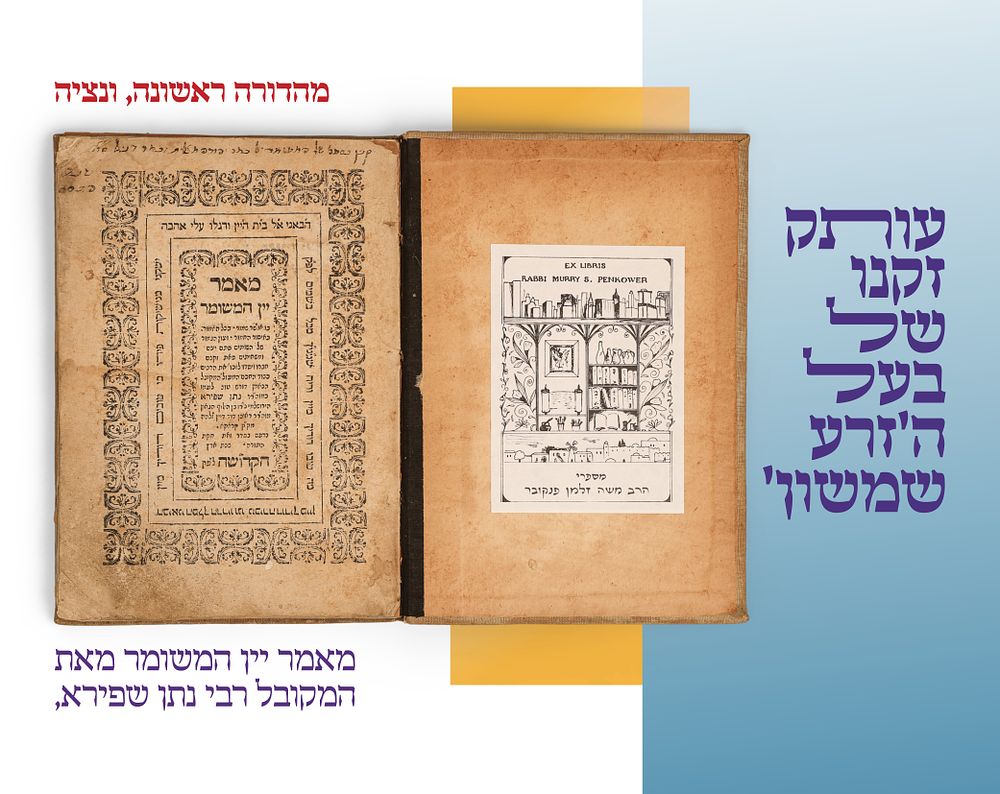
Copy of the grandfather of the author of Zera Shimshon, Ma’amar Yayin HaMeshumar by the Mekubal Rabbi Nossan Shapiro. First edition, Venice, 1660. - Sefer Ma’amar Yayin HaMeshumar, a collection of writings concerning the prohibition of drinking gentile wine, by the Gaon and Mekubal Rabbi Nosson Shapiro. Venice, 1620. First edition. On the title page, an ancient ownership inscription: “Purchased with our money of … the honorable Rabbi Yehuda Matzliach and the honorable Rabbi Daniel (Pad)… year 5401.” It appears to refer to Rabbi Yehuda Matzliach Padova, rabbi of the Modena community, grandfather (maternal grandfather) of Rabbi Shimshon Chaim Nachmani zt”l, author of Zera Shimshon. Additional ownership inscriptions appear on the verso of the title page as well. This work was printed as part of a major controversy that arose against a mistaken leniency practiced in Italy regarding the prohibition of stam yeynam (gentile wine), as well as issues concerning the prohibition of removing the beard’s sidelocks. The book also includes kabbalistic secrets. Included are letters, printed here for the first time, from leading sages of that generation regarding the prohibition of gentile wine, including “Kisvei HaKodesh of the Rabbanei Saloniki, ” “Imrei Yosher of the Rabbanei Constantinople, ” the Maharshdam and others. Approbations of the Venetian rabbis: Rabbi Avigdor Tzividal, Rabbi Ben Tzion Tzarfati, and Rabbi Yehuda Saraval. The Gaon and Mekubal Rabbi Nossao Shapiro, known as “Rabbi Nosson Shapiro the Yerushalmi, ” was one of the leading sages of Krakow in his generation. He later ascended to Eretz Yisrael, serving as rabbi of the Ashkenazi community in Jerusalem. In 1655 he was sent as an emissary of the Jerusalem community to Italy, where he passed away. The Chida refers to him with the honorific “HaRav HaNasi” – an acronym for “HaRav Nossan Shapiro Yishmerehu Elokim.” He was among the editors of the writings of the Arizal as recorded by Rabbi Chaim Vital, his editorial work taking place in parallel with that of his contemporary editors. During his travels in Italy he maintained contact with the leading sages of the generation, including Rabbi Moshe Zacuto, and even composed the wording for his tombstone after his passing. [8], 38 leaves. Condition: —