Bidspirit auction | Historical item! An original Chumash
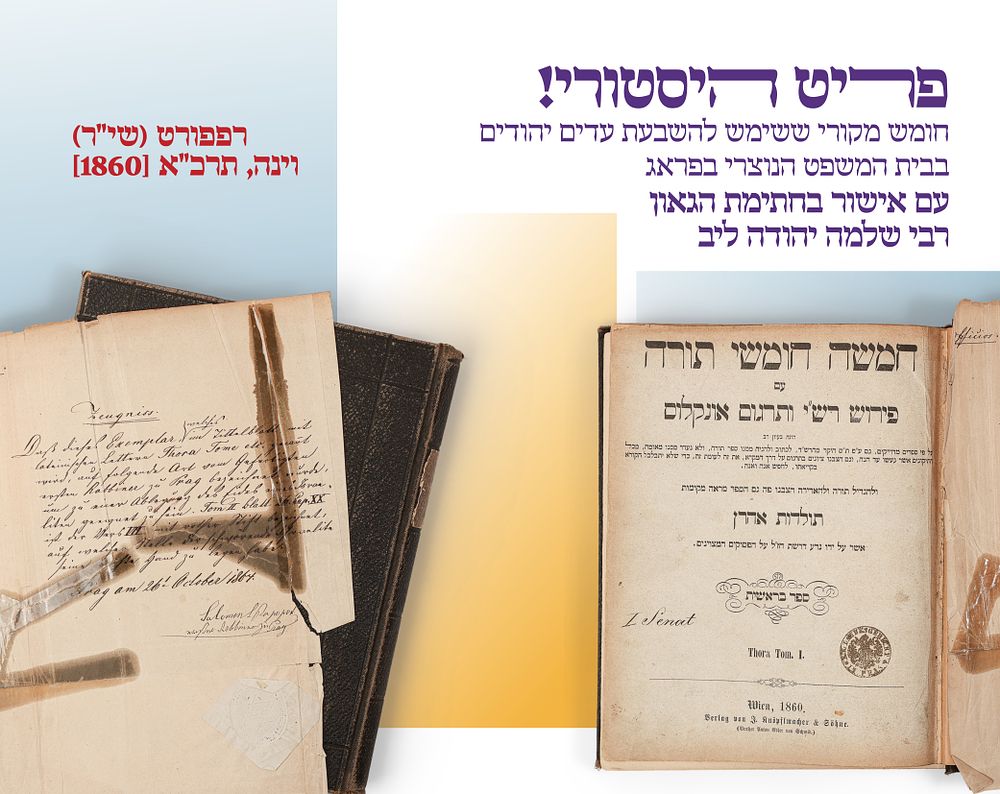
Historical item! An original Chumash used for the swearing-in of Jewish witnesses in the Christian court in Prague — with certification bearing the signature of the gaon Rabbi Shlomo Yehuda Leib Rapoport (Shir) — Vienna, 1860. - Five Books of the Torah with Haftaros and Five Megillos, with Rashi’s commentary and Targum Onkelos. Vienna, 1860 (תרכ”א). Rare and historically significant item A special copy of exceptional historical importance, designated for official use in the court in Prague for the oath-taking of Jewish witnesses. On this Chumash, Jews appearing before the civil authorities were sworn in, and it served as an official juridical object within the oath procedure. The origin of this practice lies in the suspicion held by European authorities regarding the validity of Jewish oaths, partly due to a lack of understanding of Hatarat Nedarim and the prayer of Kol Nidrei. As a result, in many places Jews were required to swear special oaths, which at times carried a humiliating character. Over time, Jews were permitted to swear upon their own sacred books, and designated Chumashim and Bibles were kept in courthouses for this purpose. The Chumash is accompanied by an official handwritten document in a European language, bearing the signature of the gaon Rabbi Shlomo Yehuda Leib Rapaport (Shir) zt”l, rabbi of Prague, certifying that this book is suitable for the oath-taking of Jews in court. A tangible testimony to its special function is found in the passage of the Ten Commandments, where the verse “Lo tisa et Shem Hashem Elokecha lashav” is marked, and above it are German annotations indicating the place where the hand is to be placed during the oath. Shlomo Yehuda Leib Rapaport Rabbi Shlomo Yehuda Leib Rapaport (Shir) (c. 1790–1867), among the leading scholars of Galicia and Prague in his generation. Born in Lemberg to Rabbi Aharon Chaim Rapaport, he was recognized from his youth as an exceptional prodigy, deeply versed in all areas of Torah. In 1810 he married Frida, daughter of Rabbi Aryeh Leib Heller, author of Ketzots HaChoshen, and maintained close ties with his household. He prepared indexes and glosses later printed in his father-in-law’s work Avnei Milu’im. In 1837 he was appointed Av Beit Din of Tarnopol, and in 1840 was called to serve as rabbi of Prague, a distinguished position he held until his passing. Although known as a scholar with broad secular knowledge and historical research, he remained a committed Torah scholar and guardian of tradition. In Prague he worked to strengthen Torah and religious life during a period of growing reform influence, striving to preserve the traditional character of the Jewish community. Collation: 68, 68, 51, 55, 59 + one handwritten leaf. Tears and paper repairs. Folding marks. Condition: Fair. The spine is detached from the bookbinding spine. On one page, trimming of the leaves affected the heading. Condition of the book: good–very good.