Bidspirit auction | Early Hebrew printing in Kushta
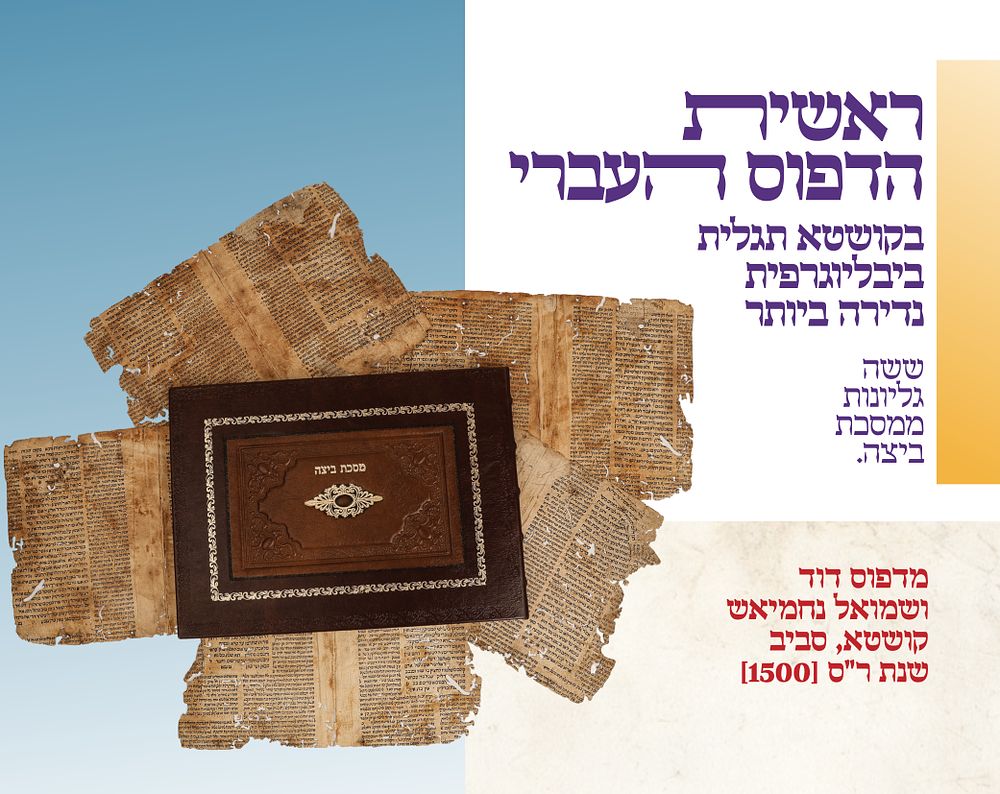
Early Hebrew printing in Kushta — an extremely rare bibliographical discovery: six sheets from Tractate Beitzah, from the press of David and Shmuel Nehmias, Constantinople, circa 5260 [1500]. - Babylonian Talmud, Tractate Beitzah, with the commentaries of Rashi and Tosafot. Six sheets (12 leaves) from an early and almost entirely lost edition of the Talmud, printed in the early period of Hebrew printing in Constantinople at the press of the brothers David and Shmuel Nehmias. This edition is among the earliest surviving remnants of Talmudic printing after the expulsion from Spain, of which until now only isolated leaves were known. In the incunabula catalogue of the J.T.S. and in Prof. Dimitrovsky’s Sridei Bavli (5739), only scant fragments from this printing are recorded. Offered here is an extraordinary discovery: six consecutive sheets from Tractate Beitzah (12 leaves), containing Gemara, Rashi, and Tosafot. According to their typographical characteristics, these leaves reflect the transitional stage between the Hebrew printing tradition of Spain and Portugal and the beginnings of Hebrew printing in Constantinople after the expulsion. Until now, only extremely limited fragments from this period were known, including a leaf from Tractate Eruvin and a leaf and a half from Tractate Kiddushin. On the basis of those remnants, bibliographers Avraham Yaari, Yudlov, and Heimann attributed the printing to Constantinople circa 1500–1505. The watermarks found in the present leaves provide substantial corroboration of this dating and support their attribution to the first half of the first decade of the 16th century. The significance of these leaves is especially notable due to their early Sephardic textual form and layout. This is among the earliest known witnesses to Tractate Beitzah with Tosafot. No other known leaves of Beitzah with Tosafot from a period predating the Bomberg Venice Talmud are extant. It appears to represent an early stage based on the Soncino printing of 1495, with the addition of Tosafot — a highly rare phenomenon in early Hebrew printing. At the end of the tractate no colophon is found. To complete the final leaf, a passage from the Mordechai was printed. Comparison of this text with the standard version of the Mordechai reveals significant variations, including additions, omissions, and textual differences of major scholarly importance. The leaves were discovered in the binding waste of a responsa volume of Maharl ben Chaviv, Venice 1621, preserved in its original binding. For use as binding material, the leaves were trimmed to fit the book’s dimensions, resulting in damage to several sections, particularly in the Tosafot passages. Worming, stains, and wear. Fair–poor condition. An extremely rare remnant from the earliest stage of Talmud printing after the Spanish expulsion, and a discovery of primary bibliographical, textual, and historical importance. Accompanied by comprehensive research material from leading experts confirming attribution, significance, and dating. The sheets are housed in an elaborate custom leather binding.