Bidspirit auction | Chaim VeShalom by R. Chayim
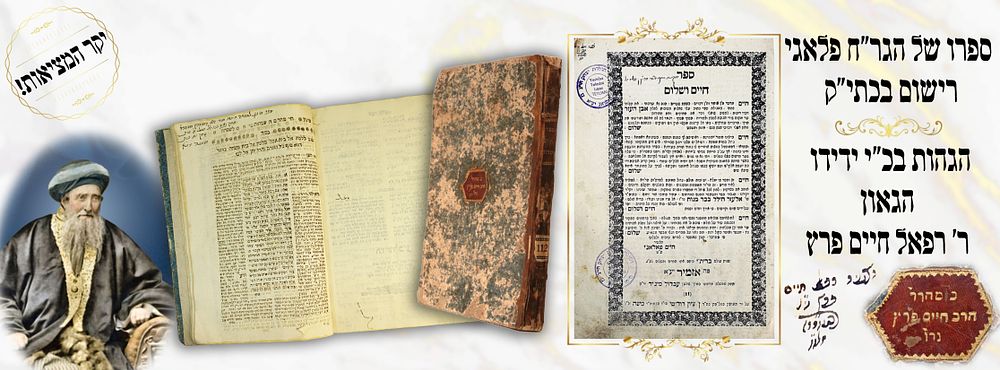
Chaim VeShalom by R. Chayim Palaggi, First Edition, Rabbinic Copy, Bound with Mi-yagon LeSimchah by the Teacher of R. Chayim Palaggi – with inscription in his own handwriting - Sefer MiYagon LeSimchah, Salonika 1795, by R. Yitzchak Gatenyo, with an inscription in the actual handwriting of his distinguished disciple, the holy Gaon Rabbi Chaim Palaggi. Bound together with Sefer Chaim VeShalom, Izmir 1857, by the holy Gaon Rabbi Chaim Palaggi, with the signature and marginal notes of his friend, Rabbi Raphael Chaim Peretz, author of Zochreynu LeChaim. These first editions are very rare. A Sefer Chaim VeShalom Forty-one responsa on Hilchot Even HaEzer By the holy Gaon Rabbi Chaim Palaggi Izmir 1857, first edition With ownership inscriptions and marginal notes of the Gaon Rabbi Raphael Chaim Peretz. B Hilchot Smachot by Maharam of Rothenburg With the commentary MiYagon LeSimchah By the Gaon Rabbi Yitzchak Gatenio, author of Beit Yitzchak Salonika 1792 or 1795, first edition With an inscription in the actual handwriting of Rabbi Chaim Palaggi. Rabbi Yitzchak Gatineo, author of Beit Yisschak and Beit Moed, was the Gaon of Izmir (d. between 1800–1813), son of Rabbi Elyakim, author of To'afot Re'em. He was the teacher of Rabbi Chaim Palaggi, who refers to him reverently as “my master, my holy teacher”. This book was never completed in print; it was published only through ch. 32. The surviving printed leaves were preserved by his disciple, R. Chaim Palaggi, who inserted them into several copies of his own book, Chaim VeShalom, more than sixty years after the original printing. This is noted in Areshet, vol. 3, 1961, pp. 111–112, nos. 27–28, and in the Bibliographic Institute records. Since the book had no printed title page, R. Chaim Palaggi personally wrote, at the head of the work, in his holy handwriting: “ספר מיגון לשמחה חיברו מורי הרב המובהק כמוהר”ר יצחק גאטינייו ז”ל בעל ס' בית ישחק וס' בית מועד זיע”א” Previous Owner: Rabbi Raphael Chaim Benjamin Peretz (Remark: the name “Benjamin” was apparently added later in life; it does not appear in the inscription here nor in his responsa) Rabbi Raphael Chaim Peretz served as rabbi in Constantinople and Çanakkale, later as Av Beit Din in Dardanelles and in Gallipoli, and authored Zochrenu LeChaim. He was born in 1810 to Rabbi Avraham Peretz, Dayan in Constantinople and author of Avnei Shoham, from whom he learned in his youth. He studied under R. Moshe Frisco in Constantinople and became a Dayan there. He later served as rabbi of Dardanelles, and in 1867 he became the rabbi of Gallipoli, where he published his first work, Zochrenu LeChaim, vol. 1, including correspondence with R. Avraham Palaggi. The Sdei Chemed praises him, writing: “And now has been printed the book Zochrenu LeChaim, by one of the distinguished rabbis of our generation, the master Rabbi Raphael Chaim Peretz, son of the author of Avnei Shoham.” Rabbi Chaim Palaggi likewise wrote to him in a responsum: “One who enlightens the eyes of scholars, distinguished above all, from the great city of sages, Constantinople the mighty, sharp and brilliant, of good understanding, rightful judge, the esteemed sage, perfect and mighty, our teacher Rabbi Raphael Chaim Peretz, may his light shine.” (Chakikei Lev, vol. 2, Choshen Mishpat, Siman 1) He passed away around 1880. On the title page appears the signature of R. Raphael Chaim Peretz. Throughout the book appear elegant marginal notes in his handwriting, in which he disputes the author’s words, or references discussions in his own work Zochrenu LeChaim. Additional Owners: Somehow the book traveled from Turkey to Tetouan, where it came into the hands of “the heirs of Rabbi Yitzchak ben Walid, ” the famed kabbalist whose grave is a known place of salvation. Rabbi Yitzchak ben Walid (1777–1870) was a great kabbalist, Av Beit Din, and rabbi of the Tetouan community for about forty years, author of Vayomer Yitzchak. The book contains stamps of the Yeshiva Toldot Yitzchak of Tetouan, which operated on the second floor of the synagogue named for Rabbi Yitzchak ben Walid. That synagogue is today a museum, still under the custodianship of his descendants.