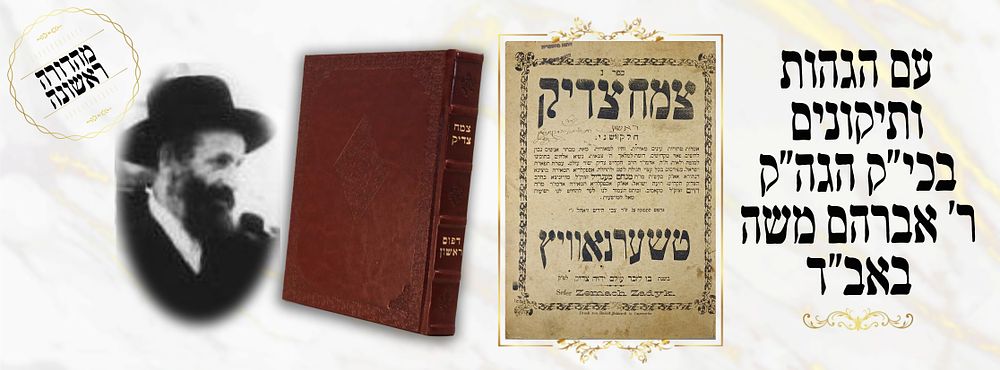
Bidspirit auction | Tzemach Tzadik First edition printing –
Tzemach Tzadik First edition printing – with handwritten completions by the Gaon R. Avraham Moshe Babad, Av Beit Din of Gura Humora - Sefer Tzemach Tzadik By the holy Rabbi Menachem Mendel of Vizhnitz Chernivtsi 1885 – first edition Three parts bound in one volume. Introduction by the author’s son, the Rebbe R. Baruch of Vizhnitz, author of Imrei Baruch. This copy belonged to the great Rabbi Avraham Moshe Babad, Av Beit Din of Gura Humora, and his personal touch is visible throughout the sefer. From the middle of Parashat Kedoshim onward several leaves were blank, and they were completed through expert craftsmanship in his beautiful handwriting. The introductory page had been partially torn and he completed both sides of it with meticulous precision in his own script. Likewise several other leaves in the volume were completed by attaching sheets of paper and writing in a hand that imitates the printed type. Additionally, he added many marginal notes and insights. The Gaon Rabbi Avraham Moshe Babad was born in Gura Humora in Bukovina to the city’s rabbi, Rabbi Menachem Mendel Babad, a Chortkov chassid known as a Torah scholar who maintained halachic correspondence with the leading sages of his era. In his youth he learned from his father, and later traveled to study under Rabbi Meir Arik of Tarnow, becoming his primary disciple. He continued corresponding with his teacher in Torah even after returning to his hometown. After his father’s passing in 1930, he was appointed as rabbi of the chassidic community of Gura Humora. He married the daughter of Rabbi Eliezer Nissan Horowitz of Safed, son of Rabbi Naftali Chaim of Dzhikov. She had been orphaned from her father and was the stepdaughter of the holy Ahavat Yisrael of Vizhnitz, who married her widowed mother and raised the daughters. From that time onward, R. Avraham Moshe became a fervent Vizhnitz chassid, and the Rebbes of Vizhnitz held him in the highest esteem. [See attached the letter from the Imrei Chaim to him, warning him not to fast against medical advice.] After his marriage he returned to serve as the rabbi of his birthplace. He worked tirelessly to strengthen the youth against the rise of secular influences. During World War II and the destruction of Romanian Jewry he was in Transnistria, in the Dzhurin ghetto with his brother-in-law, the Makor Baruch of Seret-Vizhnitz. At that time he learned together with his young nephew, later the Yeshuot Moshe of Vizhnitz, and with the Gaon R.i Yosef Naftali Stern. After the war he returned to Gura Humora and rebuilt his community. In 1948 he attempted to immigrate to Eretz Yisrael' but was deported to Cyprus, where he served as rabbi of the detention camp. After the establishment of the State he immigrated to Eretz Yisrael and settled in Bnei Brak, where he became close to the Chazon Ish. Together with his wife he managed an institution for girls who had survived the Holocaust, under the auspices of the Chazon Ish. Later he moved to Jaffa and became the rabbi of the Givat Aliyah neighborhood. For a time he also served as Rosh Yeshiva of Seret Vizhnitz. In his old age he moved to Jerusalem, to the Mea Shearim neighborhood. He passed away on 22.08.1980, and was buried according to his request in the new cemetery at the foot of the ancient cemetery in Safed. In several other sefarim in his possession he practiced this same practice— completing missing leaves in his own handwriting. We have seen such a copy of Meor VeShemesh, and even a volume of Pachad Yitzchak by R. Yitzchak Lampronti in which he completed several leaves. Most of his sefarim bear various stamps he used during different periods, but this volume is unstamped. It is possible that he possessed it during difficult years of the Holocaust or the Cyprus exile, and thus exerted himself to complete the sefer due to lack of replacement copies. Magnificent new binding.